
Zamia fischeri
Evergreen pine-oak forests and cloud forests·Subterranean stem·Presumed rare in the wild due to habitat destruction
Zamia fischeri is a species of cycad native to northeastern Mexico, characterized by its subterranean stem and relatively small leaves compared to its cones. It thrives as an understory plant in evergreen pine-oak and cloud forests. The species is named after Gustav Fischer, a 19th-century cycad enthusiast.
Key Facts
- ›Endemic to Mexico, found in the Sierra Madre Oriental.
- ›Has a subglobose subterranean stem approximately 8 cm in diameter.
- ›Leaves are relatively small, measuring 15 to 30 cm in length.
- ›Pollen cones are tan, ovoid-cylindrical, and 5-7 cm long.
- ›Seed cones are greenish-gray to gray, cylindrical to ovoid-cylindrical, and 8-12 cm long.
- ›Red seeds are 1.3 to 1.8 cm long.

Mexico
- Subglobose subterranean stem about 8 cm in diameter
- Large stem compared to leaf size
- Leaves are about 15 to 30 centimeters long
- Petioles are 5 to 10 centimeters long
- Rachis has 5 to 9 pairs of leaflets
- Leaflets are papyraceous, tapering toward the base, and acute apically
- Leaflet margins have several serrations in the outermost half
- Larger middle leaflets are 3 to 5 centimeters long and 0.5 to 1 centimeters wide
- Lancelike leaflets
- Tan pollen cones are usually ovoid-cylindrical in shape, obtuse towards the apex, 5 to 7 centimeters in length, and 1 to 2 centimeters in diameter
- Peduncle of pollen cone is 1.5 to 2.5 centimeters long
- Seed cones are greenish-gray to gray, cylindrical to ovoid-cylindrical in shape, acuminate at the apex, 8 to 12 centimeters long and 4 to 7 centimeters in diameter
- Large cones compared to leaf size
Red Seeds, About 1.3 To 1.8 Centimeters Long, 0.5 To 0.8 Centimeters In Diameter
Habitat Destruction
About Zamia fischeri
Zamia fischeri is a species of cycad belonging to the Zamiaceae family, endemic to the northeastern regions of Mexico. It is distinguished by its subglobose subterranean stem, which measures approximately 8 cm in diameter, and by its cones, which are notably large in proportion to its leaves. The species is named in honor of Gustav Fischer, a dedicated cycad enthusiast from the 19th century, and it also lends its name to the Fischeri clade.
Description and Characteristics
The plant's leaves are relatively small, typically ranging from 15 to 30 cm in length. Each leaf is composed of a petiole of 5 to 10 cm and a rachis bearing 5 to 9 pairs of leaflets. These leaflets are characterized by their papyraceous texture, tapering towards the base, and an acute apex with serrated margins in the outer half. The larger, central leaflets measure between 3 to 5 cm in length and 0.5 to 1 cm in width. Zamia fischeri can be identified by its lancelike leaflets and the absence of prickles on its petioles, which helps differentiate it from similar species like Zamia vazquezii.
Reproductively, Zamia fischeri produces tan pollen cones that are usually ovoid-cylindrical, measuring 5 to 7 cm long and 1 to 2 cm in diameter. The seed cones are greenish-gray to gray, also cylindrical to ovoid-cylindrical, and are larger, ranging from 8 to 12 cm in length and 4 to 7 cm in diameter. The seeds themselves are distinctively red, measuring about 1.3 to 1.8 cm in length and 0.5 to 0.8 cm in diameter.
Range and Habitat
Zamia fischeri is native to the Sierra Madre Oriental mountain range in northeastern Mexico, with populations found in the states of Hidalgo, Querétaro, San Luis Potosí, and Tamaulipas. It thrives as an understory plant within the evergreen pine-oak forests and cloud forests, typically found at elevations up to 900 meters. Its habitat receives substantial annual rainfall, between 1500 to 2000 mm, with summer temperatures generally between 20 and 30 degrees Celsius and winter temperatures ranging from 10 to 20 degrees Celsius.
Ecology and Cultivation
Ecologically, Zamia fischeri plays a role as the host plant for Cycad leaf necrosis virus, a significant finding as it is the only known Badnavirus to infect a gymnosperm. The species is considered rare in the wild, primarily due to ongoing habitat destruction. Consequently, Zamia fischeri is also rare in cultivation, with limited instances of collection from its natural environment.
Source: Wikipedia ↗
Frequently Asked Questions
What is Zamia fischeri?
Zamia fischeri is a species of cycad belonging to the Zamiaceae family. It is native to Mexico and is known for its subterranean stem and its reproductive cones which are disproportionately large compared to its leaves.
Where is Zamia fischeri found?
This cycad species is endemic to the Sierra Madre Oriental of northeastern Mexico, specifically in the states of Hidalgo, Querétaro, San Luis Potosí, and Tamaulipas. It grows as an understory plant in evergreen pine-oak forests and cloud forests.
What distinguishes Zamia fischeri from other similar species?
Zamia fischeri can be differentiated from species like Zamia vazquezii by its smaller leaves (15-30 cm), lancelike leaflets, and the absence of prickles on its petioles. It is also noted for having a large stem and cones relative to its leaf size.
What are the characteristics of Zamia fischeri's cones and seeds?
The tan pollen cones are typically ovoid-cylindrical, measuring 5 to 7 cm in length. The seed cones are greenish-gray to gray, cylindrical to ovoid-cylindrical, and range from 8 to 12 cm in length. The plant produces red seeds that are about 1.3 to 1.8 cm long.
What is the habitat and ecological role of Zamia fischeri?
Zamia fischeri grows in evergreen pine-oak forests and cloud forests up to 900 meters, receiving significant annual rainfall. It is also notable as the host plant for Cycad leaf necrosis virus, the only known Badnavirus to infect a gymnosperm.
Related Cycad species
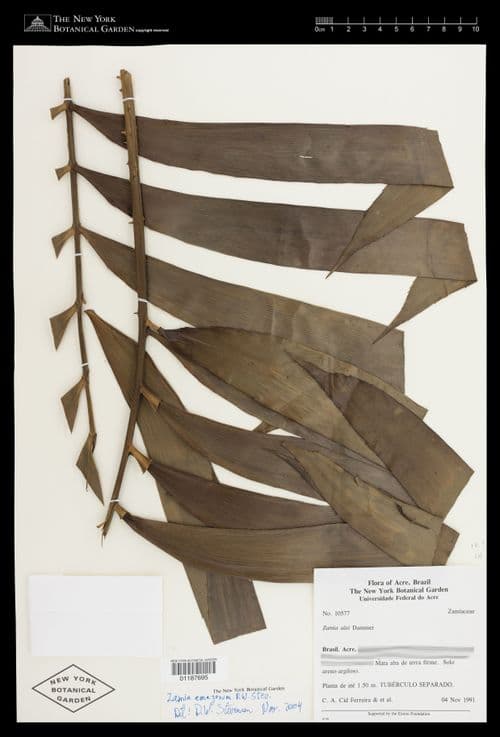
Zamia amazonum
Zamia amazonum is a cycad species found across the Amazon basin in Brazil, Colombia, Peru, and Venezuela, as well as in Colombia's Chocó Department. It is characterized by its subterranean stem and long, prickly petioles bearing numerous leaflets. This species is dioecious, meaning individual plants are either male or female, and produces distinct male and female cones.

Zamia acuminata
Zamia acuminata is a species of cycad found in the tropical forests of Costa Rica and Panama. It is characterized by its subterranean stem, long pinnately compound leaves with acuminate leaflets, and distinctive cream to tan reproductive cones. This species is notably threatened by habitat loss, highlighting the importance of its conservation.

Encephalartos humilis
Encephalartos humilis is a small cycad species native to the former Transvaal Province of South Africa. It is characterized by its subterranean stem and leathery, pinnate leaves that form a crown. This dioecious species produces distinct male and female cones, with seeds enclosed in colorful flesh.