
Zamia integrifolia
Habitats with well-drained sands or sandy loam soils, preferring filtered sunlight to partial shade.·Low-growing, with a trunk that is often subterranean and can form multi-branched clusters.·Insect pollination, primarily by the weevil Rhopalotria slossoni and the beetle Pharaxonotha floridana.
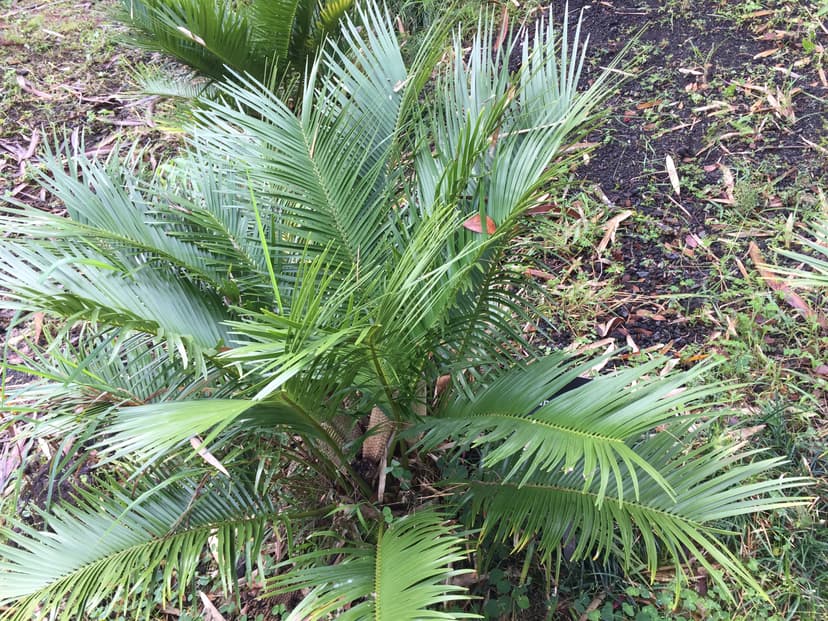
Zamia integrifolia, commonly known as coontie or Florida arrowroot, is a low-growing, woody cycad native to the southeastern United States, the Bahamas, Cuba, the Cayman Islands, and Puerto Rico. It is distinguished by its often subterranean trunk, large tuberous root system, and pinnately compound leaves. This species is notable for its traditional use by Indigenous Americans to produce starch and its remarkable cold hardiness, allowing it to survive significant frost.
Key Facts
- ›It is the only cycad native to the continental United States.
- ›The plant possesses a tuberous root system that stores water and nutrients, enabling survival during cold periods.
- ›Zamia integrifolia is dioecious, meaning individual plants are either male or female.
- ›Indigenous peoples historically processed its roots to extract a starch, known as Florida arrowroot.
- ›The entire plant, except for the seed's pulpy covering, is toxic due to the presence of cycasin.

Coontie, Koonti, Florida Arrowroot, Wild Sago, Comtee
United States, Bahamas, Cuba, Cayman Islands, Puerto Rico
Trunk Height: 3–25 cm, Often Subterranean, Forms Multi-Branched Clusters Over Time, Possesses A Large, Tuberous Root System
- Length: 20–100 cm
- Number of leaflets: 5-30 pairs
- Leaflet shape: Linear to lanceolate or oblong-obovate
- Leaflet length: 8–25 cm
- Leaflet width: 0.5–2 cm
- Leaflet margin: Entire or with indistinct teeth at the tip
- Leaflets are often revolute
- Petioles are prickly
- Male cones: Cylindrical, 5–16 cm long, often clustered
- Female cones: Elongate-ovoid, 5–19 cm long and 4–6 cm in diameter
- Seed cones: Reddish, with a distinct acuminate tip
Reddish, Distinct Acuminate Tip, Sarcotesta Is Not Toxic
Source of Edible Starch, Ornamental
- Overexploitation for starch production in the 19th and early 20th centuries
- Habitat loss
About Zamia integrifolia
Zamia integrifolia: The Resilient Coontie
Zamia integrifolia, more commonly known as coontie, is a remarkable cycad species holding the distinction of being the only cycad native to the continental United States. Its natural range extends across the southeastern United States, primarily Florida, and also includes the Bahamas, Cuba, the Cayman Islands, and Puerto Rico. This tough, woody plant is characterized by its low-growing habit, often featuring a trunk that is subterranean or only slightly emerges from the ground, from which its distinctive pinnately compound leaves emerge.
Botanical Characteristics and Adaptation
The plant possesses a substantial, tuberous root system that serves as a vital storage organ for water and nutrients. This adaptation, coupled with the ability to shed its leaves during cold periods and enter dormancy, grants Zamia integrifolia a significant degree of cold hardiness, allowing it to survive in regions with frost. Its leaves, which can reach lengths of up to one meter, are composed of numerous pairs of leaflets that are typically linear to lanceolate. Reproduction occurs via cones, with separate male and female plants (dioecious), and pollination is facilitated by specific insect species, notably certain weevils and beetles.
Traditional Use and Toxicity
Historically, Zamia integrifolia played a crucial role in the subsistence of Indigenous American tribes, particularly in Florida, such as the Seminole and Tequesta. They developed intricate methods to process the plant's roots, leaching out water-soluble toxins like cycasin to produce a versatile starch. This starch was used to make a bread-like substance and was commercially exploited as 'Florida arrowroot' in the late 19th and early 20th centuries. It is important to note that while the processed starch was edible, the entire plant, excluding the pulpy covering of the seeds, is highly toxic if not properly prepared, containing potent toxins that can cause severe health issues, including liver failure.
Source: Wikipedia ↗
Frequently Asked Questions
What are the common names for Zamia integrifolia?
Zamia integrifolia is known by several common names, including coontie, koonti, Florida arrowroot, and wild sago. The name 'coontie' originates from the Seminole Native American language.
Where is Zamia integrifolia found naturally?
This cycad is indigenous to the southeastern United States, specifically Florida, as well as the Bahamas, Cuba, the Cayman Islands, and Puerto Rico. Populations in Georgia are presumed to be extinct.
What kind of habitat does Zamia integrifolia prefer?
Zamia integrifolia thrives in habitats with well-drained sands or sandy loam soils. It generally prefers filtered sunlight to partial shade.
Is Zamia integrifolia edible?
While the entire plant is toxic, Indigenous tribes like the Seminole and Tequesta processed the roots to remove water-soluble toxins, creating a starch used for food. Proper preparation is crucial to neutralize its toxicity.
What makes Zamia integrifolia cold hardy?
Zamia integrifolia exhibits cold hardiness due to its often subterranean trunk and a large, tuberous root system. During cold periods, the leaves can be shed, and the plant enters dormancy within its root system, allowing it to survive temperatures as low as USDA region 8b.
How does Zamia integrifolia reproduce?
Zamia integrifolia is dioecious, with separate male and female plants. Reproduction involves the production of cones, with male cones bearing pollen and female cones bearing seeds. Pollination is facilitated by specific beetle species.
Related Cycad species

Encephalartos horridus
Encephalartos horridus, commonly known as the Eastern Cape blue cycad, is a distinctive, low-growing cycad native to the Eastern Cape Province of South Africa. It is recognized for its striking blue-gray, spiny leaves and typically develops a subterranean stem. This species thrives in arid shrublands and rocky ridges, exhibiting a slow growth rate and requiring specific conditions for successful cultivation.
Zamia inermis
Zamia inermis is a critically endangered cycad species native to Actopan, Veracruz, Mexico. It is characterized by its shrub-like growth, with a trunk that can be branched and upright leaves composed of numerous linear-lanceolate leaflets. This species is dioecious and faces significant threats from habitat loss, wildfires, and over-harvesting.

Encephalartos dolomiticus
Encephalartos dolomiticus, commonly known as the Wolkberg cycad, is a critically endangered cycad species native to the Wolkberg region of South Africa. This tree-like cycad typically grows up to 2 meters tall and is characterized by its distinctive bluish leaves forming a crown, with lance-shaped leaflets arranged oppositely along the rachis. It is a dioecious species, producing separate male and female cones.