
Zamia loddigesii
Zamia loddigesii, also known by the common name teocinte, is a species of cycad native to several states in Mexico, including Hidalgo, Oaxaca, Tamaulipas, and Veracruz. This species is characterized by its subterranean stem and compound leaves, and it is dioecious, meaning individual plants are either male or female, reproducing via cones. Unfortunately, Zamia loddigesii is threatened by habitat loss due to agricultural expansion and cattle ranching, leading to fragmented populations.
Key Facts
- ›Native to Hidalgo, Oaxaca, Tamaulipas, and Veracruz states in Mexico.
- ›Possesses a subterranean stem that can branch with age.
- ›Dioecious, with separate male and female plants bearing reproductive cones.
- ›Leaves are compound, with 12 to 23 pairs of leaflets.
- ›Primary threat is habitat loss due to agriculture and cattle pasture.
- ›Exhibits relatively high genetic diversity despite fragmented populations.

Teocinte
Hidalgo, Mexico, Oaxaca, Mexico, Tamaulipas, Mexico, Veracruz, Mexico
Subterranean, 10 To 45 cm Long, 8 To 15 cm In Diameter, Older Stems May Branch
- Compound leaves
- 45 to 96 cm long
- 30 to 41 cm wide
- Initially light-green, maturing to green or dark green
- Petiole 15 to 25 cm long with prickles
- Rachis up to 57 cm long with prickles on the lower third
- 12 to 23 pairs of leaflets per leaf
- Median leaflets 16 to 26 cm long and 1.8 to 3.1 cm wide
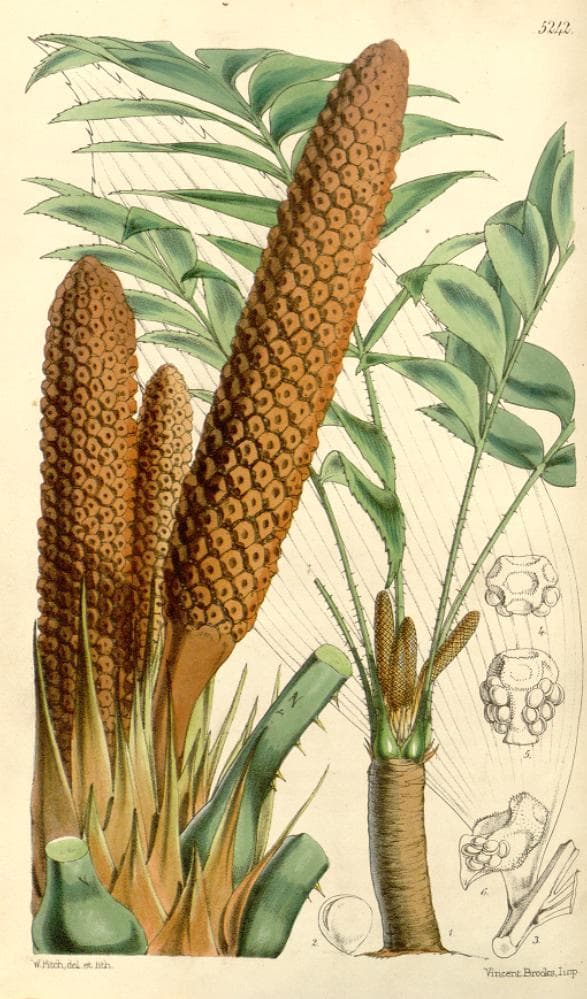
- Male cones: Erect, cylindrical, 8 to 14 cm long, 1.8 to 3.5 cm in diameter, light-brown, covered in hair.
- Female cones: Erect, ellipsoid to conical, up to 16 cm tall, up to 6 cm in diameter, beige, covered with hair.
- Ovoid
- 1.4 to 1.8 cm long
- 0.8 to 1 cm in diameter
- Sarcotesta smooth, pink when immature, turning red with maturity
Habitat Loss, Agriculture, Cattle Pasture, Fires
About Zamia loddigesii
Zamia loddigesii, commonly known as teocinte, is a species of cycad belonging to the Zamiaceae family. It is native to several states in Mexico, including Hidalgo, Oaxaca, Tamaulipas, and Veracruz. The plant is characterized by its subterranean stem, which can branch in older specimens and measures between 10 to 45 centimeters in length and 8 to 15 centimeters in diameter. It produces two to three compound leaves at the apex of its stem, which can range from 45 to 96 centimeters in length and bear 12 to 23 pairs of leaflets.
Botanical Features
As a dioecious species, Zamia loddigesii has separate male and female plants. Male reproductive structures, or strobili, are erect, cylindrical cones measuring 8 to 14 centimeters long and 1.8 to 3.5 centimeters in diameter, typically light brown and covered in hair. Female cones are also erect but are ellipsoid to conical, reaching up to 16 centimeters in height and 6 centimeters in diameter, with a beige, hairy surface. The seeds are ovoid, approximately 1.4 to 1.8 centimeters long, with a smooth sarcotesta that changes from pink to red as it matures. Pollination is facilitated by insects.
Distribution and Conservation
Zamia loddigesii is found in fragmented populations within its native tropical dry forest habitat in Mexico. This habitat is increasingly threatened by clearance for agriculture and cattle pasture, compounded by frequent fires. The species exhibits relatively high genetic diversity, though gene flow between isolated populations is limited due to poor insect flight capabilities for pollination and a lack of widespread seed dispersal vectors. Low seedling recruitment and limited reproductive activity in some individuals further complicate conservation efforts. The primary threat to its survival remains significant habitat loss.
Source: Wikipedia ↗
Frequently Asked Questions
What are the common names for Zamia loddigesii?
Zamia loddigesii is commonly known as teocinte. This name is used to refer to the species in its native regions.
Where is Zamia loddigesii found in the wild?
This cycad species is indigenous to Mexico, specifically found in the states of Hidalgo, Oaxaca, Tamaulipas, and Veracruz. Its populations are often fragmented within these regions.
What are the main threats to Zamia loddigesii?
The most significant threat to Zamia loddigesii is habitat loss. This is primarily driven by the clearing of its tropical dry forest habitat for agriculture and cattle grazing, along with frequent fires.
How does Zamia loddigesii reproduce?
Like other cycads, Zamia loddigesii is dioecious, meaning it has separate male and female plants. Reproduction involves the development of male and female cones (strobili) on these individual plants.
What are the characteristics of Zamia loddigesii's stem and leaves?
The stem of Zamia loddigesii is typically subterranean, reaching lengths of 10 to 45 centimeters and diameters of 8 to 15 centimeters, and older stems may branch. The compound leaves are long, ranging from 45 to 96 centimeters, emerging light green and maturing to dark green, and are composed of 12 to 23 pairs of leaflets.
What do the cones of Zamia loddigesii look like?
Male cones are erect, cylindrical, and typically 8 to 14 centimeters long, light brown and hairy. Female cones are erect, ellipsoid to conical, up to 16 centimeters tall, beige, and also covered in hair.
Related Cycad species
Zamia skinneri
Zamia skinneri is a species of cycad belonging to the Zamiaceae family, historically known for its variability and complex taxonomic history. Primarily found in the coastal regions of Bocas del Toro Province, Panama, it is characterized by its green-emergent leaves, distinguishing it from some closely related species which exhibit red-emergent foliage. This species engages in an obligate mutualistic relationship with the beetle Pharaxonotha clarkorum, which pollinates its cones.

Zamia portoricensis
Zamia portoricensis, commonly known as marunguey in Puerto Rican Spanish, is a cycad species belonging to the Zamiaceae family. It is exclusively found in the Susúa State Forest region of western Puerto Rico. A distinctive feature of this species is its obligate mutualistic relationship with the beetle Pharaxonotha portophylla, which lives within male cones and acts as a pollinator.

Encephalartos horridus
Encephalartos horridus, commonly known as the Eastern Cape blue cycad, is a distinctive, low-growing cycad native to the Eastern Cape Province of South Africa. It is recognized for its striking blue-gray, spiny leaves and typically develops a subterranean stem. This species thrives in arid shrublands and rocky ridges, exhibiting a slow growth rate and requiring specific conditions for successful cultivation.