
Zamia skinneri
Coastal areas.·insect·The species population was reduced to fewer than 500 after reclassifications, indicating a potentially threatened status, though a specific IUCN status is not provided.
Zamia skinneri is a species of cycad belonging to the Zamiaceae family, historically known for its variability and complex taxonomic history. Primarily found in the coastal regions of Bocas del Toro Province, Panama, it is characterized by its green-emergent leaves, distinguishing it from some closely related species which exhibit red-emergent foliage. This species engages in an obligate mutualistic relationship with the beetle Pharaxonotha clarkorum, which pollinates its cones.
Key Facts
- ›Endemic to the coastal area of mainland Bocas del Toro Province, Panama.
- ›Commonly known as cebolla roja.
- ›Engages in an obligate mutualistic relationship with the beetle Pharaxonotha clarkorum for pollination.
- ›New leaves emerge green and mature to a bright green.
- ›Its taxonomic classification has been complex, with several populations previously attributed to it now recognized as distinct species.
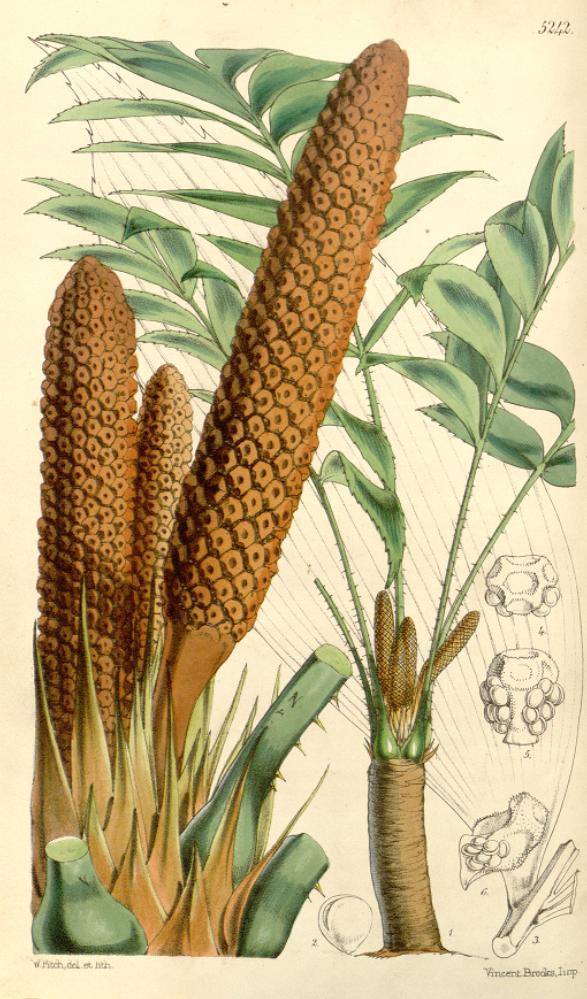
Cebolla Roja
Bocas Del Toro Province, Panama
- New leaves emerge green and mature to a bright green.
- Male cones are inhabited by the beetle Pharaxonotha clarkorum, which plays a role in pollination.
About Zamia skinneri
Zamia skinneri is a species of cycad belonging to the Zamiaceae family, recognized for its historical taxonomic complexity and its specific ecological relationship with a pollinating beetle. The species is endemic to the coastal regions of mainland Bocas del Toro Province in Panama. Its common name is cebolla roja.
Taxonomic History and Species Complex
The formal description of Zamia skinneri has been subject to considerable confusion. First described in 1851, subsequent reports of its distribution spanned multiple countries. However, detailed studies, particularly in the 2000s, revealed that what was once considered a single, variable species likely encompassed several distinct, undescribed species. In 2008, research led to the recharacterization and naming of new species such as Zamia hamannii, Zamia imperialis, and Zamia nesophila, which were previously included within Z. skinneri. This taxonomic revision significantly reduced the estimated population size of the actual Zamia skinneri to fewer than 500 individuals.
Botanical Characteristics and Mutualism
Zamia skinneri is characterized by its green-emergent leaves, meaning new foliage unfurls green and matures to a bright green. This contrasts with some related species where new leaves emerge with a reddish hue. A notable aspect of its biology is the obligate mutualistic relationship it shares with the beetle Pharaxonotha clarkorum. These beetles inhabit and reproduce within the male cones of Zamia skinneri, feeding on pollen and cone tissues. In return, they serve as crucial pollinators, transferring pollen to the female cones, thus ensuring the reproductive success of the cycad.
Source: Wikipedia ↗
Frequently Asked Questions
What is the common name for Zamia skinneri?
The common name for Zamia skinneri is cebolla roja. This name is used locally for the plant.
Where is Zamia skinneri found naturally?
Zamia skinneri is naturally found in the coastal area of mainland Bocas del Toro Province, Panama. Its distribution has been a subject of taxonomic study.
What is the relationship between Zamia skinneri and the beetle Pharaxonotha clarkorum?
There is an obligate mutualistic relationship between Zamia skinneri and the beetle Pharaxonotha clarkorum. The beetle lives and breeds in the male cones, consuming pollen and cone tissues, and in turn, acts as a pollinating vector by transferring pollen to female cones.
How are the leaves of Zamia skinneri described?
The new leaves of Zamia skinneri emerge green in color and mature to a bright green. This characteristic helps distinguish it from some related species.
Has the classification of Zamia skinneri always been straightforward?
No, the classification of Zamia skinneri has been historically complex. It was long considered a variable species complex, and studies have led to the reclassification of several populations into new species, reducing the recognized population of Z. skinneri.
Related Cycad species

Zamia loddigesii
Zamia loddigesii, also known by the common name teocinte, is a species of cycad native to several states in Mexico, including Hidalgo, Oaxaca, Tamaulipas, and Veracruz. This species is characterized by its subterranean stem and compound leaves, and it is dioecious, meaning individual plants are either male or female, reproducing via cones. Unfortunately, Zamia loddigesii is threatened by habitat loss due to agricultural expansion and cattle ranching, leading to fragmented populations.

Zamia portoricensis
Zamia portoricensis, commonly known as marunguey in Puerto Rican Spanish, is a cycad species belonging to the Zamiaceae family. It is exclusively found in the Susúa State Forest region of western Puerto Rico. A distinctive feature of this species is its obligate mutualistic relationship with the beetle Pharaxonotha portophylla, which lives within male cones and acts as a pollinator.

Encephalartos horridus
Encephalartos horridus, commonly known as the Eastern Cape blue cycad, is a distinctive, low-growing cycad native to the Eastern Cape Province of South Africa. It is recognized for its striking blue-gray, spiny leaves and typically develops a subterranean stem. This species thrives in arid shrublands and rocky ridges, exhibiting a slow growth rate and requiring specific conditions for successful cultivation.