
Zamia pumila
Inhabits a variety of habitats with well-drained sands or sandy loam soils, preferring filtered sunlight to partial shade.·Low-growing plant with a trunk that is often subterranean.·Certain insects, namely the cycad weevil Rhopalotria slossoni.
Zamia pumila is a small, hardy cycad native to the Greater Antilles, recognized as the type species for its genus and family. It is characterized by tough, woody stems, often subterranean, and pinnate leaves with toothed leaflets. This dioecious plant produces distinctive reddish seed cones and is pollinated by specific insects.
Key Facts
- ›Type species for the genus Zamia and the family Zamiaceae.
- ›Native to the Greater Antilles, including Cuba, Puerto Rico, and the Dominican Republic.
- ›Features pinnate leaves with linear to lanceolate leaflets, often with toothed tips.
- ›Possesses a low-growing, often subterranean trunk and a tuberous root system.
- ›Produces reddish, acuminate seed cones and is pollinated by the cycad weevil Rhopalotria slossoni.
- ›Contains a toxin called cycasin, affecting the gastrointestinal and nervous systems.
GuáYiga, GuáYara
Cuba, Puerto Rico, Dominican Republic, Hispaniola
- Trunk grows to 3–25 cm high and diameter, but is often subterranean.
- Forms a multi-branched cluster over time.
- Possesses a large, tuberous root system, which is an extension of the above-ground stems.
- Leaves are 60–120 cm long.
- Have 5-30 pairs of leaflets.
- Leaflets are linear to lanceolate or oblong-obovate, 8–25 cm long and 0.5–2 cm broad.
- Leaflets often have distinct teeth at the tip.
- Leaflets are often revolute.
- Petioles are prickly.
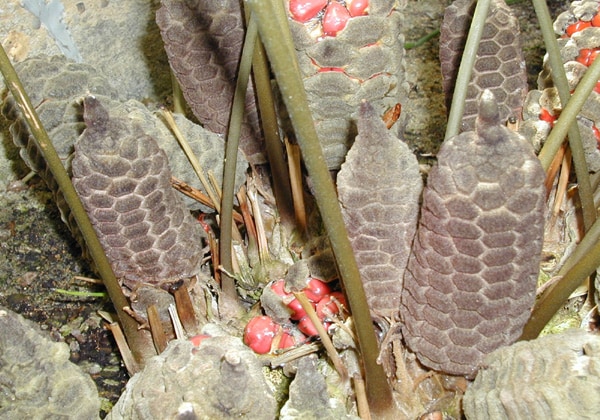
- Reddish seed cones with a distinct acuminate tip.
- Male cones are cylindrical, growing to 3–15 cm long, often clustered.
- Female cones are elongate-ovoid, growing to 6–15 cm long and 4–6 cm in diameter.
- The roots and half-buried stems were used by the TaíNo people for their yield of a starch.
- Habitat loss due to clearing for cattle ranching
- Intensive land use
- Potential extirpation in some former populations
About Zamia pumila
Zamia pumila, a resilient cycad species, is indigenous to the Greater Antilles, with documented populations in central Cuba, southern Puerto Rico, and the Dominican Republic. It holds significant botanical importance as it was the first species described for the genus Zamia, making it the type species for the genus, the Zamia pumila species complex, and the entire family Zamiaceae.
Botanical Description
This cycad is characterized by its low-growing habit, featuring a trunk that can reach between 3 to 25 centimeters in height and diameter, though it is frequently subterranean. Over time, it develops into a multi-branched cluster supported by a substantial tuberous root system, which effectively serves as an extension of its above-ground stems. The leaves of Zamia pumila are robust, measuring between 60 to 120 centimeters in length, and are adorned with 5 to 30 pairs of leaflets. These leaflets are typically linear to lanceolate or oblong-obovate in shape, ranging from 8 to 25 centimeters in length and 0.5 to 2 centimeters in width, often exhibiting distinct teeth at their tips and a revolute margin. The plant is dioecious, meaning individual plants are either male or female. Reproductive structures include cylindrical male cones, often clustered and growing up to 15 centimeters long, and elongate-ovoid female cones that can reach 6 to 15 centimeters in length and 4 to 6 centimeters in diameter. These cones are notably reddish and possess an acuminate tip.
Ecology and Habitat
Zamia pumila thrives in habitats that offer well-drained sandy or sandy loam soils, preferring conditions of filtered sunlight to partial shade. Its reproduction is facilitated by specific insects, most notably the cycad weevil Rhopalotria slossoni. The plant itself contains a potent toxin known as cycasin, which can impact the gastrointestinal and nervous systems of animals. Despite its toxicity, the Taíno people historically utilized the plant's roots and partially buried stems for their starch content, employing careful leaching methods to mitigate the poisonous effects. The species also plays a role in the local ecosystem, serving as a food source for insects such as the Atala butterfly (Eumaeus atala), which sequesters the plant's toxin for its own defense.
Conservation and Distribution
While historically present in Haiti, populations of Zamia pumila have possibly been extirpated there due to extensive land use. In Puerto Rico, populations have faced significant declines, primarily attributed to land clearing for cattle ranching. These factors highlight the vulnerability of this species to habitat alteration and human activities.
Source: Wikipedia ↗
Frequently Asked Questions
What is Zamia pumila commonly known as?
Zamia pumila is commonly known as guáyiga or guáyara in Spanish. It is a small, tough, woody cycad.
Where is Zamia pumila found naturally?
Zamia pumila is native to the Greater Antilles. It is currently known to exist on central Cuba, southern Puerto Rico, and the Dominican Republic on Hispaniola.
What are the characteristics of Zamia pumila's leaves?
The leaves of Zamia pumila are typically 60–120 cm long, with 5-30 pairs of leaflets. Each leaflet is linear to lanceolate or oblong-obovate, 8–25 cm long and 0.5–2 cm broad, often with distinct teeth at the tip and a revolute margin.
How does Zamia pumila reproduce?
Zamia pumila is dioecious, meaning it has separate male and female plants. Male cones are cylindrical and grow up to 15 cm long, while female cones are elongate-ovoid and can reach 15 cm long and 6 cm in diameter.
Is Zamia pumila poisonous?
Yes, Zamia pumila is poisonous. It produces a toxin called cycasin, which can affect the gastrointestinal tract and nervous system. However, this toxin can be removed by careful leaching.
What are the conservation concerns for Zamia pumila?
Populations of Zamia pumila have declined due to habitat clearing for cattle ranching and intensive land use. Some populations may have become extirpated in certain areas.
Related Cycad species

Encephalartos horridus
Encephalartos horridus, commonly known as the Eastern Cape blue cycad, is a distinctive, low-growing cycad native to the Eastern Cape Province of South Africa. It is recognized for its striking blue-gray, spiny leaves and typically develops a subterranean stem. This species thrives in arid shrublands and rocky ridges, exhibiting a slow growth rate and requiring specific conditions for successful cultivation.
Zamia inermis
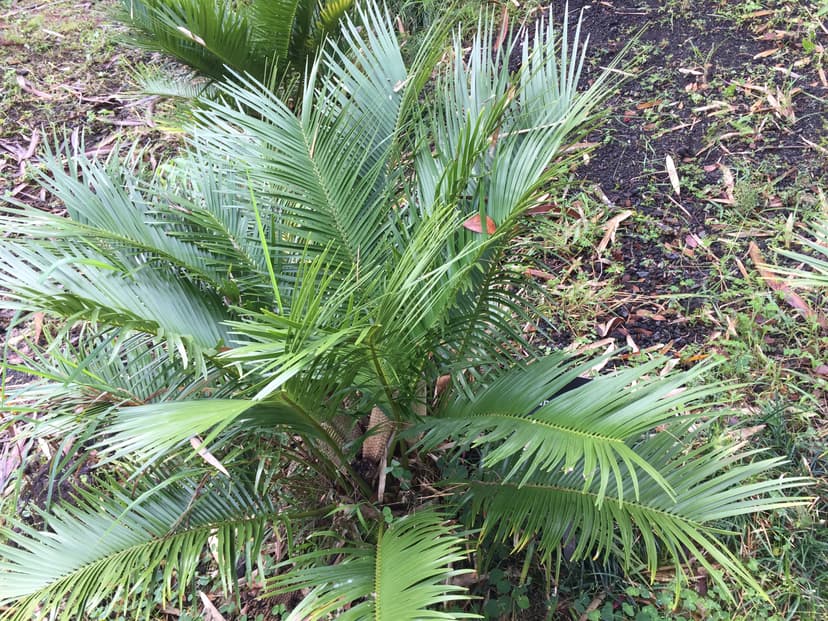
Zamia inermis is a critically endangered cycad species native to Actopan, Veracruz, Mexico. It is characterized by its shrub-like growth, with a trunk that can be branched and upright leaves composed of numerous linear-lanceolate leaflets. This species is dioecious and faces significant threats from habitat loss, wildfires, and over-harvesting.

Encephalartos dolomiticus
Encephalartos dolomiticus, commonly known as the Wolkberg cycad, is a critically endangered cycad species native to the Wolkberg region of South Africa. This tree-like cycad typically grows up to 2 meters tall and is characterized by its distinctive bluish leaves forming a crown, with lance-shaped leaflets arranged oppositely along the rachis. It is a dioecious species, producing separate male and female cones.