
Aardonyx
Aardonyx is a genus of basal sauropodomorph dinosaur from the Early Jurassic period of South Africa. Known from disarticulated bones of two immature individuals, it exhibits a unique mix of traits, showing adaptations for both bipedal and quadrupedal locomotion and feeding. Its discovery helped fill a gap in understanding the transition towards the large, quadrupedal sauropods.
Key Facts
- ›Aardonyx lived during the Early Jurassic period.
- ›Fossils were discovered in South Africa.
- ›It was named by Adam Yates and his team.
- ›Aardonyx could move bipedally but also adopt quadrupedal movement.
- ›It shows transitional features between early sauropodomorphs and derived sauropods.
- ›The genus is known from immature individuals, suggesting rapid growth.

- Possesses arm features intermediate between basal sauropodomorphs and derived sauropods.
- Hind limbs and pelvic girdle suggest a transition from bipedal to quadrupedal movement.
- Jaws are narrow and v-shaped with a pointed symphysis.
- Lacks fleshy cheeks, indicated by reduced neurovascular foramina in the maxilla.
- Possesses developed lateral plates along skull bone margins to brace teeth.
- Femur shaft is straighter, and the fourth trochanter is more distally placed compared to basal sauropodomorphs.
Melanorosaurus, Sauropods, Vulcanodon, Chinshakiangosaurus
South Africa
About Aardonyx
Aardonyx is a genus of basal sauropodomorph dinosaur that roamed the Earth during the Early Jurassic period. Its name, derived from Afrikaans and Greek, translates to "earth claw," reflecting its discovery and certain physical traits. Fossils of this dinosaur were unearthed in South Africa, specifically within the Elliot Formation, a site rich in early dinosaur remains. The genus is primarily known from the type species, Aardonyx celestae, named in honor of Celeste Yates for her work in preparing the fossil material.
Description and Paleobiology
The genus is represented by disarticulated bones belonging to two immature individuals, suggesting rapid growth rates interrupted seasonally. Aardonyx exhibits a fascinating mosaic of features that place it at a crucial juncture in sauropod evolution. Its locomotion was facultative bipedal; while it typically walked on two legs, it could also adopt a quadrupedal stance, a behavior observed in later, more derived sauropods like Iguanodon. This transitional ability is supported by adaptations in both its forelimbs and hind limbs.
In terms of feeding, Aardonyx showed early trends toward the bulk-browsing characteristic of giant sauropods. Its jaws were V-shaped, a plesiomorphic trait, but it lacked fleshy cheeks, an adaptation seen in later sauropods to facilitate a wider gape. This unique combination of features suggests that adaptations for a sauropod-like diet and locomotion began to emerge earlier in the evolutionary lineage than previously understood.
Significance in Sauropod Evolution
The discovery and study of Aardonyx have been instrumental in filling gaps in our knowledge of sauropod evolution. Paleontologists have noted that Aardonyx helps illustrate how bipedal animals began to acquire features necessary for a life spent on all fours. It provides evidence that the trend towards quadrupedalism and the associated anatomical changes started much earlier in dinosaur evolution than had been hypothesized. The genus is considered a sister taxon to a clade containing Melanorosaurus and true sauropods, all of which were obligate quadrupeds, further highlighting its transitional importance.
Source: Wikipedia ↗
Frequently Asked Questions
What does the name Aardonyx mean?
The name Aardonyx combines the Afrikaans word 'aard' meaning 'earth' with the Greek word 'onux' meaning 'nail' or 'claw'. This reflects its discovery and some of its physical characteristics.
When did Aardonyx live?
Aardonyx lived during the Early Jurassic epoch. This places it in a significant period for the evolution of sauropodomorph dinosaurs.
Where were Aardonyx fossils found?
Fossils of Aardonyx were discovered in South Africa, specifically from the Elliot Formation. This region is known for yielding important dinosaur fossils from the Early Jurassic.
How did Aardonyx move?
Aardonyx was primarily bipedal but could also move on all fours. This transitional locomotion is a key feature of the genus, bridging the gap between earlier two-legged ancestors and later four-legged sauropods.
What did Aardonyx eat?
Aardonyx showed adaptations for bulk-browsing, characteristic of sauropods. Features like its jaws suggest it was evolving towards a diet that involved consuming larger amounts of vegetation.
What is significant about the discovery of Aardonyx?
The discovery of Aardonyx is significant because it helps illustrate the evolutionary path from primarily two-legged dinosaurs to the large, quadrupedal sauropods. It provides evidence for how certain anatomical features necessary for quadrupedalism began to develop much earlier than previously thought.
Related Dinosaur species

Antetonitrus
Antetonitrus is a genus of sauropodiform dinosaur that lived during the Early Jurassic period in what is now South Africa. It is considered a basal sauropod, providing important insights into the origin and early evolution of this group. While quadrupedal and herbivorous like its later relatives, Antetonitrus retained primitive adaptations in its forelimbs that allowed for grasping.
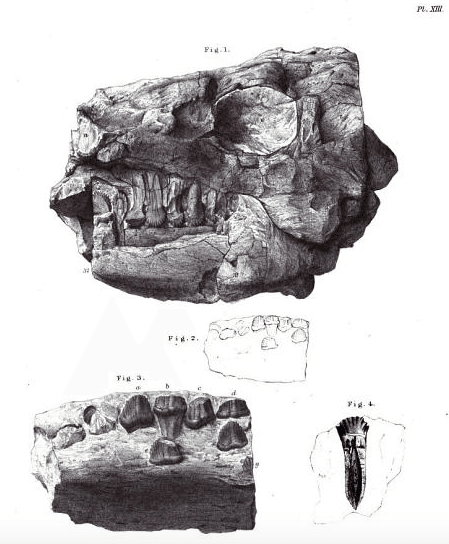
Anthodon
Anthodon was an extinct genus of parareptile that lived during the Permian period in what is now South Africa and Tanzania. Named for its distinctive flower-like teeth, which had numerous cusps, Anthodon was a relatively small herbivore, measuring about 1.2 to 1.5 meters in length.

Aristosaurus
Aristosaurus is a dubious genus of sauropodomorph dinosaur from the Early Jurassic of southern Africa, known from a single, nearly complete skeleton. Initially described as Aristosaurus erectus, it was later considered a synonym of Gyposaurus or a juvenile Massospondylus, but recent reviews classify it as an indeterminate sauropodomorph.