
Aristosaurus
Unknown·Early Jurassic·South Africa·Bipedal (indicated by pelvis morphology)
Aristosaurus is a dubious genus of sauropodomorph dinosaur from the Early Jurassic of southern Africa, known from a single, nearly complete skeleton. Initially described as Aristosaurus erectus, it was later considered a synonym of Gyposaurus or a juvenile Massospondylus, but recent reviews classify it as an indeterminate sauropodomorph.
Key Facts
- ›Aristosaurus is considered a dubious genus, meaning its validity as a distinct dinosaur is uncertain.
- ›It is known from a single, nearly complete skeleton discovered in the Clarens Formation of South Africa.
- ›The genus was named Aristosaurus erectus by Egbert Cornelis Nicolaas van Hoepen in 1920.
- ›The skeleton is flattened and preserved on two slabs, on display at the Ditsong National Museum of Natural History.
- ›Its exact taxonomic classification has been debated, with assignments to Anchisauridae, Gyposaurus, and Massospondylus.
- ›Recent reviews classify Aristosaurus as an indeterminate sauropodomorph.

- Small dinosaur
- Femur length of 13.7 cm
- Nearly complete skeleton, but flattened
- Skull missing except for parts of the upper and lower jaw with teeth
- 14 articulated dorsal vertebrae
- Compressed cervical vertebrae
- 12 caudal vertebrae preserved
- Incomplete forelimb
- Well-preserved hind limbs and feet
Gyposaurus, Massospondylus, Thecodontosaurus, Ammosaurus, Anchisaurus, Plateosaurus
Southern Africa
About Aristosaurus
Aristosaurus is a genus of sauropodomorph dinosaur that lived during the Early Jurassic period in what is now southern Africa. The only known species, Aristosaurus erectus, is known from a nearly complete skeleton discovered in the Clarens Formation of South Africa. However, the validity of Aristosaurus as a distinct genus has been questioned, leading to its classification as a dubious or indeterminate sauropodomorph by several paleontological reviews.
Discovery and Description
The holotype skeleton of Aristosaurus was discovered by quarry workers near Rosendal, South Africa, and acquired by the Ditsong National Museum of Natural History in 1915. Paleontologist Egbert Cornelis Nicolaas van Hoepen described it as a new genus and species, Aristosaurus erectus, in 1920. The generic name combines the Greek words 'aristo' (best) and 'sauros' (lizard). Van Hoepen characterized Aristosaurus as a small dinosaur, noting distinguishing features in its vertebrae and pelvis compared to other contemporary dinosaurs like Massospondylus carinatus. The morphology of its pelvis suggested bipedal locomotion.
Taxonomic History and Status
Van Hoepen initially assigned Aristosaurus to the Anchisauridae family. Over time, its classification has been debated. Friedrich von Huene later considered it a synonym of Gyposaurus capensis. In 1976, Peter Galton and Michael Albert Cluver retained it as a valid taxon. However, Michael Cooper suggested in 1981 that it might be a juvenile specimen of Massospondylus. Current scientific consensus, based on recent reviews, regards Aristosaurus as an indeterminate sauropodomorph, highlighting the ongoing uncertainty regarding its precise taxonomic placement. The specimen, bearing the number TM 130, is a significant exhibit at the Ditsong National Museum of Natural History.
Source: Wikipedia ↗
Frequently Asked Questions
What does the name Aristosaurus mean?
The generic name Aristosaurus is derived from the Greek words 'aristo,' meaning 'best,' and 'sauros,' meaning 'lizard.'
Where was Aristosaurus discovered?
The holotype skeleton of Aristosaurus was discovered by quarry workers near Rosendal in South Africa's Free State province.
What geological period did Aristosaurus live in?
Aristosaurus lived during the Early Jurassic period.
What is the current scientific classification of Aristosaurus?
While it has been assigned to various groups in the past, recent reviews consider Aristosaurus to be an indeterminate sauropodomorph, meaning its exact placement is uncertain.
What is the significance of the Aristosaurus skeleton?
The nearly complete skeleton, though flattened, provided early insights into sauropodomorph anatomy. It is a significant specimen displayed at the Ditsong National Museum of Natural History.
Related Dinosaur species
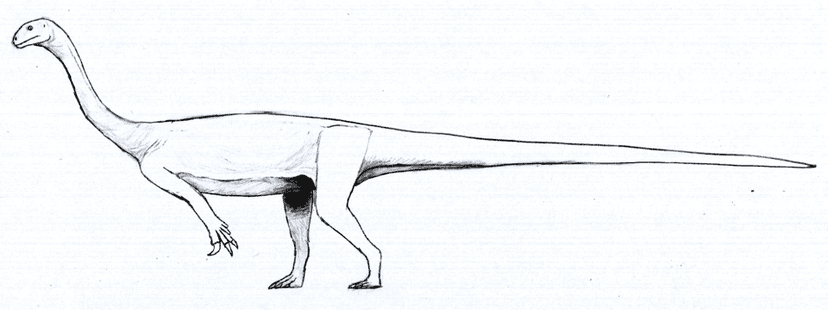
Arcusaurus
Arcusaurus is an extinct genus of sauropodomorph dinosaur that lived during the Early Jurassic period in what is now South Africa. Named for the "Rainbow Nation," Arcusaurus is known from fossil remains, including a partial skull and other skeletal elements, indicating it was a basal sauropodomorph.

Antetonitrus
Antetonitrus is a genus of sauropodiform dinosaur that lived during the Early Jurassic period in what is now South Africa. It is considered a basal sauropod, providing important insights into the origin and early evolution of this group. While quadrupedal and herbivorous like its later relatives, Antetonitrus retained primitive adaptations in its forelimbs that allowed for grasping.
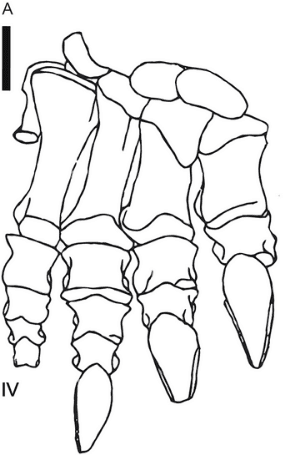
Blikanasaurus
Blikanasaurus is a genus of sauropodomorph dinosaur that lived in South Africa during the Late Triassic period. It is known only from partial hindlimb bones, which suggest it was a robust, quadrupedal animal. Due to the fragmentary nature of its fossils, much about its anatomy and classification remains uncertain.