
Antetonitrus
Antetonitrus is a genus of sauropodiform dinosaur that lived during the Early Jurassic period in what is now South Africa. It is considered a basal sauropod, providing important insights into the origin and early evolution of this group. While quadrupedal and herbivorous like its later relatives, Antetonitrus retained primitive adaptations in its forelimbs that allowed for grasping.
Key Facts
- ›Antetonitrus was a quadrupedal herbivore from the Early Jurassic.
- ›It is considered a basal sauropod, important for understanding sauropod evolution.
- ›Its forelimbs had grasping capabilities, a primitive trait not seen in later sauropods.
- ›Fossils were discovered in the Elliot Formation of South Africa.
- ›The holotype specimen may have reached 8-10 meters in length and weighed 5.6 metric tons.
- ›Its scientific name means 'before thunder lizard'.

- Quadrupedal stance
- Forelimbs retained grasping ability
- Forelimbs longer relative to hind legs than earlier ancestors
- Shortened metatarsus
- Broad and thick wrist bones for weight support
- Elliptical femur cross-section
- High neural spines on vertebrae
- Well-developed hyposphene-hypantrum articulations
- Large claw on the first toe of the hind foot
- Slightly sigmoidal femur
Lessemsaurus, Ingentia, Isanosaurus, Vulcanodon, Melanorosaurus, Blikanasaurus
Africa
About Antetonitrus
Antetonitrus is a genus of sauropodiform dinosaur that roamed the Earth during the Early Jurassic period. Its fossils have been discovered in the Elliot Formation of South Africa, making it one of the oldest known sauropods chronologically. The genus is particularly important for understanding the origin and early evolutionary stages of sauropods, a group that would later include iconic giants like Brontosaurus.
Discovery and Naming
The fossils now recognized as Antetonitrus were initially discovered by James Kitching in 1981 in South Africa's Free State. These specimens were housed at the Bernard Price Institute and misidentified as Euskelosaurus. It was Australian expert Adam Yates who, in a 2003 report co-authored with Kitching, identified them as a distinct taxon and formally named Antetonitrus. The genus name, meaning 'before thunder lizard,' alludes to its ancient lineage preceding more famous sauropods. The sole species, Antetonitrus ingenipes, was named for its 'massive foot,' reflecting adaptations for weight-bearing.
Physical Characteristics and Evolution
Antetonitrus was a quadrupedal herbivore, a characteristic shared with its later sauropod relatives. However, it retained primitive adaptations, notably in its forelimbs, which were capable of grasping. This contrasts with more derived sauropods, whose forelimbs were primarily adapted for supporting immense weight and had lost grasping ability. The genus exhibits features indicating an increase in body size, such as broader and thicker wrist bones and an elliptical femur cross-section. Its vertebrae also possessed high neural spines and well-developed articulations for trunk rigidity. While the first toe of the hind foot bore a large claw, it was not sickle-shaped as seen in later sauropods.
Classification and Paleogeography
Antetonitrus is classified as a basal sauropod, positioned evolutionarily between more derived sauropods and earlier sauropodomorphs. Its vertebrae show similarities to Lessemsaurus from South America, and its limb bones resemble those of Blikanasaurus, another early sauropod from South Africa. During the Early Jurassic, the continents were united as the supercontinent Pangaea, allowing for widespread distribution of early sauropods and their relatives across the globe.
Source: Wikipedia ↗
Frequently Asked Questions
What does the name Antetonitrus mean?
The name Antetonitrus is derived from the Latin words 'ante' meaning 'before' and 'tonitrus' meaning 'thunder.' This name refers to its existence before other known sauropods, such as Brontosaurus, which translates to 'thunder lizard.'
When and where did Antetonitrus live?
Antetonitrus lived during the Early Jurassic period. Its fossils were discovered in the Elliot Formation of South Africa.
What was the diet of Antetonitrus?
Antetonitrus was a herbivore, meaning it primarily ate plants.
How large was Antetonitrus?
The holotype specimen of Antetonitrus may have measured between 8 to 10 meters (26 to 33 feet) in length and weighed approximately 5.6 metric tons (6.2 short tons).
What makes Antetonitrus important for dinosaur evolution?
Antetonitrus is significant because it exhibits a mix of primitive and advanced features. It shows early adaptations for quadrupedalism and increased body size, characteristic of later sauropods, while still retaining grasping abilities in its forelimbs, which are considered primitive.
What is known about the Antetonitrus fossil record?
The original specimen, or holotype, includes several vertebrae and numerous limb bones from both forelimbs and hind limbs, presumed to be from a single individual. Additionally, five limb bones from a smaller individual have been referred to the genus.
Related Dinosaur species
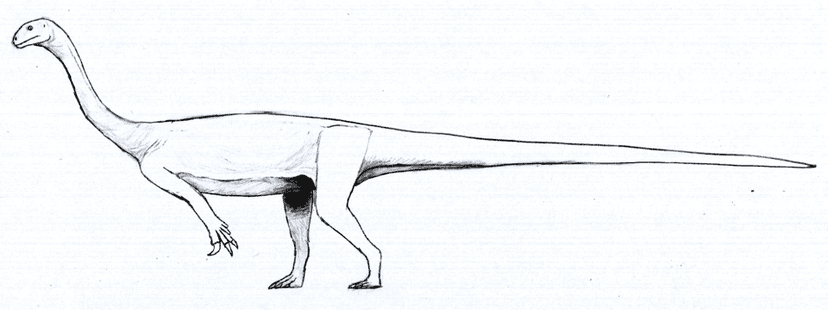
Arcusaurus
Arcusaurus is an extinct genus of sauropodomorph dinosaur that lived during the Early Jurassic period in what is now South Africa. Named for the "Rainbow Nation," Arcusaurus is known from fossil remains, including a partial skull and other skeletal elements, indicating it was a basal sauropodomorph.

Aristosaurus
Aristosaurus is a dubious genus of sauropodomorph dinosaur from the Early Jurassic of southern Africa, known from a single, nearly complete skeleton. Initially described as Aristosaurus erectus, it was later considered a synonym of Gyposaurus or a juvenile Massospondylus, but recent reviews classify it as an indeterminate sauropodomorph.
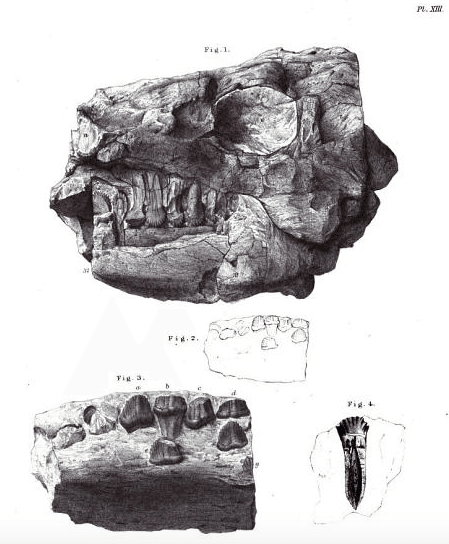
Anthodon
Anthodon was an extinct genus of parareptile that lived during the Permian period in what is now South Africa and Tanzania. Named for its distinctive flower-like teeth, which had numerous cusps, Anthodon was a relatively small herbivore, measuring about 1.2 to 1.5 meters in length.