
Afrovenator
Afrovenator, meaning "African hunter," was a large theropod dinosaur that roamed Africa during the Middle to Late Jurassic period. Known from a single, relatively complete skeleton, it is distinguished by several unique anatomical features and is considered the only definitive Gondwanan megalosaur.
Key Facts
- ›Lived during the Middle to Late Jurassic period, approximately 167 to 161 million years ago.
- ›Its scientific name, Afrovenator abakensis, means "African hunter from Abaka."
- ›Fossils were discovered in the Tiourarén Formation of Niger, Western Africa.
- ›Estimated to be around 8 meters (26 feet) long and weigh approximately 1 tonne (2,200 lbs).
- ›It possessed a gracile build with relatively long forelimbs and lower legs.
- ›Afrovenator is classified as a megalosaurid theropod.

- Estimated length of around 8 meters.
- Estimated weight of approximately 1 tonne.
- Gracile build with relatively long forelimbs and lower legs.
- Flexible, S-shaped neck with well-developed neck muscles.
- Skull is generally flat, with a long front branch on the maxilla bearing fourteen teeth sockets.
- Distinctive rounded horn on top of the lacrimal bone.
- Teeth show proximodistally subrectangular distocentral denticles and a sigmoidal shape in distal view.
Torvosaurus, Spinosaurus, Allosaurus, Eustreptospondylus, Dubreuillosaurus, Piatnitzkysaurus, Magnosaurus, Streptospondylus, Aucasaurus
Africa
About Afrovenator
Afrovenator: The African Hunter
Afrovenator, a name meaning "African hunter," was a formidable theropod dinosaur that lived during the Middle to Late Jurassic periods, approximately 167 to 161 million years ago. Its remains were discovered in the Tiourarén Formation of Niger, in Western Africa, making it a significant find for understanding dinosaur diversity on the Gondwanan supercontinent. Afrovenator is currently the only definitively identified Gondwanan megalosaur.
Discovery and Naming
The discovery of Afrovenator occurred in 1993, with its formal description published in 1994 by paleontologists Paul Sereno and colleagues in the journal Science. The genus name reflects its predatory nature and African origin, while the species name, abakensis, honors the Tuareg people and the region of Abaka in Niger where the fossil was unearthed. The holotype specimen, UC OBA 1, is a remarkably complete skeleton, offering substantial insight into the dinosaur's anatomy, though parts of the skull and lower jaws are missing.
Physical Characteristics and Lifestyle
Estimates suggest Afrovenator reached lengths of around 8 meters (26 feet) and weighed approximately 1 tonne (2,200 lbs). It possessed a gracile build, characterized by relatively long forelimbs and lower legs, indicating it was likely an agile predator. Its flexible, S-shaped neck suggests well-developed musculature, potentially allowing for powerful movements during hunting and feeding, though not to the extreme extent seen in spinosaurids. Unique anatomical features, or autapomorphies, distinguish Afrovenator from its closest relatives, including specific characteristics of its neck vertebrae, wrist bones, and the structure of its pubic bone.
Classification
Afrovenator is firmly placed within the Megalosauridae family, a group of large theropods. While this family was once considered a catch-all category, it has since been redefined. Afrovenator is often found in phylogenetic analyses as a basal member of the Megalosauridae, sometimes grouped with other genera like Eustreptospondylus and Dubreuillosaurus, forming clades such as Megalosaurinae or Eustreptospondylinae.
Source: Wikipedia ↗
Frequently Asked Questions
When did Afrovenator live?
Afrovenator lived during the Middle to Late Jurassic geological periods. This timeframe is estimated to be between 167 and 161 million years ago.
What does Afrovenator mean?
The name Afrovenator is derived from Latin and means "African hunter." The specific name, abakensis, refers to the region in Niger where its fossil was found.
Where were Afrovenator fossils found?
The primary discovery site for Afrovenator was the Tiourarén Formation in the Agadez department of Niger, located in the Sahara region of Western Africa.
How large was Afrovenator?
Based on the known skeleton, Afrovenator is estimated to have been about 8 meters (26 feet) long. Its weight has been estimated at around 1 tonne (2,200 lbs).
What type of dinosaur was Afrovenator?
Afrovenator was a theropod dinosaur, belonging to the family Megalosauridae. It is considered the only definitively Gondwanan megalosaur.
Related Dinosaur species

Alpkarakush
Alpkarakush is an extinct genus of theropod dinosaur that lived during the Jurassic period in what is now Kyrgyzstan. Known from a partial skeleton, this large predator is characterized by its high, arched skull and slender hindlimbs, with a prominent bony structure over its eyes.
Aorun
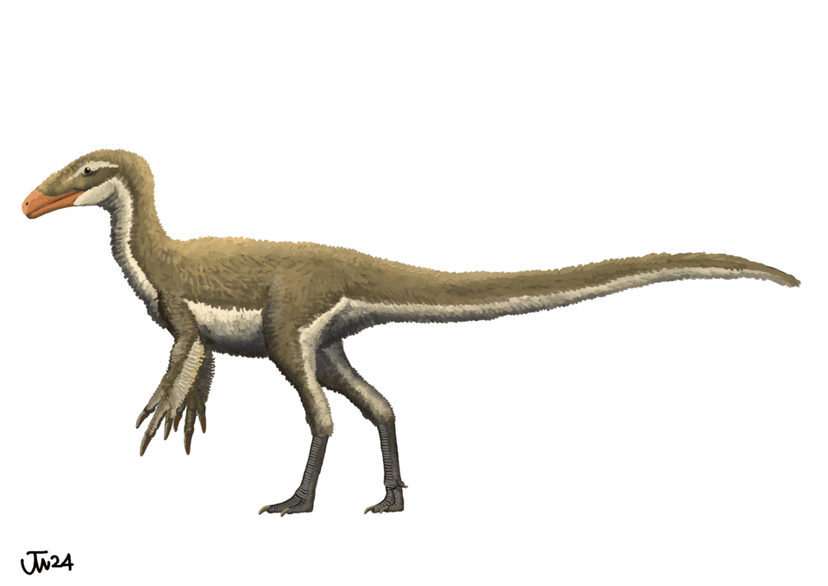
Aorun is a genus of carnivorous theropod dinosaur that lived approximately 161.6 million years ago during the Late Jurassic Period. Discovered in China, it is considered one of the oldest known coelurosaurs and is characterized by its small size and distinctive dentition. The only known species is Aorun zhaoi.

Asfaltovenator
Asfaltovenator vialidadi was a large theropod dinosaur that lived during the Early Jurassic period in what is now Argentina. Its classification has been a subject of debate, with some studies placing it as a basal allosauroid and others suggesting it belongs within the Allosauridae family. The discovery of its partial skeleton has provided valuable insights into the evolution of tetanuran theropods during a period of significant environmental change.