
Aorun
Aorun is a genus of carnivorous theropod dinosaur that lived approximately 161.6 million years ago during the Late Jurassic Period. Discovered in China, it is considered one of the oldest known coelurosaurs and is characterized by its small size and distinctive dentition. The only known species is Aorun zhaoi.
Key Facts
- ›Lived approximately 161.6 million years ago during the Late Jurassic Period.
- ›Discovered in the Xinjiang region of China.
- ›A carnivorous theropod dinosaur, likely preying on small lizards and mammals.
- ›Estimated to be about 1 meter (3.3 ft) long and weigh 1.5 kilograms (3.3 lbs) as a juvenile.
- ›Considered one of the oldest known coelurosaurs.
- ›The type specimen is a juvenile, likely less than one year old.
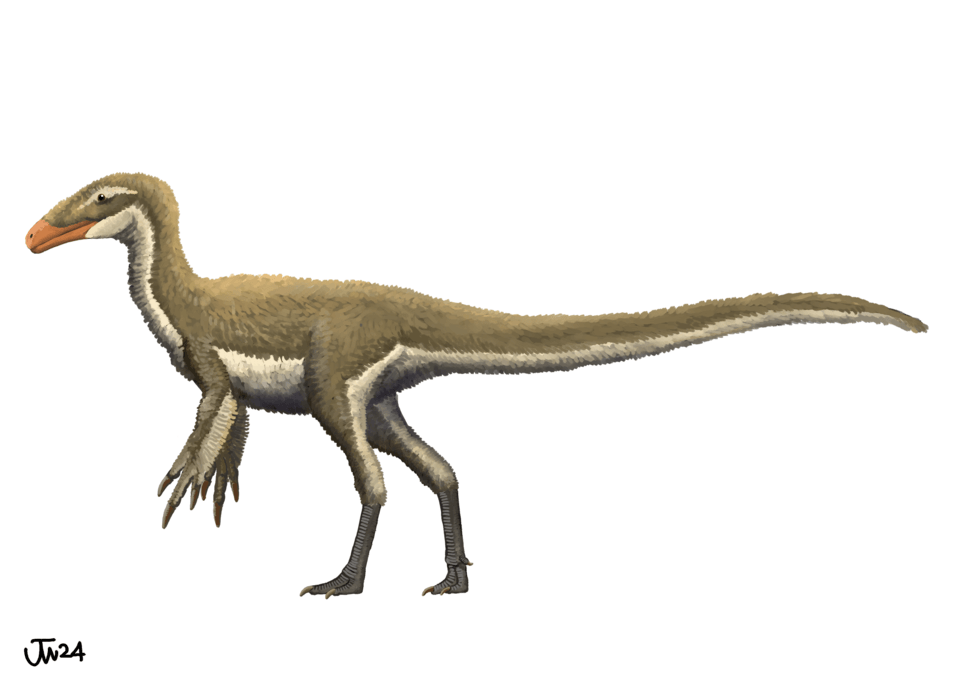
- Small bipedal predator.
- Gracile hand with thin metacarpals.
- Distinctive teeth: some without serrations, others with very fine serrations only on the distal carinae.
- Relatively large orbit.
- Thumb claw is large and curved, other hand claws are smaller and straighter.
- Mildly opisthocoelous neck vertebrae.
Guanlong, Haplocheirus, Limusaurus, Monolophosaurus, Sinraptor, Zuolong, Alvarezsaurids, Bannykus, Xiyunykus, Jaculinykus
Asia
About Aorun
Aorun is a genus of carnivorous theropod dinosaur that roamed the Earth approximately 161.6 million years ago during the Late Jurassic Period. Discovered in the Xinjiang region of China, it is considered a significant find as one of the oldest known coelurosaurs, a diverse group of theropods that includes many well-known species. The only known species, Aorun zhaoi, was formally described in 2013.
Discovery and Naming
The fossil remains, including a nearly complete skull and postcranial elements, were unearthed in 2006 by a team led by James Clark and Jonah Choiniere in the Junggar Basin. The genus name, Aorun, is derived from the Chinese mythical deity Ao Run, the Dragon King of the West Sea, while the species name, zhaoi, honors Professor Zhao Xijin for his contributions to vertebrate paleontology. The discovery was made in terrestrial red-brown siltstone of the Shishugou Formation.
Description and Paleoecology
The type specimen of Aorun represents a juvenile individual, estimated to be less than one year old. It measured about 1 meter (3.3 ft) in length and weighed approximately 1.5 kilograms (3.3 lbs). Physically, Aorun was a small bipedal predator with a gracile build, distinctive dentition, and sharp claws. Its habitat was a warm, seasonally dry basin, and it likely preyed on small vertebrates like lizards and mammals. The Shishugou Formation is known for its rich paleofauna, and Aorun is among the oldest coelurosaurs found there, contributing to our understanding of Jurassic theropod diversity.
Source: Wikipedia ↗
Frequently Asked Questions
When did Aorun live?
Aorun lived approximately 161.6 million years ago during the Late Jurassic Period. This places it at the boundary of the Oxfordian and Callovian stages.
Where was Aorun discovered?
The fossil remains of Aorun were discovered in a remote region of Xinjiang, China, specifically in the Wucaiwan locality of the Shishugou Formation.
What did Aorun eat?
Aorun was a carnivorous theropod dinosaur. It is believed to have been a predator of small animals such as lizards and mammals.
How big was Aorun?
The known specimen of Aorun is a juvenile, measuring about 1 meter (3.3 ft) in length and weighing approximately 1.5 kilograms (3.3 lbs). Its adult size is not precisely known.
What is special about Aorun's classification?
Aorun is significant because it is considered one of the oldest known coelurosaurian dinosaurs, a group that includes many famous theropods like Tyrannosaurus Rex and Velociraptor. Some researchers have also suggested it could be a carnosaurian.
Who named Aorun?
The species Aorun zhaoi was named and described in 2013 by Jonah Choiniere, James Clark, Catherine Forster, Mark Norell, David Eberth, Gregory Erickson, Chu Hongjun, and Xu Xing.
Related Dinosaur species

Afrovenator
Afrovenator, meaning "African hunter," was a large theropod dinosaur that roamed Africa during the Middle to Late Jurassic period. Known from a single, relatively complete skeleton, it is distinguished by several unique anatomical features and is considered the only definitive Gondwanan megalosaur.

Alpkarakush
Alpkarakush is an extinct genus of theropod dinosaur that lived during the Jurassic period in what is now Kyrgyzstan. Known from a partial skeleton, this large predator is characterized by its high, arched skull and slender hindlimbs, with a prominent bony structure over its eyes.

Asfaltovenator
Asfaltovenator vialidadi was a large theropod dinosaur that lived during the Early Jurassic period in what is now Argentina. Its classification has been a subject of debate, with some studies placing it as a basal allosauroid and others suggesting it belongs within the Allosauridae family. The discovery of its partial skeleton has provided valuable insights into the evolution of tetanuran theropods during a period of significant environmental change.