
Ambopteryx
Ambopteryx was a genus of scansoriopterygid dinosaur that lived in China during the Late Jurassic period. It is notable for being one of the few dinosaurs discovered with both feather coverings and bat-like membranous wings, a feature it shared with its close relative, Yi. Ambopteryx possessed a short head, a hyper-elongate third finger likely used for wing support, and a short tail ending in a pygostyle.
Key Facts
- ›Ambopteryx is a scansoriopterygid dinosaur from the Late Jurassic of China.
- ›It possessed both feathers and bat-like membranous wings, a rare combination among dinosaurs.
- ›Its hyper-elongate third finger was likely a key structure for supporting its wing membrane.
- ›Fossil evidence suggests Ambopteryx was omnivorous, with gastroliths and possible bone fragments found in its stomach region.
- ›The genus includes a single species, Ambopteryx longibrachium, named for its long upper arm.

- Short, blunt head
- Hyper-elongate third finger
- Bat-like membranous wings extending from the third finger to the abdomen
- Feathered head, neck, and shoulder regions
- Short tail ending in a pygostyle
- Forelimbs approximately 1.3 times longer than hindlimbs
Yi
China
About Ambopteryx
Ambopteryx is a genus of scansoriopterygid dinosaur, known from the Oxfordian stage of the Late Jurassic period in China. It holds significant scientific interest as one of the few dinosaur species discovered with evidence of both feathers and bat-like membranous wings. This unique combination sets it apart and provides valuable insights into the diversity of flight and aerial locomotion among dinosaurs.
Discovery and Naming
The genus name, Ambopteryx, is a combination of the Latin word "ambo" meaning "both" and the Ancient Greek word "pteryx" meaning "wing." This nomenclature reflects the dinosaur's dual wing characteristics. The species name, Ambopteryx longibrachium, highlights its particularly long upper arm. The holotype specimen, IVPP V24192, is a remarkably well-preserved, articulated skeleton that includes associated soft tissue, discovered in 2017 in Liaoning Province, China, within the Yanliao Biota. The specimen is considered to be a subadult or adult based on the fusion of its pygostyle.
Description and Paleobiology
Ambopteryx shared several traits with other scansoriopterygids, including a short, blunt head and an exceptionally elongated third finger. While once thought to be used for grub extraction, this hyper-elongate finger is now believed to have been crucial for supporting the wing membrane, or patagium, which stretched from the third finger to the abdomen. The forelimbs were longer than the hindlimbs, with the ulna being shorter than the humerus. Unlike most non-avian theropods, Ambopteryx possessed a short tail that terminated in a pygostyle, a feature shared with some oviraptorosaurs and therizinosaurs. Analysis of the abdominal region revealed gastroliths and fragments of bone, suggesting that Ambopteryx was omnivorous, likely consuming a varied diet. Its close relative, Yi, was the first dinosaur discovered with similar wing structures, and Ambopteryx is considered its sister taxon.
Source: Wikipedia ↗
Frequently Asked Questions
What does the name Ambopteryx mean?
The name Ambopteryx is derived from the Latin word 'ambo' meaning 'both' and the Ancient Greek word 'pteryx' meaning 'wing'. This name refers to the dinosaur's unique combination of membranous wings and a bird-like body plan.
What period did Ambopteryx live in?
Ambopteryx lived during the Oxfordian stage of the Late Jurassic period.
Where were the fossils of Ambopteryx discovered?
The holotype specimen of Ambopteryx was discovered in Liaoning Province, China, near Wubaiding Village.
What did Ambopteryx eat?
Based on the presence of gastroliths and possible bone fragments in its abdominal region, Ambopteryx is believed to have been omnivorous.
What was unique about Ambopteryx's wings?
Ambopteryx had bat-like membranous wings, supported by its third finger, which was exceptionally long. This is in addition to its feathered body, making it one of the few dinosaurs known to have had both types of wing structures.
How large was Ambopteryx?
The estimated body length of the holotype specimen of Ambopteryx was about 32 centimeters (13 inches), with an estimated weight of 306 grams (10.8 ounces).
Related Dinosaur species
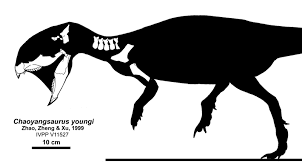
Chaoyangsaurus
Chaoyangsaurus was a genus of marginocephalian dinosaur belonging to the Ceratopsia, meaning "horned faces." This herbivorous dinosaur lived during the Late Jurassic period in what is now northeastern China. Despite a complex naming history, it was officially described in 1999, with its scientific name honoring both its discovery location and a pioneering Chinese paleontologist.

Archaeornithomimus
Archaeornithomimus was a medium-sized ornithomimosaurian theropod dinosaur that lived in what is now Inner Mongolia, China, during the Late Cretaceous period, approximately 96 million years ago. Named "ancient bird mimic," this dinosaur is thought to have been an omnivore, potentially feeding on plants, fruits, eggs, and small animals, and it likely possessed feathers and a keratinous beak.

Caenagnathasia
Caenagnathasia is a genus of small oviraptorosaurian theropod dinosaurs that lived in present-day Uzbekistan during the Late Cretaceous period. It is notable for being one of the smallest non-avian dinosaurs known, characterized by its beaked skull and bird-like features.