
Chaoyangsaurus
Chaoyangsaurus was a genus of marginocephalian dinosaur belonging to the Ceratopsia, meaning "horned faces." This herbivorous dinosaur lived during the Late Jurassic period in what is now northeastern China. Despite a complex naming history, it was officially described in 1999, with its scientific name honoring both its discovery location and a pioneering Chinese paleontologist.
Key Facts
- ›Chaoyangsaurus was a herbivore from the Late Jurassic period.
- ›It belonged to the Ceratopsia group, known for "horned faces."
- ›Fossils were discovered in the Chaoyang area of Liaoning Province, China.
- ›The species was officially named Chaoyangsaurus youngi in 1999.
- ›Estimated to be about 1 meter long and weigh 6 kilograms.
- ›Possessed unique skull features, including a low coronoid process on the lower jaw.
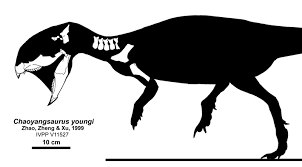
- Estimated length of 1 meter
- Estimated weight of 6 kilograms
- Weakly developed jugal boss with smooth surface
- Convex rear lower edge of the quadrate bone
- Low coronoid process on the lower jaw with a flat top
- Ridge separating the side and underside of the angular bone
- Skull approximately 14 centimeters long
- Four crenulations on the lower cutting edge of the rostral bone
- Two conical premaxillary teeth
- Eight or nine maxillary teeth
- Eleven dentary teeth in the lower jaw
- Imbricated and vertically long cheek teeth with enamel on inner and outer sides
China
About Chaoyangsaurus
Chaoyangsaurus is a genus of marginocephalian dinosaur that roamed the Earth during the Late Jurassic period. Belonging to the Ceratopsia, a group famously known for their "horned faces," Chaoyangsaurus was primarily a herbivore. Its fossils were discovered in northeastern China, specifically in the Chaoyang area of Liaoning Province.
Discovery and Naming
The remains of Chaoyangsaurus were first found in 1976 by Cheng Zhengwu. The dinosaur experienced a complex naming history, with several invalid spellings appearing in publications before its official description. The name "Chaoyoungosaurus" was used incorrectly in guidebooks and by paleontologist Zhao Xijin in the early 1980s, but these instances lacked formal descriptions, rendering them nomina nuda (naked names).
An emended spelling, "Chaoyangosaurus," also appeared without a formal description. It wasn't until 1999 that the dinosaur received its official scientific name, Chaoyangsaurus youngi, published by Cheng, Zhao, and Xu Xing. This name holds priority as the first validly described genus name. The genus name honors the locality of its discovery, while the species name pays tribute to Yang Zhongjian, a significant figure in Chinese vertebrate paleontology.
Description and Phylogeny
The holotype specimen of Chaoyangsaurus youngi includes a partial skeleton with parts of the skull, lower jaws, neck vertebrae, and shoulder blade, representing an adult individual. In 2010, Gregory S. Paul estimated its length at approximately 1 meter (3.3 feet) and its weight at around 6 kilograms (13 pounds). Distinctive features include a weakly developed jugal boss, a convex rear lower edge of the quadrate bone, and a low coronoid process on the lower jaw.
The skull was about fourteen centimeters long, featuring crenulations on the rostral bone and two conical premaxillary teeth. It had eight or nine maxillary teeth and eleven dentary teeth in the lower jaw, with cheek teeth that were imbricated and vertically long. In terms of its evolutionary relationships, Chaoyangsaurus was placed in a basal position within the Ceratopsia, with some debate about its exact placement within or outside the Neoceratopia. In 2006, it was recognized as part of the Chaoyangsauridae, defined as the most basal ceratopian clade.
Source: Wikipedia ↗
Frequently Asked Questions
What does the name Chaoyangsaurus mean?
The genus name Chaoyangsaurus means "Chaoyang lizard," referring to the Chaoyang area in northeastern China where its fossils were found. The specific name, youngi, honors the Chinese paleontologist Yang Zhongjian, also known as C. C. Young, who founded Chinese vertebrate paleontology.
When did Chaoyangsaurus live?
Chaoyangsaurus lived during the Late Jurassic epoch. The fossils were found in rock layers dated to between 150.8 and 145.5 million years ago.
What did Chaoyangsaurus eat?
Chaoyangsaurus was primarily a herbivore, meaning it fed on plants. Like other ceratopsians, its diet consisted of vegetation.
Where were Chaoyangsaurus fossils found?
The remains of Chaoyangsaurus were discovered at Ershijiazi, in the Chaoyang area of Liaoning Province in northeastern China.
How big was Chaoyangsaurus?
Estimates suggest that Chaoyangsaurus was a small dinosaur, measuring about 1 meter (3.3 feet) in length and weighing approximately 6 kilograms (13 pounds).
What are some distinctive physical characteristics of Chaoyangsaurus?
Chaoyangsaurus had a weakly developed jugal boss with a smooth surface and a convex rear lower edge of the quadrate bone. The coronoid process of its lower jaw was low with a flat top, and the angular bone featured a ridge separating its side and underside.
Related Dinosaur species

Ambopteryx
Ambopteryx was a genus of scansoriopterygid dinosaur that lived in China during the Late Jurassic period. It is notable for being one of the few dinosaurs discovered with both feather coverings and bat-like membranous wings, a feature it shared with its close relative, Yi. Ambopteryx possessed a short head, a hyper-elongate third finger likely used for wing support, and a short tail ending in a pygostyle.

Chuanqilong
Chuanqilong is a genus of basal ankylosaurid dinosaur that lived during the Early Cretaceous period in what is now Liaoning Province, China. Known from a nearly complete juvenile skeleton, this medium-sized dinosaur was characterized by a triangular skull, osteoderm-covered body, and a tail lacking a club. It is closely related to Liaoningosaurus, with some research suggesting they may represent the same species at different life stages.

Crichtonsaurus
Crichtonsaurus was a genus of herbivorous ankylosaurid dinosaur that lived in what is now China during the Late Cretaceous period. Named in honor of author Michael Crichton, the genus is now considered dubious, with its type species, Crichtonsaurus bohlini, being a nomen dubium due to a lack of unique diagnostic traits in the holotype and questionable referral of other specimens. A second species, Crichtonsaurus benxiensis, was later renamed Crichtonpelta.