
Angulomastacator
Herbivore·Late Cretaceous·Big Bend National Park, Texas·Bipedal/Quadrupedal
Angulomastacator was a duck-billed dinosaur that lived during the Campanian stage of the Late Cretaceous period. Its fossils were discovered in Big Bend National Park, Texas, within the Aguja Formation. This dinosaur is distinguished by a uniquely curved upper jaw bone, suggesting it may have been an endemic form to the region.
Key Facts
- ›Angulomastacator means "bend chewer", referencing its jaw shape and discovery location.
- ›It is known from a partial left maxilla (upper jaw bone).
- ›The maxilla has a distinctive 45° downward curve at its anterior end.
- ›It is classified as a lambeosaurine, a group of hadrosaurs known for cranial crests.
- ›Fossils were found in the Aguja Formation of Big Bend National Park, Texas.
- ›It lived during the Campanian-aged Late Cretaceous period.

- Hadrosaurid Dinosaur
- Bipedal/Quadrupedal
- Herbivorous Dentition With Ever-Replacing Teeth
- Unique Downturned Upper Jaw Bone
North America
About Angulomastacator
Angulomastacator is a genus of duck-billed dinosaur that roamed the Earth during the Campanian stage of the Late Cretaceous period. Its name, meaning "bend chewer," reflects both the unusual shape of its upper jaw and the Big Bend region of Texas where its fossils were discovered. The discovery of Angulomastacator in the Aguja Formation of Big Bend National Park provides evidence for potentially endemic dinosaur fauna in this area.
Fossil Evidence
The known fossil record of Angulomastacator consists of a single, partial left maxilla, which is the primary bone of the upper jaw bearing teeth. This bone exhibits a remarkable characteristic: it curves downwards by approximately 45° at its anterior end, with the tooth row following this unusual bend. This distinctive morphology sets Angulomastacator apart from other known hadrosaurs.
Classification and Lifestyle
Angulomastacator is classified within the Lambeosaurinae, a group of hadrosaurs recognized for their elaborate, hollow cranial crests. While Angulomastacator's own crest is not preserved, its classification suggests it belonged to this well-known lineage of herbivorous dinosaurs. As a hadrosaurid, Angulomastacator would have been adapted for bipedal or quadrupedal locomotion and possessed rows of continuously replaced teeth, ideal for processing plant material.
Source: Wikipedia ↗
Frequently Asked Questions
What does the name Angulomastacator mean?
The name Angulomastacator translates to "bend chewer". This name refers to the bent shape of its upper jaw bone and the Big Bend area in Texas where it was discovered.
What is Angulomastacator known from?
Angulomastacator is known from a single fossil specimen: a partial left maxilla. This is the primary tooth-bearing bone of the upper jaw.
Where was Angulomastacator discovered?
Fossils of Angulomastacator were discovered in Big Bend National Park, Texas, within the Aguja Formation. The specific locality is in the upper shale member of this formation.
What geological period did Angulomastacator live in?
Angulomastacator lived during the Campanian stage of the Late Cretaceous period. This is estimated to be around 76.6 million years ago.
What group of dinosaurs does Angulomastacator belong to?
Angulomastacator is classified as a lambeosaurine. This is a subgroup of hadrosaurs, which are commonly known as duck-billed dinosaurs, and are characterized by hollow cranial crests.
What is unique about Angulomastacator's jaw?
The most unique feature of Angulomastacator is its partial left maxilla, which curves downwards approximately 45° at its front end. The tooth row also bends to accommodate this curvature, a trait not seen in other hadrosaurs.
Related Dinosaur species

Anasazisaurus
Anasazisaurus was a genus of saurolophine hadrosaurid dinosaur that roamed the Earth approximately 74 million years ago during the Late Cretaceous Period. Its fossils were discovered in the San Juan Basin of New Mexico, USA. Known from a partial skull, Anasazisaurus is distinguished by a unique, short nasal crest situated above and between its eyes.

Arstanosaurus
Arstanosaurus is a genus of hadrosauroid dinosaur known from the Late Cretaceous Bostobe Formation of Kazakhstan. Its fossil record is sparse, consisting primarily of a partial left maxilla and a possibly associated femur, leading to a history of taxonomic confusion. It was once considered a hadrosaurid, then a ceratopsid, and is now regarded as an indeterminate hadrosauroid.
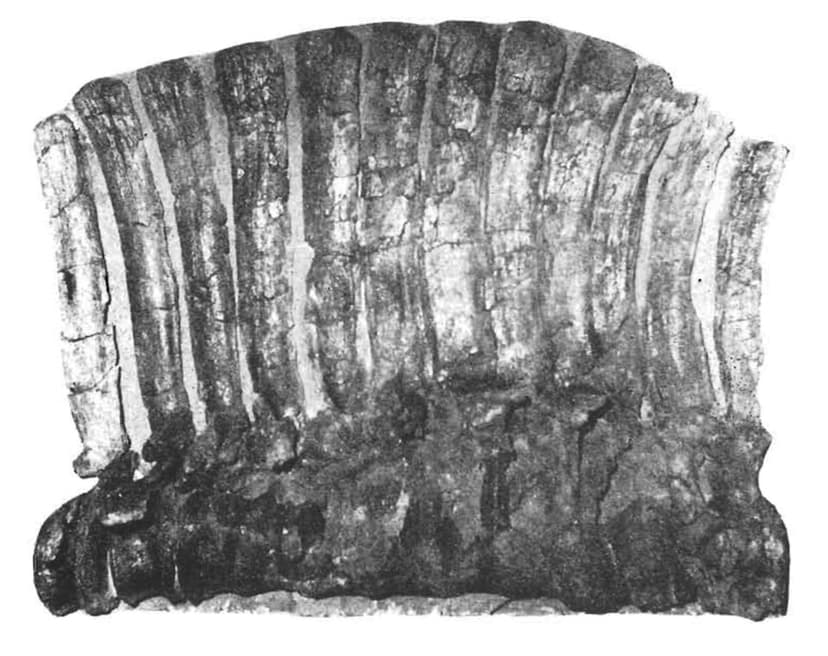
Barsboldia
Barsboldia was a large hadrosaurid dinosaur that lived during the Maastrichtian stage of the Late Cretaceous period in what is now Mongolia. It is known from a partial skeleton including vertebrae, pelvis, and ribs, and is distinguished by its very tall neural spines, particularly over the hips. While initially classified as a lambeosaurine, later studies suggest it may have been a saurolophine.