
Aragosaurus
Herbivore·Early Cretaceous·Aragón, Spain·Quadrupedal
Aragosaurus was a large, quadrupedal, herbivorous sauropod dinosaur that lived during the Early Cretaceous period in what is now Spain. With an estimated length of 18 meters and a weight of 25 tonnes, it possessed a long neck, a powerful tail, and a bulky body, similar in build to Camarasaurus. Its large, wide teeth were adapted for slicing leaves and branches from tall conifer trees.
Key Facts
- ›Aragosaurus means "Aragon lizard".
- ›It was a quadrupedal, plant-eating sauropod.
- ›Lived during the Early Cretaceous (Berriasian stage), approximately 145-140 million years ago.
- ›Estimated to be about 18 meters long and weigh around 25 tonnes.
- ›Had a long neck, long powerful tail, small head, and bulky body.
- ›Fossils were discovered in the Villar del Arzobispo Formation in Aragón, Spain.

Long Neck, Long Powerful Tail, Small Head, Bulky Body, Forelimbs Slightly Shorter Than Hind Limbs, Large, Wide Teeth
Camarasaurus
Spain
About Aragosaurus
Aragosaurus, a name meaning "Aragon lizard," was a significant herbivorous sauropod dinosaur that roamed the Earth during the Early Cretaceous period. Its fossils have been unearthed in the region of Aragón, Spain, specifically within the Villar del Arzobispo Formation.
Life in the Early Cretaceous
Aragosaurus lived during the Berriasian stage, approximately 145 to 140 million years ago. This large dinosaur was quadrupedal and primarily consumed plant matter. Its imposing size is estimated at around 18 meters (59 feet) in length, with a substantial weight of approximately 25 tonnes. Like other sauropods, Aragosaurus possessed a characteristic long neck, a long and powerful tail, a relatively small head, and a bulky body. Its forelimbs were only slightly shorter than its hind limbs, supporting its substantial frame.
Anatomy and Diet
Aragosaurus shared notable similarities with the genus Camarasaurus. It is believed to have had a short, compact skull and a moderately long neck. The dinosaur's teeth were large and wide, perfectly adapted for slicing through the leaves and branches of the tall conifer trees that likely formed its diet. The muscular tail served as a crucial counterbalance and likely played a role in its locomotion and stability.
Discovery
The existence of Aragosaurus is known from a partial skeleton recovered in Spain. The species was formally named and described in 1987 by paleontologists Sanz, Buscalioni, Casanovi, and Santafe. The type species is designated as Aragosaurus ischiaticus.
Source: Wikipedia ↗
Frequently Asked Questions
What does the name Aragosaurus mean?
The name Aragosaurus means "Aragon lizard." This refers to the region of Aragón in Spain where its fossils were discovered.
What did Aragosaurus eat?
Aragosaurus was a herbivore, meaning it ate plants. Its large, wide teeth were well-suited for slicing through the leaves and branches of tall conifer trees.
How big was Aragosaurus?
Aragosaurus was a large dinosaur, estimated to be about 18 meters (59 feet) in length and weigh approximately 25 tonnes.
When did Aragosaurus live?
Aragosaurus lived during the Early Cretaceous period, specifically the Berriasian stage, which was approximately 145 to 140 million years ago.
Where were Aragosaurus fossils found?
The fossils of Aragosaurus were discovered in Galve, Teruel, in the autonomous territory of Aragón, Spain. They were found in the Villar del Arzobispo Formation.
Related Dinosaur species

Amargasaurus
Amargasaurus is a genus of sauropod dinosaur that lived in what is now Argentina during the Early Cretaceous epoch. It is distinguished by two parallel rows of tall spines running down its neck and back, a feature unique among known sauropods. While relatively small for a sauropod, Amargasaurus was a herbivore with a body plan typical of its group, characterized by a long tail, short neck, and barrel-shaped trunk.
Asiatosaurus
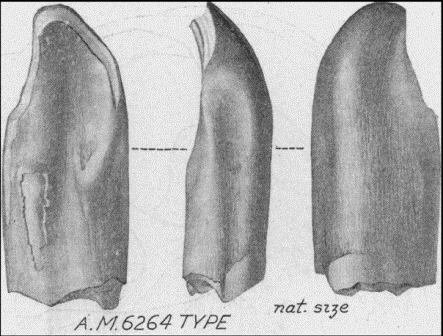
Asiatosaurus is an extinct genus of herbivorous sauropod dinosaur that lived during the Early Cretaceous period in what is now Mongolia and China. The genus is known primarily from teeth, with the type species, Asiatosaurus mongoliensis, and another species, Asiatosaurus kwangshiensis, both being classified as nomina dubia due to the scant nature of their fossil remains. Despite its limited fossil evidence, Asiatosaurus holds significance as the first sauropod genus named from East Asia.

Astrodon
Astrodon was a large herbivorous sauropod dinosaur that lived in what is now the eastern United States during the Early Cretaceous period. Fossils of this genus were discovered in Maryland and are estimated to be around 110 to 112 million years old. Its scientific name, Astrodon johnstoni, refers to the star-shaped cross-section found when one of its teeth was cut.