
Astrodon
Herbivore·Early Cretaceous·Maryland, USA·Quadrupedal
Astrodon was a large herbivorous sauropod dinosaur that lived in what is now the eastern United States during the Early Cretaceous period. Fossils of this genus were discovered in Maryland and are estimated to be around 110 to 112 million years old. Its scientific name, Astrodon johnstoni, refers to the star-shaped cross-section found when one of its teeth was cut.
Key Facts
- ›Astrodon was a large herbivorous sauropod dinosaur.
- ›It lived during the Early Cretaceous period.
- ›Fossils have been found in the Arundel Formation in Maryland.
- ›The genus was named by Christopher Johnston in 1859.
- ›The type species, Astrodon johnstoni, was named by Joseph Leidy in 1865.
- ›Astrodon is the state dinosaur of Maryland.

- Estimated Length of 20 m
- Estimated Height of 9 m
- Estimated Body Mass of 20 Metric Tons
- Teeth With A Characteristic Star-Formed Cross-Section
Pleurocoelus Nanus, Pleurocoelus Altus
United States
About Astrodon
Astrodon is a genus of large herbivorous sauropod dinosaur that roamed the Earth during the Early Cretaceous period. Measuring an impressive 20 meters (66 feet) in length and reaching an estimated body mass of 20 metric tons (22 short tons), Astrodon was one of the larger herbivores of its time. Its fossils have primarily been unearthed in the Arundel Formation of Maryland, in the eastern United States, with dating placing its existence around 110 to 112 million years ago.
Discovery and Naming
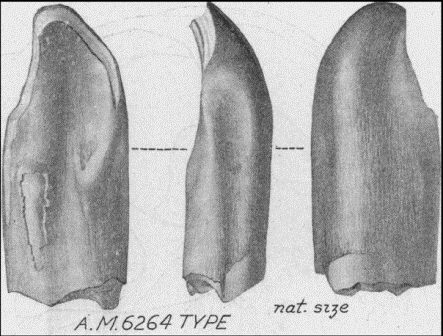
The first discovery of Astrodon fossils occurred in 1858 when two dinosaur teeth were found in an iron ore pit in Maryland. Chemist Philip Thomas Tyson brought these teeth to the attention of dentist Christopher Johnston, who noted a unique star-shaped cross-section in one of the teeth. Johnston named the genus Astrodon in 1859, derived from Greek words meaning 'star tooth'. Although Johnston did not assign a specific epithet, Joseph Leidy is credited with naming the type species, Astrodon johnstoni, in 1865. If Johnston had named a species, it would have been the second dinosaur species identified in the United States.
Taxonomy and Species
The taxonomic history of Astrodon is complex, with several species and genera being assigned to it over time. O. C. Marsh named Pleurocoelus nanus and P. altus from bones found in the Arundel Formation. Later, paleontologists like John Bell Hatcher and Charles W. Gilmore proposed that these species were synonymous with Astrodon johnstoni, suggesting that the different names represented different growth stages of the same dinosaur. However, this synonymization remains a subject of debate among scientists. Some researchers argue that the available fossil material, particularly the type specimens, lacks definitive diagnostic features to clearly distinguish Astrodon from other sauropods or to confirm the synonymy with Pleurocoelus. Consequently, some paleontologists consider Astrodon johnstoni, Pleurocoelus nanus, and P. altus to be nomina dubia (doubtful names).
Paleoecology and Habitat
Astrodon inhabited a paleoenvironment characterized by broad, generally flat plains crisscrossed by streams, likely resembling modern-day coastal regions of the southeastern United States. This environment was situated along the edge of the expanding Atlantic Ocean basin. During the Early Cretaceous, the region preserved in the Arundel Formation supported a diverse ecosystem. Astrodon shared its habitat with various dinosaurs, including coelurosaurs, ankylosaurs like Priconodon crassus, nodosaurids, possible basal ceratopsians, and ornithopods such as Tenontosaurus. It coexisted with large theropods like Acrocanthosaurus atokensis, which likely served as apex predators. The flora of the time included trees, cycads, and conifers.
Fossil material assigned to Astrodon has also been found in Oklahoma, within the Antlers Formation, which dates to approximately 110 million years ago. Here, Astrodon lived alongside other dinosaurs like the sauropod Sauroposeidon proteles and the dromaeosaurid Deinonychus antirrhopus, as well as Acrocanthosaurus atokensis. The ornithopod Tenontosaurus was the most common dinosaur in this paleoenvironment.
Cultural Significance
Astrodon holds a special place in American paleontology and culture. In 1998, Astrodon johnstoni was designated the official state dinosaur of Maryland. It also previously held the title of state dinosaur for Texas before being replaced by Sauroposeidon. Life-sized models of Astrodon are on display at institutions such as the North Carolina Museum of Natural Sciences and the Maryland Science Center, allowing the public to visualize this ancient giant.
Source: Wikipedia ↗
Frequently Asked Questions
What does Astrodon mean?
The name Astrodon comes from Greek words meaning 'star tooth'. This refers to the distinctive star-shaped cross-section observed when its teeth were cut.
When did Astrodon live?
Astrodon lived during the Early Cretaceous period, approximately 110 to 112 million years ago.
Where were Astrodon fossils found?
The primary discovery location for Astrodon fossils is the Arundel Formation near Muirkirk, Maryland, in the eastern United States. Fossils have also been found in Oklahoma.
What did Astrodon eat?
Astrodon was a herbivorous dinosaur, meaning it primarily ate plants.
How large was Astrodon?
Astrodon is estimated to have been a large dinosaur, measuring around 20 meters (66 feet) in length and weighing about 20 metric tons (22 short tons).
Is Astrodon the same as Pleurocoelus?
Some paleontologists have argued that Pleurocoelus is a junior synonym of Astrodon, meaning they are the same genus. However, this interpretation is not universally accepted, with some researchers considering the material of both genera to be undiagnostic.
Related Dinosaur species

Amargasaurus
Amargasaurus is a genus of sauropod dinosaur that lived in what is now Argentina during the Early Cretaceous epoch. It is distinguished by two parallel rows of tall spines running down its neck and back, a feature unique among known sauropods. While relatively small for a sauropod, Amargasaurus was a herbivore with a body plan typical of its group, characterized by a long tail, short neck, and barrel-shaped trunk.

Aragosaurus
Aragosaurus was a large, quadrupedal, herbivorous sauropod dinosaur that lived during the Early Cretaceous period in what is now Spain. With an estimated length of 18 meters and a weight of 25 tonnes, it possessed a long neck, a powerful tail, and a bulky body, similar in build to Camarasaurus. Its large, wide teeth were adapted for slicing leaves and branches from tall conifer trees.
Asiatosaurus
Asiatosaurus is an extinct genus of herbivorous sauropod dinosaur that lived during the Early Cretaceous period in what is now Mongolia and China. The genus is known primarily from teeth, with the type species, Asiatosaurus mongoliensis, and another species, Asiatosaurus kwangshiensis, both being classified as nomina dubia due to the scant nature of their fossil remains. Despite its limited fossil evidence, Asiatosaurus holds significance as the first sauropod genus named from East Asia.