
Archaeoraptor
Unknown (composite fossil)·Cretaceous·China·Unknown (composite fossil)
Archaeoraptor is the informal name given to a fossil specimen from China that was presented as a transitional fossil between birds and dinosaurs. Scientific investigation revealed it to be a chimera, a fraudulent composite made from pieces of different, genuine fossils. This discovery led to significant controversy and highlighted issues within the illegal fossil trade.
Key Facts
- ›The "Archaeoraptor" fossil was a composite, or forgery, made from parts of at least three different specimens.
- ›The head and upper body fragments belonged to the primitive fossil bird Yanornis.
- ›The tail was identified as belonging to the dromaeosaurid dinosaur Microraptor.
- ›The legs and feet were from an as-yet unidentified animal.
- ›National Geographic published an article in 1999 describing it as a "missing link" between birds and dinosaurs.
- ›Subsequent studies and internal investigations confirmed the specimen's fraudulent nature.

- Composite fossil fabricated from multiple specimens.
- Original publication suggested a link between birds and dinosaurs.
- Components included bird-like upper body, dromaeosaur tail, and unknown legs/feet.
Yanornis, Microraptor
China
About Archaeoraptor
What is Archaeoraptor?
Archaeoraptor is the informal designation for a fossil specimen that gained notoriety in 1999 when featured in National Geographic magazine as a purported "missing link" between terrestrial theropod dinosaurs and birds. This fossil, originating from China, was presented as a significant discovery that could elucidate the evolutionary connection between these groups. However, even before its popular unveiling, significant doubts about its authenticity were raised.
Scandal and Exposure
The story of Archaeoraptor began with farmers in China illegally excavating shale pits and selling fossils. One farmer is believed to have assembled a composite fossil from a bird specimen with feather impressions, a feathered tail, and legs, cementing them together to create a more complete-looking specimen. This assembled fossil was smuggled to the United States and eventually purchased by a museum.
Further scientific examination revealed the fossil to be a chimera, a fraudulent construction. The head and upper body fragments were identified as belonging to the primitive fossil bird Yanornis. The tail was later determined to be from a small, winged dromaeosaurid dinosaur, Microraptor, which was formally named in 2000. The legs and feet were from an entirely different, as yet unidentified, animal.
Impact and Legacy
The publication of Archaeoraptor in National Geographic without rigorous peer review led to widespread scientific controversy. While Archaeoraptor itself was a forgery, the scandal inadvertently highlighted the existence of numerous genuine feathered dinosaur fossils that were being discovered and demonstrated the evolutionary link between birds and theropods. The case also drew attention to the illegal fossil trade and the ethical issues surrounding the scientific description and popularization of fossils obtained under questionable circumstances.
Source: Wikipedia ↗
Frequently Asked Questions
What was Archaeoraptor?
Archaeoraptor is the informal name given to a fossil specimen that was presented as a significant discovery linking birds and dinosaurs. However, it was later proven to be a composite forgery made from different fossils.
Was Archaeoraptor a real dinosaur?
The fossil specimen known as Archaeoraptor was not a single, real dinosaur. It was a fraudulent creation assembled from parts of genuine fossils from different species, including a bird and a dromaeosaur.
Who discovered Archaeoraptor?
The fossil was found by farmers in China and assembled by one of them before being sold. Paleontologists Phil Currie and Xu Xing were involved in its later study and exposure as a forgery, while National Geographic published the initial popular account.
What did the Archaeoraptor fossil consist of?
The head and upper body of the Archaeoraptor fossil were identified as belonging to the primitive bird Yanornis. The tail was found to be from a dromaeosaurid dinosaur called Microraptor, and the legs and feet were from an unknown animal.
Why was Archaeoraptor considered a "missing link"?
National Geographic promoted the Archaeoraptor fossil as a "missing link" because its fabricated appearance combined features of both birds (feathers, bird-like body) and theropod dinosaurs (toothed jaw, long tail), suggesting a transitional form.
What happened to the Archaeoraptor fossil?
After its exposure as a forgery, the Archaeoraptor fossil was returned to China in June 2000. It has since been exhibited alongside its component fossils, Yanornis and Microraptor.
What was the impact of the Archaeoraptor scandal?
The Archaeoraptor scandal brought significant attention to the illegal fossil trade in China and the potential for fossil forgery. It also spurred further research into feathered dinosaurs and the evolution of birds.
Related Dinosaur species
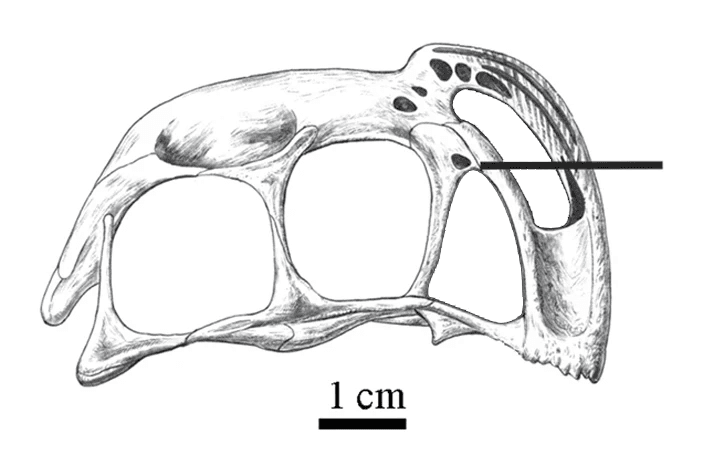
Banji
Banji is an extinct genus of oviraptorid dinosaur that lived approximately 66 million years ago in what is now China. This small, lightly built, ground-dwelling carnivore is known for its distinctive tall, crested skull with unique vertical striations.

Caudipteryx
Caudipteryx was a genus of small, feathered oviraptorosaurian dinosaurs that inhabited China during the Early Cretaceous period. Known for its bird-like appearance, it featured a stout trunk, long legs, and a beak-like snout, with some paleontologists even suggesting it was a bird. Its discovery provided significant evidence for the evolutionary link between birds and dinosaurs.

Changmiania
Changmiania is a genus of basal ornithopod dinosaur discovered in China, living during the Early Cretaceous period. Known from two near-complete articulated skeletons, it is distinguished by unique anatomical features and a short neck. Its fossils suggest it may have been a burrowing animal, potentially buried alive during a volcanic eruption.