
Banji
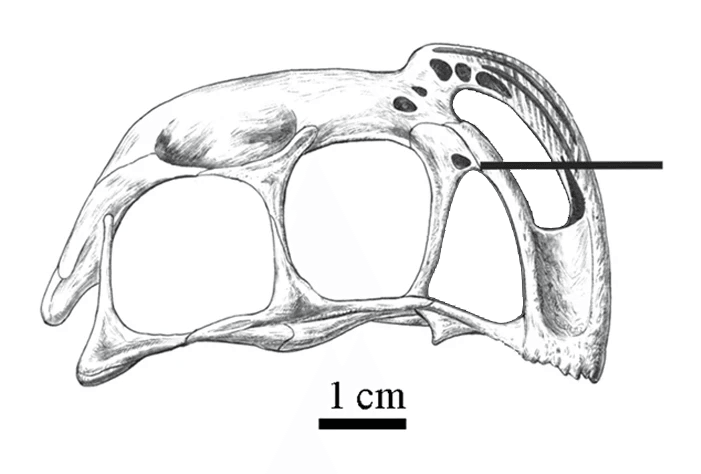
Banji is an extinct genus of oviraptorid dinosaur that lived approximately 66 million years ago in what is now China. This small, lightly built, ground-dwelling carnivore is known for its distinctive tall, crested skull with unique vertical striations.
Key Facts
- ›Lived approximately 66 million years ago during the late Cretaceous Period.
- ›Fossils were discovered in China, likely from the Nanxiong Formation.
- ›Possessed a tall, crested skull adorned with vertical striations.
- ›Had an unusually long nasal opening that followed the curve of the crest.
- ›Considered a juvenile individual of Corythoraptor by some researchers.
- ›Was a small, bipedal carnivore.
Small, Lightly Built, Ground-Dwelling, Tall, Crested Skull, Crest Adorned With Vertical Striations, Unusually Long Nasal Opening
Corythoraptor
China
About Banji
Banji is an extinct genus of oviraptorid dinosaur that roamed the Earth approximately 66 million years ago, during the latter part of the Cretaceous Period. Its fossils have been discovered in what is now China, specifically from deposits believed to be part of the Nanxiong Formation, dating to the Cretaceous–Paleogene boundary.
Discovery and Naming
The defining specimen of Banji, known as the holotype IVPP V 16896, consists of a nearly complete skull and lower jaw. This fossil was acquired by the Chinese Institute of Vertebrate Paleontology and Paleoanthropology. The genus and species, Banji long, were formally described and named in 2010 by paleontologists Xu Xing and Feng-Lu Han. The name is derived from Chinese, meaning 'striped crest dragon', a reference to a prominent feature of its skull.
Description and Characteristics
Banji was a small, lightly built, ground-dwelling dinosaur that moved on two legs. As a juvenile, it was estimated to be about 65 centimeters (2.1 feet) in length. A key characteristic of Banji is its tall, crested skull, a feature shared with other oviraptorids. Uniquely, the sides of this crest are marked with a series of vertical striations, and the top of its lower jaw also features grooves. Furthermore, Banji possessed an unusually long nasal opening that extended close to the eye socket, following the curve of the crest.
Taxonomic Considerations
In 2024, paleontologist Andrea Cau proposed that Banji might represent an immature individual of the contemporary oviraptorid dinosaur Corythoraptor. This interpretation suggests that Banji could be a senior synonym of Corythoraptor, meaning Corythoraptor would be the valid name and Banji would be considered the same animal at a different life stage. This hypothesis is based on shared unique skull characteristics, with the distinguishing features between the two taxa potentially being ontogenetically variable.
Source: Wikipedia ↗
Frequently Asked Questions
When did Banji live?
Banji lived approximately 66 million years ago, during the later part of the Cretaceous Period. This places it near the Cretaceous–Paleogene boundary.
Where were Banji fossils found?
The holotype specimen of Banji was recovered near the city of Ganzhou in Jiangxi Province, China. The rock encasing the fossil suggests it is from the Nanxiong Formation.
What did Banji look like?
Banji was a small, lightly built, ground-dwelling dinosaur. It was distinguished by a tall, crested skull with unique vertical striations on its sides and an unusually long nasal opening.
What is the meaning of the name Banji?
The scientific name Banji long (斑嵴 龍) is derived from Chinese, meaning 'striped crest dragon'. This refers to the distinctive striped crest on its skull.
Is Banji considered a distinct dinosaur species?
Some researchers, like Andrea Cau in 2024, have considered Banji to be an immature individual of the contemporary dinosaur Corythoraptor. This would make Banji a senior synonym of Corythoraptor, meaning it would no longer be considered a separate genus.
What did Banji eat?
Banji is described as a carnivore. However, specific details about its diet beyond this classification are not provided.
Related Dinosaur species

Asiatyrannus
Asiatyrannus is an extinct genus of tyrannosaurine theropod dinosaur that lived during the Late Cretaceous period in what is now China. Known from a single specimen including a skull and partial skeleton, it is distinguished by its deep-snouted skull and relatively small body size compared to some contemporary tyrannosaurs. However, its validity as a distinct genus has been questioned, with some researchers suggesting it may represent a juvenile individual of the more well-known genus Tarbosaurus.
Caihong
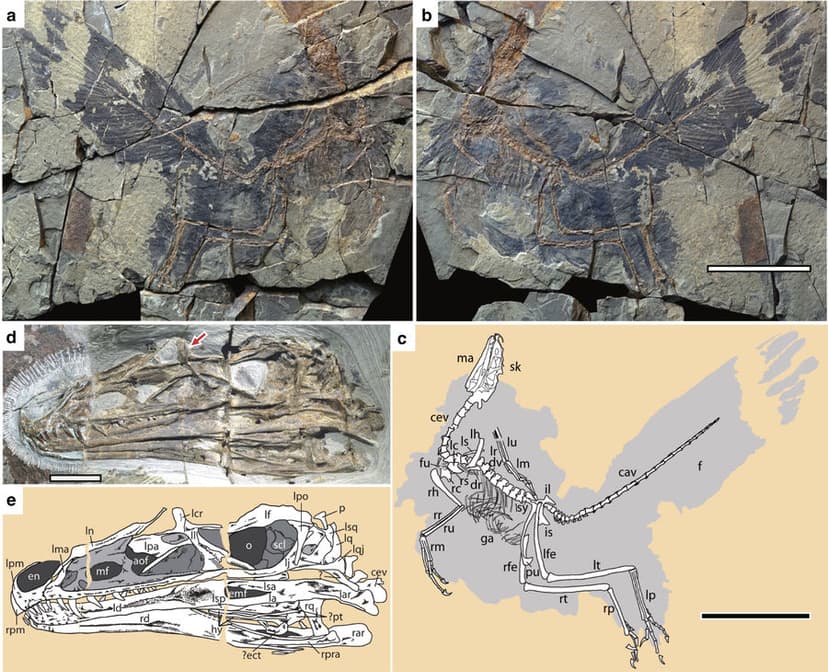
Caihong is a small paravian theropod dinosaur discovered in China, living during the Late Jurassic period. Its name, meaning 'rainbow' in Mandarin, reflects the spectacular preservation of its fossil, which includes soft tissues and extensive plumage. This well-preserved specimen offers significant insights into the evolution of feathered dinosaurs.
Changzhousaurus
Changzhousaurus is a small, extinct paravian theropod dinosaur from the Early Cretaceous period of China. It is known from a nearly complete skeleton that showcases extensive feathering, including wing-like structures on its forelimbs and hindlimbs, and a tail fan. Its exact evolutionary relationships remain unclear due to a mosaic of anatomical features found in its fossils.