
Argentinosaurus
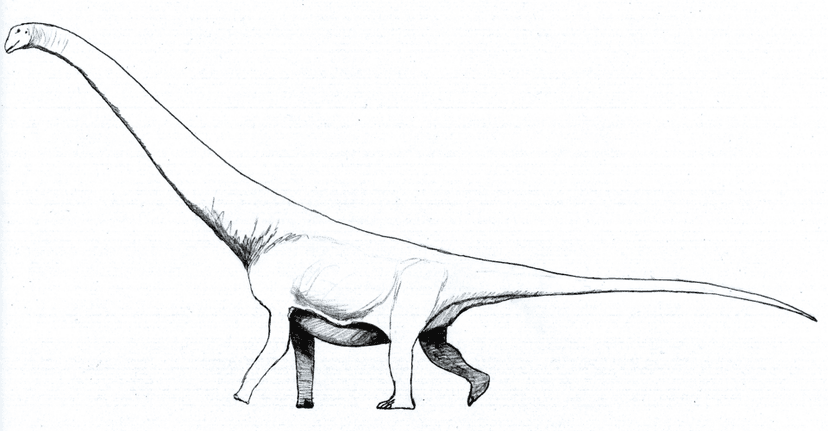
Argentinosaurus, meaning "lizard from Argentina," was a colossal titanosaurian sauropod dinosaur that roamed what is now Argentina during the Late Cretaceous period. Despite its fragmentary fossil remains, it is recognized as one of the largest land animals ever to have lived, with estimated lengths of 30-35 meters and weights ranging from 65 to 80 tons. Its immense size and characteristics place it within the dominant group of sauropods of its era.
Key Facts
- ›Argentinosaurus lived during the Late Cretaceous period.
- ›Its name translates to "lizard from Argentina."
- ›It is considered one of the largest land animals known, with lengths up to 35 meters.
- ›Fossils were discovered in the Huincul Formation of Argentina.
- ›It belonged to the titanosaurian group of sauropods.
- ›The species is known from fragmentary remains, including vertebrae and a femur.

- Estimated length of 30–35 meters.
- Estimated weight of 65–80 tonnes.
- Enormous dorsal vertebrae, up to 159 cm in height.
- Femur approximately 2.5 meters long.
- Possessed camellate bone structure in vertebrae, with air-filled chambers.
Andesaurus, Epachthosaurus, Saltasaurus, Futalognkosaurus, Patagotitan
South America
About Argentinosaurus
Argentinosaurus, a name meaning "Argentine lizard," stands as one of the most colossal land animals ever to have walked the Earth. This immense dinosaur lived during the Late Cretaceous period, inhabiting the region that is now Argentina. While its fossil record is incomplete, paleontological estimates place its length between 30 to 35 meters (98 to 115 feet) and its weight between a staggering 65 to 80 metric tons (72 to 88 short tons). Argentinosaurus belonged to the Titanosauria, a group that represented the dominant sauropods of the Cretaceous era.
Discovery and Naming
The journey to understand Argentinosaurus began in 1987 when a farmer discovered the first bone on his land near Plaza Huincul. Subsequent excavations, led by Argentine paleontologist José Bonaparte, unearthed crucial remains including several dorsal vertebrae and parts of the sacrum. Additional discoveries, such as a complete femur, have contributed to our knowledge. The genus and species, Argentinosaurus huinculensis, were formally described and named by Bonaparte and Rodolfo Coria in 1993, with the specific name honoring the town of Plaza Huincul.
Physical Characteristics and Paleobiology
Reconstructing Argentinosaurus is challenging due to the fragmentary nature of its fossils. However, the known remains, such as its enormous vertebrae measuring up to 159 centimeters (63 inches) in height, attest to its gigantic scale. The femur, measuring approximately 2.5 meters (8.2 feet) long, further emphasizes its immense size. Like other titanosaurs, Argentinosaurus likely possessed a lightweight skeletal structure facilitated by air-filled cavities within its bones, an adaptation for supporting its massive body. Paleobiological studies suggest that such colossal size offered protection against predators and allowed for efficient nutrient extraction from food. It is estimated that Argentinosaurus reached sexual maturity around 8-10 years old and physical maturity by 20, with an estimated lifespan of about 30 years. Its diet consisted of plants, making it a herbivore.
Source: Wikipedia ↗
Frequently Asked Questions
What does the name Argentinosaurus mean?
The name Argentinosaurus means "lizard from Argentina." It refers to the country where its fossils were discovered and its reptilian nature.
When did Argentinosaurus live?
Argentinosaurus lived during the Late Cretaceous period. The fossils were recovered from the Huincul Formation, dating to approximately 97 to 93.5 million years ago.
How large was Argentinosaurus?
Argentinosaurus was one of the largest land animals known. Estimates suggest it measured between 30 to 35 meters (98 to 115 feet) long and weighed between 65 to 80 metric tons (72 to 88 short tons).
What group of dinosaurs did Argentinosaurus belong to?
Argentinosaurus was a member of Titanosauria, which was the dominant group of sauropods during the Cretaceous period. Titanosaurs are characterized by their immense size and unique anatomical features.
Where were the fossils of Argentinosaurus found?
The first bone of Argentinosaurus was discovered on a farm near Plaza Huincul in Neuquén Province, Argentina. The fossils were recovered from the Huincul Formation in that region.
What is known about the physical characteristics of Argentinosaurus?
Due to its fragmentary remains, exact details are scarce. However, it possessed enormous vertebrae, with one dorsal vertebra measuring 159 cm (63 in) in height and 129 cm (51 in) in width. It also had a complete femur measuring 2.5 meters (8.2 ft) long.
Related Dinosaur species
Andesaurus
Andesaurus is a genus of basal titanosaurian sauropod dinosaur that lived in South America during the middle Cretaceous Period. Characterized by its long neck, long tail, and medium size for a sauropod, Andesaurus is considered one of the most primitive members of the Titanosauria clade. Its fossils have been discovered in Argentina.

Aeolosaurus
Aeolosaurus was a genus of titanosaurian sauropod dinosaur that lived in South America during the Late Cretaceous Period. Characterized by a long neck and tail, it was a quadrupedal herbivore. The genus is well-represented, with remains from several individuals belonging to at least two species, though no skull material has been recovered.

Amargasaurus
Amargasaurus is a genus of sauropod dinosaur that lived in what is now Argentina during the Early Cretaceous epoch. It is distinguished by two parallel rows of tall spines running down its neck and back, a feature unique among known sauropods. While relatively small for a sauropod, Amargasaurus was a herbivore with a body plan typical of its group, characterized by a long tail, short neck, and barrel-shaped trunk.