
Andesaurus
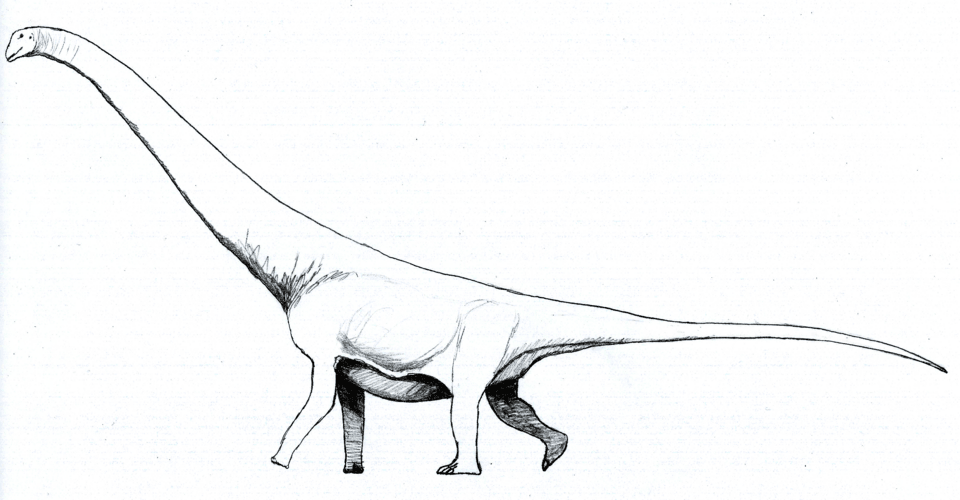
Andesaurus is a genus of basal titanosaurian sauropod dinosaur that lived in South America during the middle Cretaceous Period. Characterized by its long neck, long tail, and medium size for a sauropod, Andesaurus is considered one of the most primitive members of the Titanosauria clade. Its fossils have been discovered in Argentina.
Key Facts
- ›Andesaurus existed during the middle of the Cretaceous Period.
- ›It was a basal titanosaurian sauropod dinosaur.
- ›Fossils were discovered in the Candeleros Formation in Argentina.
- ›Estimated length ranges from 15 to 18 meters, with a body mass of around 7 metric tons.
- ›Its tail vertebrae had slightly procoelous articulation, a primitive titanosaur feature.
- ›Andesaurus possessed a small head on a long neck and an equally long tail.
- Medium-sized sauropod
- Small head
- Long neck
- Long tail
- Opisthocoelous dorsal vertebrae with large lateral pleurocoels
- Slightly procoelous tail vertebrae with less prominent convexity than derived titanosaurs
- Tall neural spines on back vertebrae
Saltasaurus, Argentinosaurus, Puertasaurus, Epachthosaurus, Phuwiangosaurus, Malawisaurus
South America
About Andesaurus
Andesaurus is a genus of basal titanosaurian sauropod dinosaur that inhabited South America during the middle Cretaceous Period. This dinosaur is known from a partial skeleton discovered in the Candeleros Formation of Argentina, which dates to the Cenomanian stage, approximately 99.6 to 97 million years ago. The name Andesaurus, meaning 'Andes lizard,' reflects the proximity of its fossil remains to the Andes mountain range.
Description and Physical Characteristics
Andesaurus was a medium-sized sauropod, with estimated total lengths ranging from 15 to 18 meters (49 to 59 feet) and a body mass of around 7 metric tons (7.7 short tons). Like other sauropods, it would have possessed a small head situated at the end of a long neck, balanced by an equally long tail. The dorsal vertebrae exhibit opisthocoelous centra and large lateral pleurocoels, which are pneumatic depressions. A distinctive feature, potentially diagnostic for Andesaurus, is an additional ridge supporting the lower articulation for the ribs on its vertebrae. Its tail vertebrae, or caudals, are slightly procoelous, meaning the anterior face is concave and the posterior face is convex, though this convexity is less pronounced than in more derived titanosaurs. The articulations between its tail vertebrae are considered a primitive trait, characteristic of early titanosaurs.
Classification and Paleoecology
Andesaurus is classified as one of the most basal members of the Titanosauria, a diverse group of sauropod dinosaurs. This classification is based on several plesiomorphic (primitive) features, particularly in its vertebral articulations. The Candeleros Formation, where Andesaurus fossils were found, represents an ancient braided river system. This environment was also home to other dinosaurs, including the theropods Buitreraptor and Giganotosaurus, as well as the rebbachisaurid sauropod Limaysaurus.
Discovery
The fossils of Andesaurus were discovered by Alejandro Delgado, after whom the sole known species, Andesaurus delgadoi, is named. The genus and species were formally described and named in 1991 by paleontologists Jorge Orlando Calvo and José Fernando Bonaparte. The known material consists of a partial skeleton including several vertebrae from the lower back and tail, elements of the pelvis, rib fragments, and incomplete limb bones.
Source: Wikipedia ↗
Frequently Asked Questions
What does the name Andesaurus mean?
The name Andesaurus means 'Andes lizard'. It refers to the Andes mountain range, near where its fossils were discovered, and the Greek word 'sauros' meaning 'lizard'.
Where were Andesaurus fossils found?
The fossils of Andesaurus were found in the Candeleros Formation, located in Neuquén Province, Argentina. This formation is part of the Neuquén Group.
What period did Andesaurus live in?
Andesaurus lived during the middle of the Cretaceous Period, specifically the Cenomanian stage, approximately 99.6 to 97 million years ago.
How big was Andesaurus?
Andesaurus was a medium-sized sauropod. Estimates suggest a length of 15 to 18 meters (49 to 59 feet) and a body mass of around 7 metric tons (7.7 short tons).
What is significant about Andesaurus's classification?
Andesaurus is considered one of the most basal (primitive) known members of the Titanosauria. Its tail vertebrae articulation, being flat on both ends (amphiplatyan), is a primitive trait not seen in more derived titanosaurs.
What other dinosaurs lived alongside Andesaurus?
The Candeleros Formation, where Andesaurus fossils were found, also contains remains of theropods such as Buitreraptor and Giganotosaurus, and other sauropods like Limaysaurus.
Related Dinosaur species

Argentinosaurus
Argentinosaurus, meaning "lizard from Argentina," was a colossal titanosaurian sauropod dinosaur that roamed what is now Argentina during the Late Cretaceous period. Despite its fragmentary fossil remains, it is recognized as one of the largest land animals ever to have lived, with estimated lengths of 30-35 meters and weights ranging from 65 to 80 tons. Its immense size and characteristics place it within the dominant group of sauropods of its era.

Aeolosaurus
Aeolosaurus was a genus of titanosaurian sauropod dinosaur that lived in South America during the Late Cretaceous Period. Characterized by a long neck and tail, it was a quadrupedal herbivore. The genus is well-represented, with remains from several individuals belonging to at least two species, though no skull material has been recovered.

Amargasaurus
Amargasaurus is a genus of sauropod dinosaur that lived in what is now Argentina during the Early Cretaceous epoch. It is distinguished by two parallel rows of tall spines running down its neck and back, a feature unique among known sauropods. While relatively small for a sauropod, Amargasaurus was a herbivore with a body plan typical of its group, characterized by a long tail, short neck, and barrel-shaped trunk.