
Blikanasaurus
Blikanasaurus is a genus of sauropodomorph dinosaur that lived in South Africa during the Late Triassic period. It is known only from partial hindlimb bones, which suggest it was a robust, quadrupedal animal. Due to the fragmentary nature of its fossils, much about its anatomy and classification remains uncertain.
Key Facts
- ›Blikanasaurus lived during the Late Triassic.
- ›Its fossils were discovered in South Africa.
- ›It is known from incomplete hindlimb bones.
- ›It is hypothesized to have been a quadruped.
- ›The genus name means 'lizard from Blikana'.
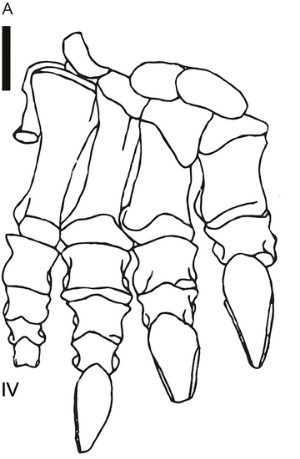
Robust Hindlimb Anatomy, Thickly Set and Robust Build
South Africa
About Blikanasaurus
Blikanasaurus is a genus of sauropodomorph dinosaur that roamed the land now known as South Africa during the Late Triassic period. The scientific name, Blikanasaurus cromptoni, pays tribute to both its discovery location, derived from Greek for 'lizard from Blikana,' and the notable American paleontologist A.W. 'Fuzz' Crompton, who significantly contributed to South African fossil exploration.
Discovery and Fossils
The fossil record of Blikanasaurus is notably sparse, consisting primarily of partial hindlimb bones. The first specimen, including an epipodium and pes, was found around 1965 at the foot of Blikana mountain in the Eastern Cape. A second, even more limited specimen—a right metatarsal—was later recovered from deposits in the eastern Free State in the early 2000s. A possible ilium has been attributed to the genus, but its identification requires further confirmation.
Description and Classification
Due to the incomplete nature of its fossils, understanding of Blikanasaurus's full anatomy is limited. However, the hindlimb bones that have been recovered are described as heavily built, suggesting that the dinosaur possessed a robust and thickly set physique. This robust build has led to the hypothesis that Blikanasaurus was an obligate quadruped, meaning it walked on all fours. While this characteristic initially led some to classify it as a basal sauropod, current scientific consensus places Blikanasaurus within the broader sauropodomorph group, albeit as a basal member. The establishment of a distinct family, Blikanasauridae, has been proposed but has not gained widespread formal acceptance due to a lack of definitive diagnostic taxa.
Source: Wikipedia ↗
Frequently Asked Questions
What does the name Blikanasaurus mean?
The generic name Blikanasaurus is derived from Greek, meaning 'lizard from Blikana'. The species name, cromptoni, honors American paleontologist A.W. 'Fuzz' Crompton.
Where were Blikanasaurus fossils found?
Fossils of Blikanasaurus have been recovered from the lower Elliot Formation in South Africa. This includes finds in the Eastern Cape and the eastern Free State.
What do the fossils tell us about Blikanasaurus's appearance?
The known fossils consist of partial hindlimb bones. These bones are heavily built, suggesting that Blikanasaurus was a thickly set and robust dinosaur.
How did Blikanasaurus move?
Based on its robust hindlimb anatomy, Blikanasaurus is hypothesized to have been an obligate quadruped, meaning it walked on all fours.
What group of dinosaurs does Blikanasaurus belong to?
Blikanasaurus is considered a basal sauropodomorph. While initially thought to be a basal sauropod due to its build, further classification remains challenging.
Related Dinosaur species
Arcusaurus
Arcusaurus is an extinct genus of sauropodomorph dinosaur that lived during the Early Jurassic period in what is now South Africa. Named for the "Rainbow Nation," Arcusaurus is known from fossil remains, including a partial skull and other skeletal elements, indicating it was a basal sauropodomorph.

Aristosaurus
Aristosaurus is a dubious genus of sauropodomorph dinosaur from the Early Jurassic of southern Africa, known from a single, nearly complete skeleton. Initially described as Aristosaurus erectus, it was later considered a synonym of Gyposaurus or a juvenile Massospondylus, but recent reviews classify it as an indeterminate sauropodomorph.

Antetonitrus
Antetonitrus is a genus of sauropodiform dinosaur that lived during the Early Jurassic period in what is now South Africa. It is considered a basal sauropod, providing important insights into the origin and early evolution of this group. While quadrupedal and herbivorous like its later relatives, Antetonitrus retained primitive adaptations in its forelimbs that allowed for grasping.