
Bajadasaurus
Bajadasaurus was a herbivorous sauropod dinosaur from the Early Cretaceous period of Patagonia, Argentina. It is notable for its extremely elongated, bifurcated neural spines on its neck vertebrae, which likely served a defensive purpose. The creature possessed a slender skull with pencil-shaped teeth concentrated at the front of its jaws.
Key Facts
- ›Lived during the Early Cretaceous epoch, approximately 145 to 132.9 million years ago.
- ›Discovered in northern Patagonia, Argentina, based on a single, well-preserved specimen.
- ›Belonged to the Dicraeosauridae family, characterized by relatively small size and short necks.
- ›Featured exceptionally long, two-pronged neural spines on its neck vertebrae.
- ›Had a slender skull with pencil-shaped teeth located at the front of its jaws.
- ›Likely used its neck spines as a passive defense against predators.

- Slender skull with pencil-shaped teeth concentrated at the front of the jaws.
- Extremely elongated, bifurcated neural spines on neck vertebrae.
- Relatively small for a sauropod, comparable in size to Asian elephants.
- Short neck compared to many other sauropods.
Amargasaurus, Dicraeosaurus, Brachytrachelopan, Suuwassea, Lingwulong
South America
About Bajadasaurus
Bajadasaurus is a genus of herbivorous sauropod dinosaur that roamed the Earth during the Early Cretaceous epoch, approximately 145 to 132.9 million years ago. Its fossils were discovered in northern Patagonia, Argentina, with the first description published in 2019 based on a remarkably complete specimen that includes its skull and parts of its neck. Bajadasaurus belongs to the Dicraeosauridae family, a group of sauropods known for their relatively smaller size and shorter necks compared to many other long-necked dinosaurs.
Physical Characteristics and Adaptations
The most striking feature of Bajadasaurus is its extraordinary neck ornamentation. It possessed extremely elongated, bifurcated (two-pronged) neural spines extending from its neck vertebrae. These spines, some measuring up to 58 cm (1 ft 11 in) in length, were likely covered by a keratinous sheath and may have served as a passive defense against predators. The skull of Bajadasaurus was slender, featuring around 48 pencil-shaped teeth that were concentrated at the front of its jaws. The eye openings were positioned in such a way that they were visible from above, potentially allowing the dinosaur to see forward while feeding.
Discovery and Classification
The sole specimen of Bajadasaurus was excavated in 2010 from the Bajada Colorada Formation by paleontologists from CONICET. The fossils were carefully extracted as a large block of rock and bone to preserve its fragile nature. The genus was formally described and named by Pablo Gallina and colleagues in 2019. Bajadasaurus is classified within the Dicraeosauridae family, a subgroup of Diplodocoidea. It shares this family with other notable genera like Amargasaurus and Dicraeosaurus, though phylogenetic analyses have placed Bajadasaurus at slightly different positions within the family's evolutionary tree.
Palaeobiology and Environment
As a herbivore, Bajadasaurus likely fed on low-lying vegetation. The unique structure of its neck spines has led to speculation about their function, with passive defense being a primary hypothesis. The forward curvature of the spines may have presented a formidable barrier to potential predators. Bajadasaurus shared its environment with other dinosaurs, including other sauropods like Leinkupal and Ninjatitan, and various theropods. The sedimentary rocks of the Bajada Colorada Formation indicate that it inhabited an area with braided river systems.
Source: Wikipedia ↗
Frequently Asked Questions
When did Bajadasaurus live?
Bajadasaurus lived during the Early Cretaceous epoch, specifically from the late Berriasian to Valanginian stages, which spans from approximately 145 to 132.9 million years ago.
Where was Bajadasaurus discovered?
The only known specimen of Bajadasaurus was discovered in the Bajada Colorada Formation in northern Patagonia, Argentina.
What is the most distinctive feature of Bajadasaurus?
Bajadasaurus is most famous for its extremely elongated, bifurcated (two-pronged) neural spines that extended from its neck vertebrae. These spines were a unique and striking characteristic of the dinosaur.
What did Bajadasaurus eat?
Bajadasaurus was a herbivore, as indicated by its classification as a sauropod dinosaur. Its skull was equipped with pencil-shaped teeth concentrated at the front of its jaws, suitable for cropping vegetation.
What is the scientific name of Bajadasaurus?
The scientific name for this dinosaur is Bajadasaurus pronuspinax.
What group of dinosaurs did Bajadasaurus belong to?
Bajadasaurus is classified as a member of the Dicraeosauridae family, which is a group of relatively small and short-necked sauropods.
Related Dinosaur species
Anabisetia
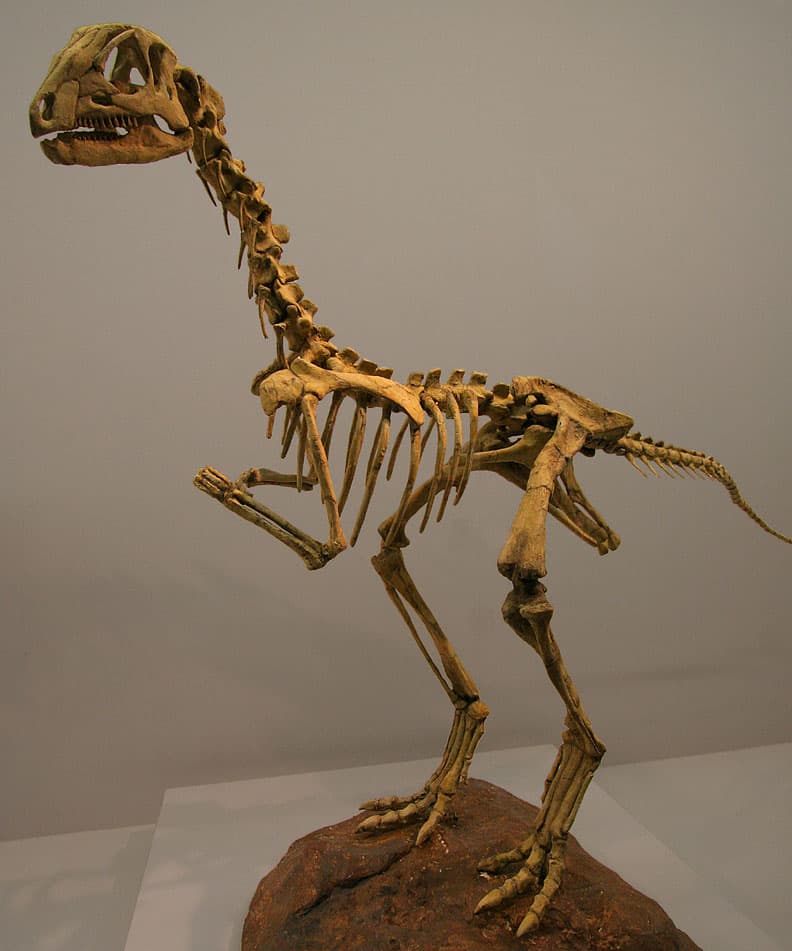
Anabisetia is a genus of small, bipedal herbivorous dinosaurs that lived during the Late Cretaceous Period in Patagonia, South America. Discovered in Argentina, this dinosaur is estimated to have been around two meters long and weighed approximately twenty kilograms. Its classification suggests a close relationship with other South American and Antarctic ornithopods.

Buitreraptor
Buitreraptor is a genus of small, bird-like theropod dinosaurs that lived during the Late Cretaceous period in what is now Argentina. Known for its distinctive elongated skull and numerous small teeth, Buitreraptor likely hunted small prey like lizards and mammals rather than large animals. Its discovery in South America provided valuable insights into the global distribution and evolution of dromaeosaurids.

Amargasaurus
Amargasaurus is a genus of sauropod dinosaur that lived in what is now Argentina during the Early Cretaceous epoch. It is distinguished by two parallel rows of tall spines running down its neck and back, a feature unique among known sauropods. While relatively small for a sauropod, Amargasaurus was a herbivore with a body plan typical of its group, characterized by a long tail, short neck, and barrel-shaped trunk.