
Bannykus
Bannykus is an extinct genus of alvarezsauroid dinosaur that lived during the Early Cretaceous period. Discovered in Inner Mongolia, China, this theropod is notable for its transitional forelimb morphology, which showed significant reduction but was less specialized than later alvarezsauroids. Evidence suggests Bannykus was a carnivore, likely using its forelimbs for digging.
Key Facts
- ›Bannykus is an alvarezsauroid theropod from the Early Cretaceous.
- ›Its fossils were found in the Bayin-Gobi Formation of Inner Mongolia, China.
- ›The genus name "Bannykus" means "half claw," referencing its transitional forelimb features.
- ›It had an estimated length of 2.77 meters and a body mass of 24-30 kg.
- ›Analysis of gut contents suggests a carnivorous diet.
- ›Its forelimbs were capable of various digging motions.
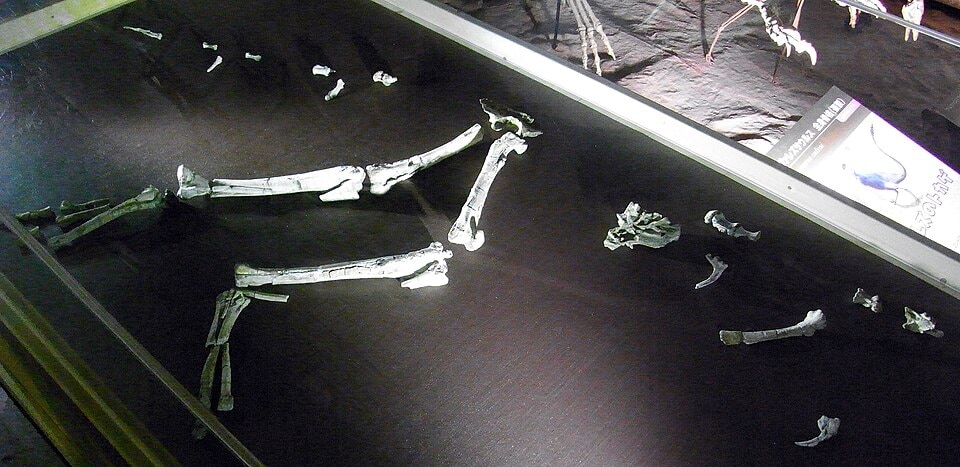
- Estimated length of 2.77 meters.
- Estimated body mass of 24–30 kilograms for an immature individual.
- Forelimbs show significant reduction and modification compared to earlier theropods.
- Forelimbs are less shortened and specialized than later alvarezsauroids.
Haplocheirus, Shuvuuia, Xiyunykus
Asia
About Bannykus
Bannykus is an extinct genus of alvarezsauroid dinosaur that roamed the Earth during the Early Cretaceous period. The type species, Bannykus wulatensis, is known from fossils discovered in the Bayin-Gobi Formation of Inner Mongolia, China. This dinosaur holds scientific importance for its transitional anatomical features, particularly in its forelimbs, which help bridge evolutionary gaps within the alvarezsauroid lineage.
Discovery and Naming
The holotype specimen of Bannykus wulatensis consists of a partially articulated, incomplete skeleton of a subadult individual estimated to be eight years old. These remains were unearthed in 2009 from the Bayin-Gobi Formation in Chaoge, Wulatehouqi, Inner Mongolia. The specimen was briefly displayed in Japan in 2012 under the unofficial name "Wulatesaurus." In 2018, the binomial name Bannykus wulatensis was formally assigned. The genus name, Bannykus, is derived from the Mandarin word 'Ban,' meaning 'half,' and the Greek word 'onyx,' meaning 'claw,' reflecting the creature's intermediate forelimb traits. The specific epithet, wulatensis, honors the region of its discovery, Wulatehouqi.
Physical Characteristics and Diet
Bannykus is considered large for an alvarezsauroid. The immature holotype specimen has an estimated length of 2.77 meters (9.1 feet) and an approximate body mass of 24–30 kilograms (53–66 lb). A key feature of Bannykus is its forelimb, which exhibits significant reduction and modification when compared to earlier theropods like Haplocheirus. However, these forelimbs were less shortened and specialized than those found in later alvarezsauroids, such as Shuvuuia. Analysis of intestinal contents from the holotype, utilizing scanning electron microscopy and Raman spectroscopy, revealed debris consistent with bone-derived material. This evidence strongly suggests that Bannykus possessed a carnivorous diet. The forelimbs of Bannykus were found to be biomechanically capable of generalized motions, indicating they were likely employed for a variety of digging activities.
Evolutionary Significance
Bannykus, alongside other alvarezsauroids like Xiyunykus, plays a crucial role in understanding the evolutionary history of its group. These dinosaurs help fill a significant temporal gap, estimated at 70 million years, in the alvarezsaur evolution. They exhibit intermediate morphologies between the more typical theropod forelimbs of early forms and the highly reduced forelimbs and minute teeth characteristic of Late Cretaceous alvarezsaurids. This position highlights a gradual evolutionary trend within the alvarezsauroid lineage, particularly concerning forelimb reduction and potential dietary shifts.
Source: Wikipedia ↗
Frequently Asked Questions
What does the name Bannykus mean?
The name Bannykus comes from the Mandarin word 'Ban,' meaning 'half,' and the Greek word 'onyx,' meaning 'claw.' This name refers to the transitional characteristics observed in its forelimbs.
Where were Bannykus fossils discovered?
Fossils of Bannykus were discovered in the Bayin-Gobi Formation in Chaoge, Wulatehouqi, Inner Mongolia, China.
What did Bannykus eat?
Based on the analysis of hard tissue debris and possible soft tissues found in the intestinal contents of the holotype, Bannykus is believed to have had a carnivorous diet.
What was significant about Bannykus's forelimbs?
Bannykus's forelimbs showed significant reduction and modification compared to earlier theropods like Haplocheirus, but were less shortened and specialized than those of later alvarezsauroids. They were biomechanically capable of generalized motions, likely used for various digging styles.
How large was Bannykus?
For the immature holotype, the estimated length was 2.77 meters (9.1 ft), and the estimated body mass was approximately 24–30 kilograms (53–66 lb).
Related Dinosaur species
Alashansaurus
Shaočilong (meaning "shark toothed dragon") was an extinct genus of theropod dinosaur that lived during the Early Cretaceous period in what is now China. Initially classified as a carcharodontosaurid, its exact phylogenetic placement has been subject to debate, with some studies suggesting it may be a tyrannosauroid or a member of the polytomic allosauroid group. Shaochilong was a relatively small carnosaur, estimated to be around 5 to 6 meters in length and weighing approximately 500 kilograms.

Chilantaisaurus
Chilantaisaurus was a large, extinct theropod dinosaur that inhabited what is now China during the Late Cretaceous period. Known primarily from an incomplete skeleton, it was characterized by its massive forelimbs, particularly its humerus, and robust hindlimbs. Its exact classification has been a subject of debate among paleontologists, with various studies placing it within or related to groups like Carcharodontosauria, Spinosauridae, or Coelurosauria.

Alxasaurus
Alxasaurus is a genus of therizinosauroid theropod dinosaur that lived during the Early Cretaceous period. Known from five specimens discovered in Inner Mongolia, it possessed features characteristic of later therizinosaurs, such as a short tail and long hand claws, and is believed to have been a bipedal herbivore. Its discovery helped solidify the understanding of therizinosaurs as derived theropods rather than basal sauropodomorphs.