
Beg
Beg tse is an extinct species of neoceratopsian dinosaur that lived in Mongolia during the Early Cretaceous period. Known from a partial skull and fragmentary postcrania, it represents the most basal neoceratopsian discovered to date. Its scientific name honors the Himalayan war deity Beg-tse, reflecting the rugose appearance of its preserved skull.
Key Facts
- ›Discovered in Mongolia in the Ulaanoosh Formation.
- ›Lived during the Early Cretaceous period, approximately 113 to 94 million years ago.
- ›Represents the most basal neoceratopsian currently known.
- ›Known from a partial skull and fragmentary postcranial remains.
- ›Named after Beg-tse, a Mongolian god of war, due to the skull's rugose appearance.

- Skull Approximately 140 mm Long
- Medium-Sized Basal Ceratopsian
- Fragmentary Postcrania Include Rib, Partial Left Scapula, Partial Right Ischium, and Bone Fragments
Yinlong, Liaoceratops
Mongolia
About Beg
What is Beg tse?
Beg tse is an extinct species of neoceratopsian dinosaur that roamed the Earth during the Early Cretaceous period. Its fossils were unearthed in the Ulaanoosh Formation of Mongolia, dating back to approximately 113 to 94 million years ago. This remarkable discovery positions Beg tse as the most basal neoceratopsian known to science, offering crucial insights into the early evolution of this dinosaur group.
Discovery and Naming
The holotype specimen of Beg tse, designated IGM 100/3652, was discovered in 2015 near Tsogt-Ovoo in Mongolia's Ömnögovi Province. The genus name, Beg, is a tribute to Beg-tse, a revered Himalayan deity and the god of war in Mongolian culture. This naming choice was inspired by the deity's depiction with a rugged or rugose countenance, a feature echoed in the preserved skull of the dinosaur.
Physical Characteristics and Significance
Based on its skull, which measures about 140 millimeters (5.5 inches) in length, Beg tse is estimated to have been a medium-sized basal ceratopsian, comparable in size to other early ceratopsians like Yinlong and Liaoceratops. The fossil remains, though incomplete, include a partial skull and very fragmentary postcranial material, such as a rib, a partial left scapula, and a partial right ischium. Beg tse displays transitional features that bridge the gap between more primitive ceratopsians and later neoceratopsians, making it phylogenetically significant for understanding dinosaur evolution.
Source: Wikipedia ↗
Frequently Asked Questions
When did Beg tse live?
Beg tse lived during the Early Cretaceous period. Its fossils date to between 113 and 94 million years ago, spanning the boundary between the Lower and Upper Cretaceous epochs.
Where were the fossils of Beg tse found?
Fossils of Beg tse were discovered in the Ulaanoosh Formation near Tsogt-Ovoo in the Ömnögovi Province of Mongolia.
What does the name Beg tse mean?
The genus name, Beg, is derived from Beg-tse, a Himalayan deity and the god of war in Mongolian culture. This name was chosen because the deity is often depicted with a rugose face, similar to the preserved skull of the dinosaur.
What physical characteristics are known about Beg tse?
Beg tse had a skull approximately 140 millimeters (5.5 inches) long. Based on this, it is considered a medium-sized basal ceratopsian, comparable in size to Yinlong and Liaoceratops. Fragmentary postcranial remains include a rib, partial scapula, and partial ischium.
What does it mean that Beg tse is the most basal neoceratopsian?
Being the most basal neoceratopsian means that Beg tse is one of the earliest and most primitive members of this group of dinosaurs currently known. It exhibits transitional features between more basal ceratopsians and other neoceratopsians.
Related Dinosaur species

Amtocephale
Amtocephale is a genus of pachycephalosaurid dinosaur discovered in the southern Gobi Desert of Mongolia. Known from a nearly complete frontoparietal dome, it represents a subadult individual. Amtocephale is considered a potentially very old representative of its family, dating back to the early Late Cretaceous period.
Choyrodon
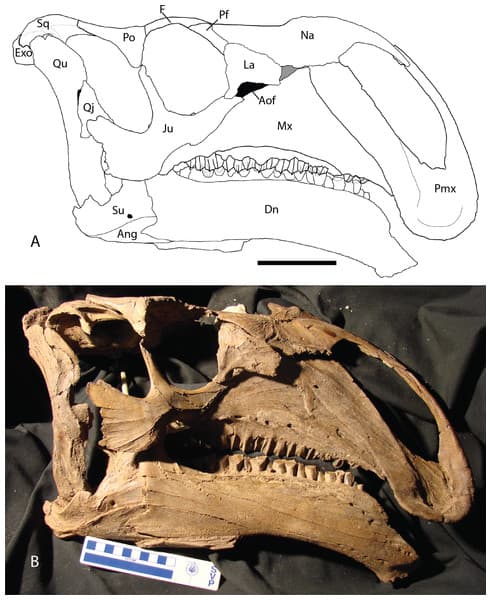
Choyrodon is a genus of hadrosauroid dinosaur that lived during the Early Cretaceous period in what is now Mongolia. The only known species, Choyrodon barsboldi, is distinguished by its unique dental features and is considered a close relative of Eolambia. Its fossils were discovered in the Khuren Dukh Formation.

Aepyornithomimus
Aepyornithomimus is a genus of ornithomimid theropod dinosaur that lived during the Late Cretaceous period, approximately 75 million years ago. Its fossils were discovered in the Djadochta Formation of Mongolia, an area believed to have been a desert at the time. The genus name "Aepyornithomimus" means "Aepyornis mimic," referencing its foot structure, and the species name "tugrikinensis" refers to its discovery location.