
Beishanlong
Beishanlong is a genus of giant ornithomimosaurian theropod dinosaur that lived in China during the Early Cretaceous period. It is notable for its considerable size, making it the second-largest ornithomimosaur discovered, surpassed only by Deinocheirus. Despite its large stature, the holotype individual was still growing when it died.
Key Facts
- ›Beishanlong is a giant ornithomimosaurian theropod dinosaur.
- ›It lived during the Early Cretaceous period in what is now China.
- ›It is the second-largest ornithomimosaur known, smaller only than Deinocheirus.
- ›Estimated length for a subadult individual is 5.9–7 meters (19–23 ft).
- ›Estimated body mass for a subadult individual ranges from 375–626 kilograms (827–1,380 lb).
- ›Its build was robust with long arms and legs, but lacking extremely elongated hands and feet.

- Approximates the largest-known individuals of Gallimimus, reaching estimated lengths of 8 meters.
- Subadult individual estimated at 5.9–7 m in length.
- Subadult individual estimated at 375–626 kg in body mass.
- Robust build.
- Long arms and legs.
- Lacked extremely elongated hands, feet, and claws of later forms.
Deinocheirus, Gallimimus, Harpymimus, Garudimimus
China
About Beishanlong
Beishanlong is a genus of giant ornithomimosaurian theropod dinosaur that inhabited China during the Early Cretaceous period. Its name, meaning 'North Mountains dragon,' reflects both its discovery location and its impressive size. Beishanlong is recognized as the second-largest ornithomimosaur discovered to date, surpassed in size only by the related genus Deinocheirus.
Discovery and Naming
Fossils of Beishanlong were unearthed in Northwestern China, specifically in Gansu province at the White Ghost Castle site. The type species, Beishanlong grandis, was formally described and named in 2010 by a team of Chinese and American paleontologists. The specific epithet 'grandis' was chosen to denote the dinosaur's considerable body size. The holotype specimen, discovered in 2006, consists of a partial skeleton lacking a skull. Additional specimens, including hindlimb remains and a pair of pubes, were found in 2007. Foot bones discovered in 1999 were also tentatively assigned to the species.
Description and Classification
Beishanlong was a large and robust dinosaur. While the exact adult size is not definitively known, estimations for a subadult individual place its length between 5.9 and 7 meters (19–23 ft) and its weight between 375 and 626 kilograms (827–1,380 lb). Histological studies of its bones indicated that the holotype individual was still growing and had not reached full maturity. Its limbs were long, though it lacked the extremely elongated hands, feet, and claws seen in some later ornithomimosaurs. Paleontologists have classified Beishanlong within the Ornithomimosauria, often placing it in a basal position. It is considered closely related to Harpymimus, and some research suggests it was a basal member of the Deinocheiridae family, preceding the evolution of Garudimimus and Deinocheirus.
Source: Wikipedia ↗
Frequently Asked Questions
What does the name Beishanlong mean?
The name Beishanlong combines a reference to the Bei Shan, meaning 'North Mountains,' with the Chinese word 'long' for 'dragon.' The specific name, 'grandis,' means 'large' in Latin, reflecting its substantial body size.
When and where did Beishanlong live?
Beishanlong lived during the late Aptian stage of the Early Cretaceous period. Its fossils were discovered in Northwestern China, in the province of Gansu, within layers of the Xinminpu Group's Xiagou Formation.
How large was Beishanlong?
Beishanlong was a giant among ornithomimosaurs, with subadult individuals estimated to be between 5.9 and 7 meters (19–23 ft) in length and weighing 375–626 kilograms (827–1,380 lb). It approached the size of the largest known individuals of Gallimimus.
What is known about Beishanlong's physical characteristics?
Beishanlong had a robust build with long arms and legs. However, unlike some later ornithomimosaurs, its hands, feet, and claws were not extremely elongated.
What is the significance of Beishanlong's growth?
Histological analysis of Beishanlong's bone structure revealed growth lines indicating that the holotype individual, despite its large size, was still growing and was considered subadult at the time of its death. This suggests that adult individuals could have been even larger.
What other dinosaurs are closely related to Beishanlong?
Beishanlong is closely related to other ornithomimosaurs. It formed a polytomy with Harpymimus and the main ornithomimosaurian branch, and later classifications placed it as basal to a clade containing Garudimimus and Deinocheirus within the Deinocheiridae family.
Related Dinosaur species
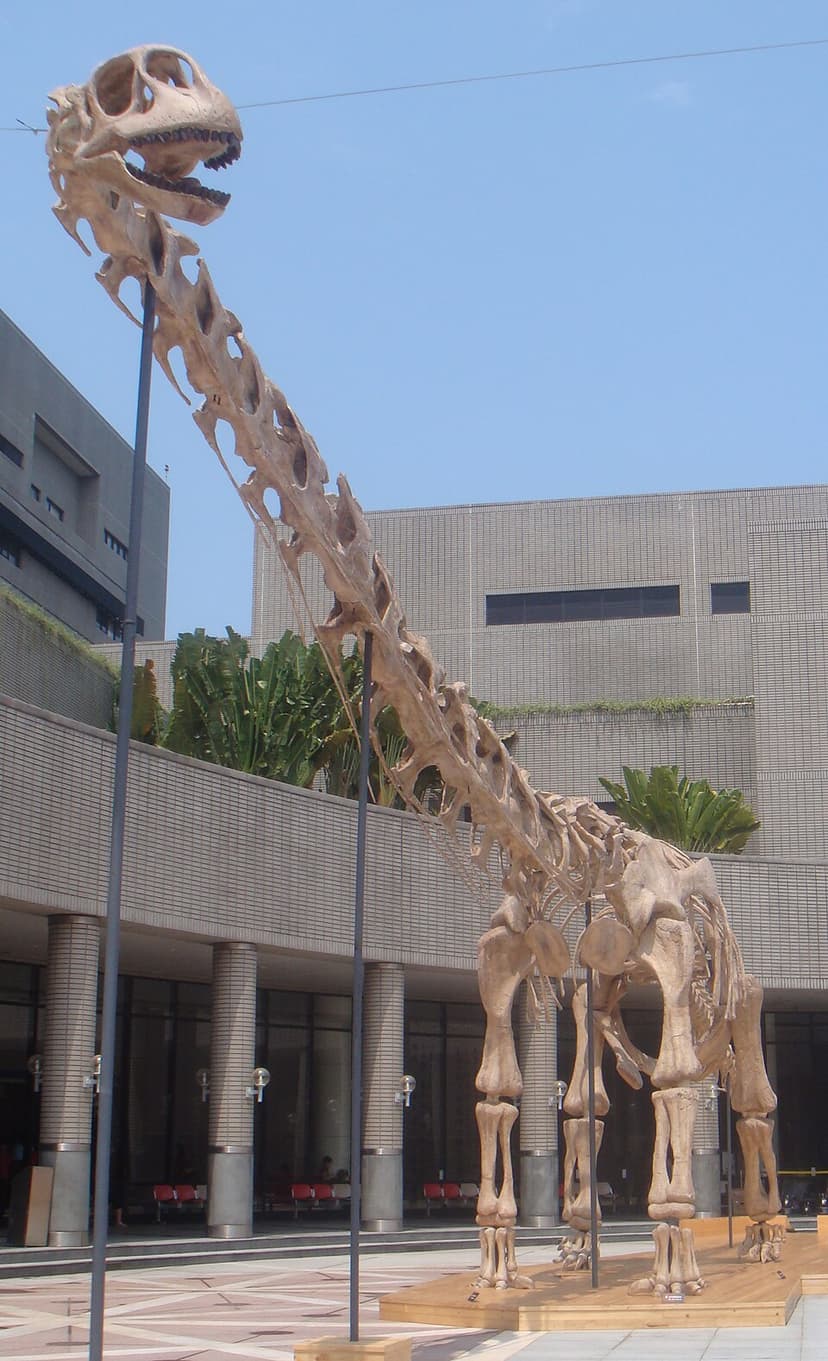
Daxiatitan
Daxiatitan was a large sauropod dinosaur that lived during the Lower Cretaceous period in what is now Gansu, China. It is known from a partial skeleton that includes vertebrae, ribs, a shoulder blade, and a thigh bone. At the time of its discovery, it was considered one of the largest dinosaurs found in China.

Beg
Beg tse is an extinct species of neoceratopsian dinosaur that lived in Mongolia during the Early Cretaceous period. Known from a partial skull and fragmentary postcrania, it represents the most basal neoceratopsian discovered to date. Its scientific name honors the Himalayan war deity Beg-tse, reflecting the rugose appearance of its preserved skull.

Brontomerus
Brontomerus is a genus of sauropod dinosaur that lived during the Early Cretaceous period, approximately 110 million years ago. It is notable for its unusually large hipbones, which would have supported the largest thigh muscles of any known sauropod, suggesting unique locomotive capabilities. The genus is known from fragmentary fossils of at least two individuals, likely an adult and a juvenile, discovered in Utah, USA.