
Deinocheirus
Omnivore·Late Cretaceous·Nemegt Formation, Mongolia·Bipedal
Deinocheirus was a colossal ornithomimosaur that roamed during the Late Cretaceous period, approximately 70 million years ago. Initially known only from its massive arms, later discoveries revealed a bulky, sail-backed dinosaur with a duck-like bill. Its unusual combination of features made its classification a long-standing mystery.
Key Facts
- ›Deinocheirus was the largest known ornithomimosaur, reaching up to 11 meters (36 feet) in length and weighing around 6.5 tons.
- ›Its most striking features were its enormous forelimbs, measuring 2.4 meters (7.9 feet) long, equipped with large, blunt claws.
- ›A prominent 'sail' was formed by tall neural spines along its back, potentially supported by a system of ligaments.
- ›Evidence suggests Deinocheirus was omnivorous, likely consuming plants and possibly fish, with its broad bill adapted for gathering food.
- ›Fossil evidence indicates it was a bipedal dinosaur, though its short legs and bulky build suggest it was not adapted for speed.

- Largest known ornithomimosaur
- Estimated length of 11 m
- Estimated weight of 6.5 t
- Enormous forelimbs measuring 2.4 m with large, blunt claws
- Tall neural spines forming a 'sail' along the back
- Broad, duck-like bill
- Hollow bones for weight reduction
Garudimimus, Beishanlong, Harpymimus
Mongolia
About Deinocheirus
Deinocheirus was a remarkable and colossal ornithomimosaur that lived approximately 70 million years ago during the Late Cretaceous period in what is now Mongolia. For decades, its existence was known only from a pair of immense arms and shoulder girdle bones, leading to its scientific name, meaning 'horrible hand'. This scarcity of fossils made Deinocheirus one of the most enigmatic dinosaurs, with its true nature a profound mystery to paleontologists.
Unveiling the Giant
In 2014, the discovery of two much more complete specimens dramatically reshaped our understanding of Deinocheirus. These finds revealed an animal of immense proportions, estimated to be up to 11 meters (36 feet) long and weighing around 6.5 metric tons. It was the largest known member of the ornithomimosaur clade, commonly known as 'ostrich dinosaurs'. Despite its bulk, Deinocheirus possessed hollow bones, a common adaptation in dinosaurs to reduce weight.
Distinctive Anatomy
A truly unique feature of Deinocheirus was the prominent 'sail' that ran along its back, formed by exceptionally tall neural spines on its vertebrae. These spines were interconnected by ligaments, creating a stiffened structure. Its forelimbs were among the longest of any bipedal dinosaur, measuring 2.4 meters (7.9 feet) and ending in large, blunt claws. The skull was also unusual for an ornithomimosaur, being large with a broad, duck-like bill and a deep lower jaw, bearing a resemblance to those of hadrosaurs. Its legs were relatively short, and its feet had blunt, broad claws.
Diet and Lifestyle
Evidence suggests Deinocheirus was omnivorous. Its broad bill and the presence of gastroliths (stomach stones) point to a diet that included plants. Furthermore, fish scales found in association with one specimen suggest it may have also consumed aquatic life. The large claws were likely used for digging or gathering vegetation. While classified as a biped, its short legs and heavy build indicate it was not adapted for speed, unlike many of its ornithomimosaur relatives. The large claws may also have served defensive purposes against predators like Tarbosaurus, whose bite marks have been found on Deinocheirus fossils.
Classification and Significance
Initially, the classification of Deinocheirus was highly debated due to its unusual combination of traits. It was eventually recognized as a primitive ornithomimosaur, most closely related to genera like Garudimimus and Beishanlong, together forming the family Deinocheiridae. Unlike other ornithomimosaurs, members of this family were not built for speed. The discovery and subsequent study of Deinocheirus highlight how incomplete fossil records can lead to long-held misconceptions about extinct animals, and how new discoveries can dramatically alter our understanding of dinosaur evolution and diversity.
Source: Wikipedia ↗
Frequently Asked Questions
What does the name Deinocheirus mean?
The name Deinocheirus is derived from Greek words 'deinos' meaning 'horrible' and 'cheir' meaning 'hand'. This name was chosen due to the immense size and formidable claws of its forelimbs.
When and where did Deinocheirus live?
Deinocheirus lived during the Late Cretaceous period, approximately 70 million years ago. Its fossils have been discovered in the Nemegt Formation of Mongolia.
What was the diet of Deinocheirus?
Deinocheirus is believed to have been omnivorous. Evidence suggests a diet that included plants, indicated by its duck-like bill and the presence of gastroliths, and potentially fish, as fish scales were found associated with one specimen.
What were the most distinctive physical features of Deinocheirus?
Deinocheirus was characterized by its massive size, exceptionally long arms with large claws, and a unique 'sail' formed by tall neural spines along its back. It also possessed a broad, duck-like bill.
Why was Deinocheirus so difficult to classify for so long?
For many years, Deinocheirus was only known from a few scattered bones, primarily its enormous arms. This lack of complete remains made it challenging to determine its evolutionary relationships, leading to various hypotheses about its classification.
How does Deinocheirus compare to other ornithomimosaurs?
Deinocheirus stands out as the largest member of the ornithomimosaur group, often called 'ostrich dinosaurs'. Unlike many of its smaller, speed-adapted relatives, Deinocheirus was a bulky animal not built for running, and its family, Deinocheiridae, represents a lineage not adapted for speed.
Related Dinosaur species

Caenagnathasia
Caenagnathasia is a genus of small oviraptorosaurian theropod dinosaurs that lived in present-day Uzbekistan during the Late Cretaceous period. It is notable for being one of the smallest non-avian dinosaurs known, characterized by its beaked skull and bird-like features.

Archaeornithomimus
Archaeornithomimus was a medium-sized ornithomimosaurian theropod dinosaur that lived in what is now Inner Mongolia, China, during the Late Cretaceous period, approximately 96 million years ago. Named "ancient bird mimic," this dinosaur is thought to have been an omnivore, potentially feeding on plants, fruits, eggs, and small animals, and it likely possessed feathers and a keratinous beak.
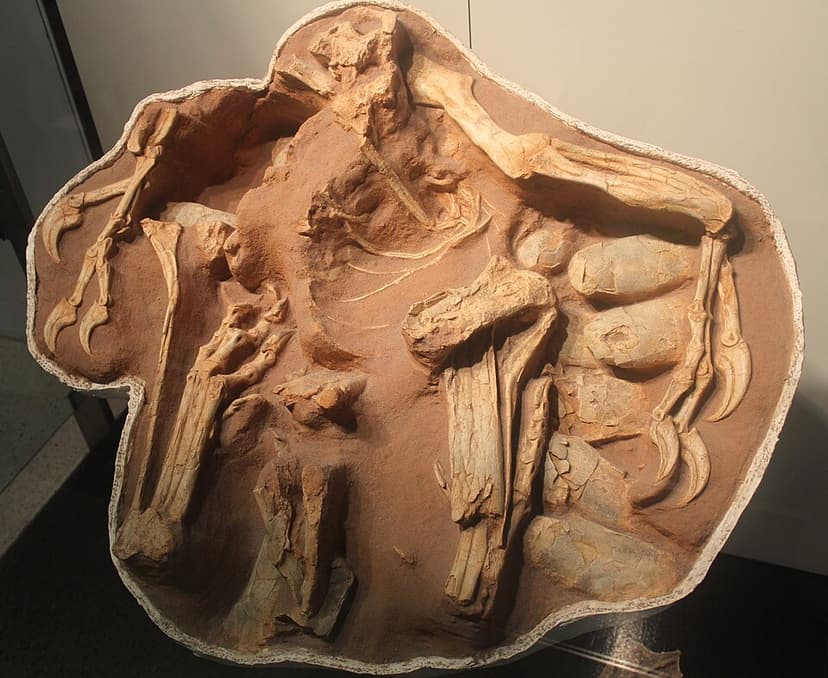
Citipati
Citipati is a genus of large oviraptorid dinosaur that lived in Asia during the Late Cretaceous period. Known for its distinctive crest and toothless beak, Citipati is famous for specimens found in brooding positions on nests, providing crucial evidence for the link between non-avian dinosaurs and birds. Its diet may have been omnivorous, with evidence suggesting it possibly preyed on smaller animals to feed its young.