
Bicentenaria
Bicentenaria argentina was a small, bipedal carnivorous dinosaur that lived during the early Late Cretaceous period in what is now Argentina. Its scientific name commemorates the 200th anniversary of Argentina's May Revolution. Discovered in the Candeleros Formation, its fossils include skull fragments, vertebrae, limb bones, and claws.
Key Facts
- ›Bicentenaria was a small, bipedal carnivorous theropod.
- ›It lived during the early Late Cretaceous period (Cenomanian stage).
- ›Fossils were discovered in the Candeleros Formation of Argentina.
- ›Its scientific name honors the 200th anniversary of the may Revolution in Argentina.
- ›Distinguishing features include praemaxillary teeth with serrations only at the base and unique hand claw morphology.
- ›Its estimated body length was between 2.5 to 3 meters.
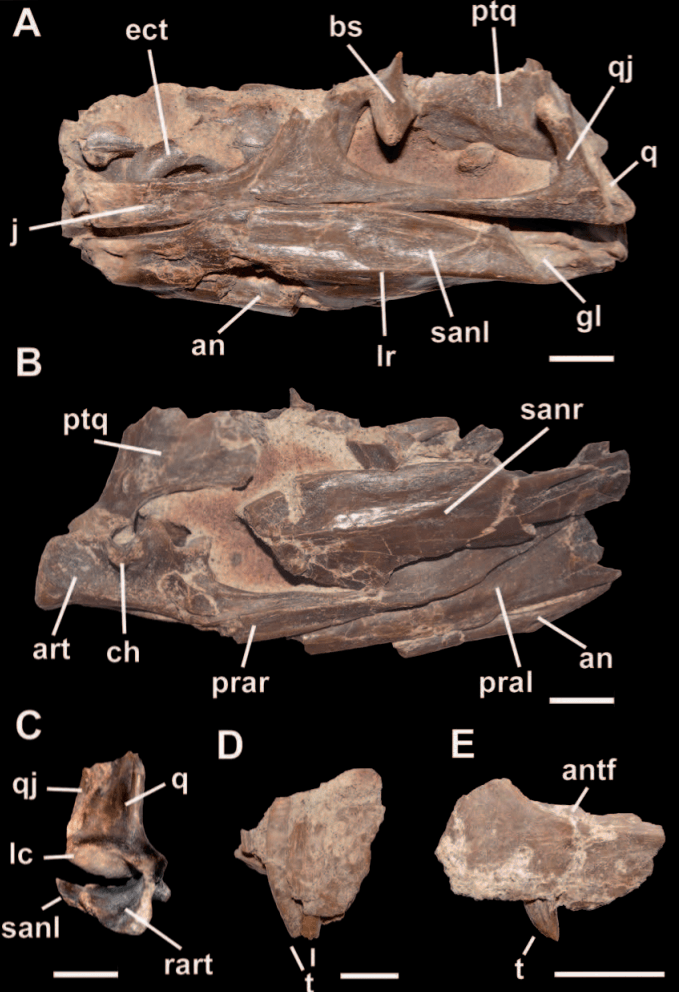
- Small bipedal predatory saurian
- Estimated body length of 2.5 to 3 meters
- Praemaxillary teeth with serrations only at the base of the crown
- Quadratojugal has an anterior branch twice as long as the ascending branch
- Quadratum has a larger outer articular nodule than the inner one
- Surangulare has a raised upper edge that is trapezoidal in lateral view
- Retroarticular protrusion of the mandible is flattened, transversely widened, and spoon-shaped
- Humerus is flattened front-to-back at the top with a deep groove at the bottom
- Hand claws of outer fingers have posteriorly overhanging leg edges
South America
About Bicentenaria
Bicentenaria argentina was a small, carnivorous theropod dinosaur that roamed the Earth during the early Late Cretaceous period. Its scientific name, meaning "two hundred year anniversary," was chosen to commemorate the 200th anniversary of Argentina's May Revolution in 1810. The fossils of this intriguing dinosaur were discovered in the Candeleros Formation of Argentina.
Discovery and Naming
The discovery of Bicentenaria's remains was serendipitous. In 1998, a drop in water levels at the Ezequiel Ramos Mexía Reservoir exposed rocks from the Candeleros Formation. Rauel Spedale and friends found several bones and claws, initially believing them to be from a machairodontine. Over subsequent years, Spedale returned to the site, carefully excavating more fossils with basic tools. The unique nature of the find was recognized, and Spedale was put in touch with paleontologist Raúl Ortiz, who confirmed it was an unknown dinosaur species. The formal description by Novas et al. was published in August 2012.
Physical Characteristics
Bicentenaria is characterized as a rather small, bipedal predatory saurian, with an estimated body length of 2.5 to 3 meters (8 to 10 ft). Its skull fragments reveal robust construction, with praemaxillary teeth that possess serrations only at the base of the crown. Distinctive features extend to the jaw structure, including a flattened and spoon-shaped retroarticular protrusion and a surangulare with a raised, trapezoidal upper edge. The humerus has a unique flattened top, and its hand claws are noted for having posteriorly overhanging leg edges, a trait that may be an autapomorphy.
Classification and Habitat
Novas et al. (2012) classified Bicentenaria within the Coelurosauria, placing it as less basal than Tugulusaurus. While specific details about its habitat are not extensively documented, its discovery in the Candeleros Formation suggests it inhabited terrestrial environments in what is now Patagonia during the Cenomanian age of the Late Cretaceous.
Source: Wikipedia ↗
Frequently Asked Questions
What does the name Bicentenaria mean?
The name Bicentenaria means 'two hundred year anniversary'. It was chosen to honor the 200th anniversary of Argentina's May Revolution in 1810.
Where were Bicentenaria fossils found?
The fossils of Bicentenaria were discovered in the Candeleros Formation in Argentina, specifically near the Ezequiel Ramos Mexía Reservoir.
What did Bicentenaria eat?
Bicentenaria is classified as a carnivorous theropod, indicating it primarily ate meat.
How large was Bicentenaria?
Bicentenaria is estimated to have been a rather small dinosaur, with a body length ranging from 2.5 to 3 meters (approximately 8 to 10 feet).
What period did Bicentenaria live in?
Bicentenaria lived during the early Late Cretaceous period, specifically the Cenomanian stage.
What are some unique features of Bicentenaria?
Unique features identified include praemaxillary teeth with serrations only at the base of the crown and hand claws of the outer fingers possessing posteriorly overhanging leg edges. The jaw structure also presents distinctive characteristics.
Related Dinosaur species

Aerosteon
Aerosteon was a megaraptoran dinosaur that lived in Argentina during the Late Cretaceous period. Its name, meaning "air bone," refers to the bird-like respiratory system evident in its fossilized remains, which included air-filled spaces in its bones. This unique feature suggests a sophisticated breathing mechanism similar to that of modern birds.
Aucasaurus
Aucasaurus is a genus of medium-sized abelisaurid theropod dinosaur that lived in Argentina during the Late Cretaceous period. It was characterized by its extremely reduced arms and lack of fingers, and possessed low ridges above its eyes instead of horns. The type specimen is well-preserved, offering significant insight into its anatomy.

Austroraptor
Austroraptor is a genus of dromaeosaurid theropod dinosaur that lived in Argentina during the Late Cretaceous period. It was a large, ground-dwelling carnivore, notable for its relatively short forelimbs and conical, non-serrated teeth. Its discovery provided insights into the diversity of dromaeosaurids in the Southern Hemisphere.