
Bicharracosaurus
Bicharracosaurus was a large macronarian sauropod dinosaur that lived during the Late Jurassic period in what is now Argentina. Its name, meaning "big animal lizard," reflects its immense size. The genus is known from a partial skeleton, including vertebrae and ribs, discovered in Chubut Province.
Key Facts
- ›Lived during the Late Jurassic period.
- ›Discovered in Chubut Province, Argentina.
- ›Estimated to be 15 meters long and weigh 20 tonnes.
- ›Possibly a brachiosaurid, belonging to the macronarian sauropod group.
- ›Unique features include pneumatic holes in tail vertebrae and a protuberance on neck vertebrae.

- Estimated length of 15 meters.
- Estimated weight of 20 tonnes.
- Possessed pneumatic holes in middle and rear tail vertebrae.
- Had a small upwardly directed protuberance on rearmost neck vertebrae.
- Sacral vertebrae centra had boat-shaped joint facets.
Argentina
About Bicharracosaurus
Bicharracosaurus was a genus of macronarian sauropod dinosaur that roamed the Earth during the Late Jurassic period. Its scientific name, Bicharracosaurus dionidei, reflects both its considerable size and the individual who discovered its remains. The genus name itself is derived from the informal Spanish word "bicharraco," meaning "big animal," a fitting descriptor for these massive creatures, combined with the Greek "saurus" for lizard.
Discovery and Naming
The type specimen of Bicharracosaurus, designated MPEF-PV 1730, was unearthed in the Chubut Province of Argentina. Its discovery was first reported in March 2001 by a local farmer named Dionide Mesa, after whom the species is named. Excavation and recovery efforts took place in stages, with significant portions of the partial skeleton, including disarticulated caudal vertebrae, articulated cervical and dorsal vertebrae with ribs, sacral vertebrae, and the ilium, being unearthed between 2002 and 2018. In 2026, Alexandra Reutter and her colleagues formally described Bicharracosaurus dionidei as a new genus and species.
Physical Characteristics
Based on the available fossil evidence, Bicharracosaurus is estimated to have reached a length of approximately 15 meters (49 feet) and a substantial weight of around 20 tonnes (44,000 pounds). Several unique anatomical features, or autapomorphies, have been identified. These include a distinctive triangular pneumatic hole within the middle and rear tail vertebrae, a small, upwardly directed protuberance at the lower end of the postzygodiapophyseal lamina in the rearmost neck vertebrae, and sacral vertebrae that feature boat-shaped joint facets on their centra. The dinosaur is believed to have been a herbivore, consistent with its sauropod classification.
Source: Wikipedia ↗
Frequently Asked Questions
What does the name Bicharracosaurus mean?
The name Bicharracosaurus combines the informal Spanish word 'bicharraco,' meaning 'big animal,' with the Latinized Greek word 'saurus,' meaning 'lizard.' It was named to reflect the dinosaur's large size.
When did Bicharracosaurus live?
Bicharracosaurus lived during the Late Jurassic geological period.
Where were the fossils of Bicharracosaurus found?
Fossils of Bicharracosaurus were discovered in the Chubut Province of Argentina, in the Cañadón Calcáreo Formation.
What was the estimated size of Bicharracosaurus?
Bicharracosaurus had an estimated length of 15 meters (49 feet) and an estimated weight of 20 tonnes (44,000 pounds).
What are some unique features of Bicharracosaurus?
Distinguishing traits include a triangular pneumatic hole in the middle and rear tail vertebrae, a small upwardly directed protuberance on the lower end of the postzygodiapophyseal lamina of the rearmost neck vertebrae, and boat-shaped joint facets on the centra of the sacral vertebrae.
Related Dinosaur species

Chubutisaurus
Chubutisaurus is a genus of somphospondylan sauropod dinosaur that lived during the Late Cretaceous period in what is now Argentina. Described in 1975, its name means "Chubut lizard," referencing the province where its fossils were discovered. Chubutisaurus is known for having a more robust radius compared to other sauropods like Venenosaurus.
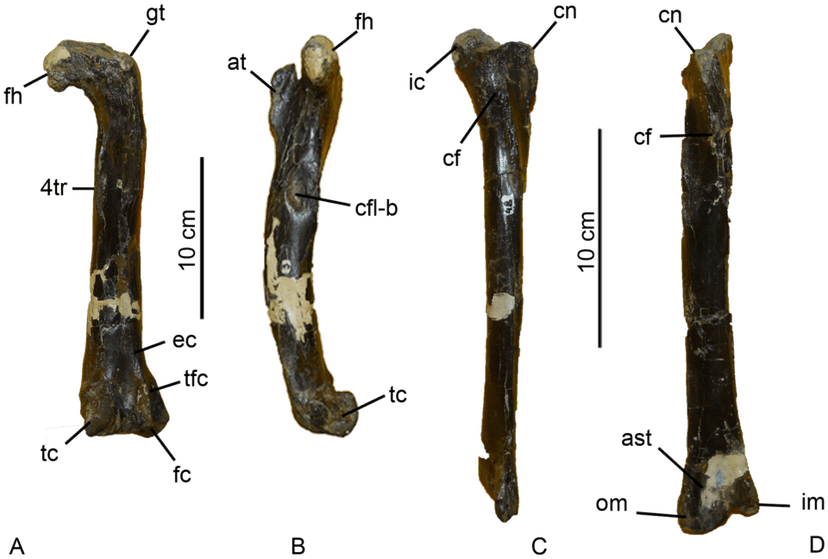
Aniksosaurus
Aniksosaurus was a bipedal theropod dinosaur that lived in what is now Chubut Province, Argentina, during the Late Cretaceous period. Its name, meaning 'spring lizard,' refers to the time of its discovery. Fossil evidence suggests Aniksosaurus may have been gregarious, particularly during its sub-adult stages.

Asfaltovenator
Asfaltovenator vialidadi was a large theropod dinosaur that lived during the Early Jurassic period in what is now Argentina. Its classification has been a subject of debate, with some studies placing it as a basal allosauroid and others suggesting it belongs within the Allosauridae family. The discovery of its partial skeleton has provided valuable insights into the evolution of tetanuran theropods during a period of significant environmental change.