
Bonapartesaurus
Bonapartesaurus is an extinct genus of herbivorous ornithopod dinosaur belonging to the Hadrosauridae family. It lived in what is now Argentina during the Late Cretaceous period. The genus was established in 2017 to house remains previously attributed to other hadrosaurids.
Key Facts
- ›Bonapartesaurus means "Bonaparte's lizard", named in honor of José Bonaparte.
- ›It was a herbivorous ornithopod dinosaur from the Hadrosauridae family.
- ›Fossils were discovered in Argentina and date to the Campanian and Maastrichtian stages of the Late Cretaceous.
- ›The holotype specimen includes vertebrae, ribs, limb bones, and parts of the pelvis and foot.
- ›Paleopathologies found on the holotype include fractures with signs of infection and a probable bone tumor.
- ›Phylogenetic analyses place Bonapartesaurus within the Saurolophini tribe and the Austrokritosauria clade.
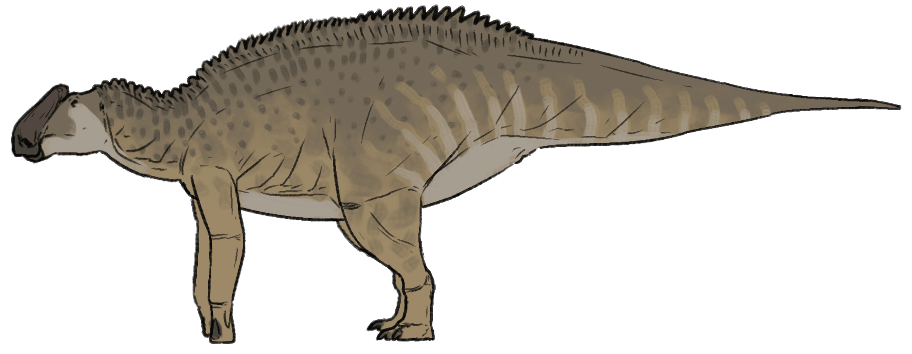
- Characterized by a high proportion between neural, sacral, and centrum spines.
- Extremely long neural spines on anterior caudal vertebrae.
- Pre-acetabular process slightly flexed ventrally.
- Iliac lamina with a height to anteroposterior length ratio of 0.8 or higher.
- Asymmetric lateral profile of the supraacetabular process.
- Posterior portion of the mediolateral postacetabular process markedly thicker.
- Expanded cnemial crest limited to the proximal end of the tibia.
- Articular surface of the astragalus for the internal malleolus of the tibia is moderately expanded medially.
Prosaurolophus, Saurolophus
Argentina
About Bonapartesaurus
Bonapartesaurus is an extinct genus of herbivorous ornithopod dinosaur that belonged to the Hadrosauridae family. Its name, meaning "Bonaparte's lizard," honors José Bonaparte. This dinosaur inhabited the region of modern-day Argentina during the Campanian and Maastrichtian stages of the Late Cretaceous period.
Discovery and Naming
The remains that would eventually be classified as Bonapartesaurus were first excavated in 1984 by paleontologist Jaime Powell and his collaborators. Initially, Powell described them in 1987 as a possible indeterminate lambeosaurine, noting similarities to Hypacrosaurus and Barsboldia due to the large neural spines. Later, in 2010, a new genus, Willinakaqe salitralensis, was erected from materials found in different locations within the Allen Formation. However, a review in 2016 by Penélope Cruz-Caballero and Rodolfo Coria suggested that the material attributed to Willinakaqe might represent more than one hadrosaurid taxon and that the diagnostic characteristics were not valid, downgrading it to an indeterminate saurolophine and rendering Willinakaqe salitrensis a nomen vanum. In a 2017 study, Cruz-Caballero and Powell reassigned the paratype of W. salitralensis to its own genus and species, Bonapartesaurus rionegrensis, recognizing it as distinct from the previously described materials.
Description and Paleopathology
The holotype specimen of Bonapartesaurus rionegrensis (MPCA-Pv SM2/1-71) includes a partial skeleton comprising dorsal and caudal vertebrae, a sacrum, ribs, fragments of the scapula and humerus, a complete ulna, an ilium, a nearly complete pubis, fragments of ischia, both femurs, tibias, fibulae, an astragalus, a calcaneus, and an articulated left foot, along with tendons. These fossils were recovered from the Salitral Moreno site in Río Negro province, Argentina, from the lower member of the Allen Formation. Unique characteristics of Bonapartesaurus include specific proportions of its vertebral spines, the morphology of its ilium, and features of its tibia and astragalus.
In 2021, CT scans revealed three paleopathologies on the holotype. These included fractures of the spinous processes on two caudal vertebrae, one showing signs of post-traumatic infection. Additionally, a probable malignant bone tumor, such as osteosarcoma, was identified on the left metatarsal II bone. While these conditions likely caused pain and affected the dinosaur's mobility, they are not believed to have been the direct cause of its death.
Phylogeny
Phylogenetic analyses have placed Bonapartesaurus within the Hadrosauridae family. Early analyses followed traditional classifications, placing it within the Hadrosaurinae and the Saurolophini tribe, suggesting it was more derived than Prosaurolophus but more basal than Saurolophus spp.. More recent studies, such as the 2023 description of Gonkoken, have recovered Bonapartesaurus as a member of the Austrokritosauria, a clade of South American saurolophines closely related to kritosaurins.
Source: Wikipedia ↗
Frequently Asked Questions
What does the name Bonapartesaurus mean?
The name Bonapartesaurus means "Bonaparte's lizard". It was named in honor of José Bonaparte.
When did Bonapartesaurus live?
Bonapartesaurus lived during the Campanian and Maastrichtian stages of the Late Cretaceous period.
Where were the fossils of Bonapartesaurus found?
Fossils of Bonapartesaurus were discovered in the Río Negro province in southern Argentina.
What did Bonapartesaurus eat?
Bonapartesaurus was a herbivorous dinosaur, meaning it primarily ate plants.
What is known about the health of Bonapartesaurus?
CT scans revealed paleopathologies on the holotype, including fractures on caudal vertebrae with signs of infection and a probable malignant bone tumor on a metatarsal bone.
What group of dinosaurs did Bonapartesaurus belong to?
Bonapartesaurus belonged to the Hadrosauridae family, specifically within the ornithopod group. Phylogenetic analyses place it within the Saurolophini tribe and the Austrokritosauria clade.
Related Dinosaur species

Aeolosaurus
Aeolosaurus was a genus of titanosaurian sauropod dinosaur that lived in South America during the Late Cretaceous Period. Characterized by a long neck and tail, it was a quadrupedal herbivore. The genus is well-represented, with remains from several individuals belonging to at least two species, though no skull material has been recovered.

Antarctosaurus
Antarctosaurus was a genus of titanosaurian sauropod dinosaurs that lived during the Late Cretaceous Period in South America. The genus is known from several species, though many are considered dubious due to fragmentary remains and taxonomic confusion. The type species, Antarctosaurus wichmannianus, is estimated to have reached about 17 meters in length, while Antarctosaurus giganteus, though poorly known, represents one of the largest dinosaurs ever discovered.

Argyrosaurus
Argyrosaurus is a genus of titanosaurian sauropod dinosaur that lived approximately 70 million years ago during the Late Cretaceous Period. Fossils of this large herbivore were discovered in Argentina, which inspired its name meaning 'silver lizard'.