
Cedrorestes
Cedrorestes is a genus of iguanodontian dinosaur that lived during the Early Cretaceous period in what is now Utah. Its classification as an early hadrosaurid or a derived iguanodontian places it near a significant evolutionary split, possessing a unique combination of features.
Key Facts
- ›Cedrorestes is known from an incomplete skeleton found in the Cedar Mountain Formation of Utah.
- ›It lived during the Valanginian-age of the Early Cretaceous period.
- ›The dinosaur is named after the Cedar Mountain Formation and author Michael Crichton.
- ›It is considered an iguanodontian ornithopod, potentially an early hadrosaurid or a derived non-hadrosaurid.
- ›Cedrorestes was a large herbivore that could move on two or four legs.
- ›Fossils were found scattered and showed signs of pre-burial damage.

- Tall ilium
- Large lateral bony process above and behind the acetabulum
- Hadrosaurid-like leg muscles indicated by hip structure
Iguanodon, Hadrosaurids
North America
About Cedrorestes
Cedrorestes is a genus of iguanodontian dinosaur that roamed the Earth during the Early Cretaceous period. Its fossils were unearthed in the Valanginian-age Yellow Cat Member of the Cedar Mountain Formation in east-central Utah, United States. The discovery is based on a partial skeleton, which includes fragments of ribs, the sacrum, parts of the ilium, a thighbone, a metatarsal, and ossified tendons. These remains show evidence of pre-burial damage, suggesting they were weathered or trampled before fossilization.
Classification and Significance
Cedrorestes is notable for its unique combination of anatomical features, which place it at a potentially critical point in dinosaur evolution. It possesses a tall ilium, characteristic of Iguanodon-like ornithopods, along with a large lateral bony process above and behind the acetabulum, a feature typically seen in hadrosaurids. This combination led its describers to suggest that Cedrorestes was close to the evolutionary division between hadrosaurids and iguanodontids, classifying it as the earliest known hadrosaurid. However, it is also considered a derived non-hadrosaurid iguanodontian.
Paleoecology and Paleobiology
Living in the Upper Yellow Cat Member of the Cedar Mountain Formation, Cedrorestes shared its habitat with a diverse array of other dinosaur species. These included fellow ornithopods like Hippodraco, an unnamed sail-backed iguanodontid, and the armored dinosaur Gastonia. Large sauropods such as Cedarosaurus and Moabosaurus, the primitive ornithomimosaur Nedcolbertia, the theropod Martharaptor, and the formidable dromaeosaurid Utahraptor were also part of this ecosystem. As a large herbivore, Cedrorestes was capable of both bipedal and quadrupedal locomotion. Evidence from its hip structure suggests it had hadrosaurid-like leg muscles, though the precise functional implications of these adaptations and any resulting differences in movement are not yet fully understood. Further discoveries of more complete fossil material are needed for a more detailed interpretation of Cedrorestes' paleobiology.
Source: Wikipedia ↗
Frequently Asked Questions
What does the name Cedrorestes mean?
The genus name Cedrorestes is derived from 'cedrus' (cedar) and 'oros' (mountain), referencing the Cedar Mountain Formation where its fossils were discovered. The suffix '-etes' means 'dweller'.
What period did Cedrorestes live in?
Cedrorestes lived during the Early Cretaceous period, specifically in the Valanginian age.
Where were the fossils of Cedrorestes found?
Fossils of Cedrorestes were discovered in east-central Utah, within the Yellow Cat Member of the Cedar Mountain Formation.
What did Cedrorestes eat?
Cedrorestes was a herbivore, meaning it primarily consumed plants.
How did Cedrorestes move?
Cedrorestes was capable of moving both bipedally (on two legs) and quadrupedally (on all fours).
What other dinosaurs lived alongside Cedrorestes?
In the Upper Yellow Cat Member, Cedrorestes shared its environment with dinosaurs like Hippodraco, Gastonia, Cedarosaurus, Moabosaurus, Nedcolbertia, Martharaptor, and Utahraptor.
How complete is the fossil record for Cedrorestes?
The fossil record for Cedrorestes is based on an incomplete skeleton, and detailed interpretations of its paleobiology await the discovery of more extensive remains.
Related Dinosaur species

Adelolophus
Adelolophus is a genus of lambeosaurine dinosaur, a type of "duck-bill" known for its cranial crests, that lived during the Late Cretaceous period in what is now Utah, USA. The only known species, *Adelolophus hutchisoni*, is represented by a partial maxilla (upper jaw bone). It is significant as the oldest known lambeosaur remains from North America and a member of the Parasaurolophini tribe, indicating a close relationship with dinosaurs like Parasaurolophus.
Animantarx
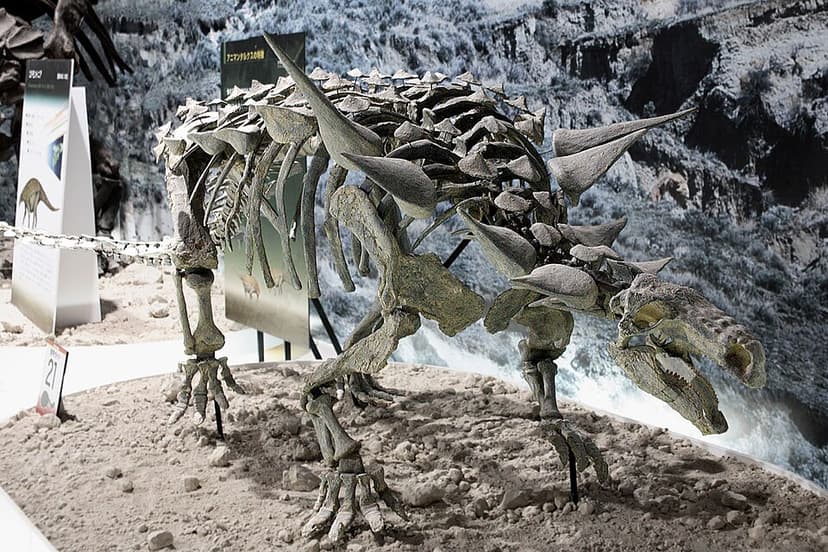
Animantarx was a herbivorous ankylosaurian dinosaur that lived in western North America during the Early and Late Cretaceous periods. Known for its heavily armored body and lack of a tail club, this quadrupedal dinosaur is estimated to have been around 3 meters (10 feet) in length. Its discovery in the Cedar Mountain Formation of Utah was unique, stemming from a radiological survey that detected unusual radioactivity in the fossil-bearing rock.

Cedarosaurus
Cedarosaurus was a nasal-crested macronarian sauropod dinosaur that lived during the Early Cretaceous Period. Its fossils were discovered in eastern Utah and it is known for its distinct vertebrae and forelimb bones, which led to its classification as a new genus. This herbivore is estimated to have reached lengths of up to 15 meters and weighed up to 10 metric tons.