
Crichtonsaurus
Crichtonsaurus was a genus of herbivorous ankylosaurid dinosaur that lived in what is now China during the Late Cretaceous period. Named in honor of author Michael Crichton, the genus is now considered dubious, with its type species, Crichtonsaurus bohlini, being a nomen dubium due to a lack of unique diagnostic traits in the holotype and questionable referral of other specimens. A second species, Crichtonsaurus benxiensis, was later renamed Crichtonpelta.
Key Facts
- ›Crichtonsaurus lived during the Late Cretaceous period in China.
- ›It was a quadrupedal, herbivorous armored dinosaur.
- ›The genus is considered dubious, with its type species Crichtonsaurus bohlini being a nomen dubium.
- ›Estimates suggest a length of 3.5 meters and a weight of 500 kilograms.
- ›The genus was named after author Michael Crichton.
- ›A second species, Crichtonsaurus benxiensis, was later reclassified as Crichtonpelta.

Terrestrial Quadruped, Squat Build, Short Humerus and Femur, Backwards-Facing Pelvis, Armored Dinosaur, Notches Near the Base of Teeth
Crichtonpelta
China
About Crichtonsaurus
Crichtonsaurus is a genus of armored dinosaur, specifically an ankylosaurid, that is believed to have lived during the Late Cretaceous period in what is now China. The genus is named in honor of Michael Crichton, the renowned author of popular dinosaur-themed novels such as Jurassic Park. While initially described as a distinct genus, further examination has led to its classification as dubious, with its type species, Crichtonsaurus bohlini, being considered a nomen dubium.
Discovery and Classification
The first fossils attributed to Crichtonsaurus were unearthed in 1999 from the Sunjiawan Formation in Liaoning Province, China. The genus and its type species, Crichtonsaurus bohlini, were formally named and described by Dong Zhiming in 2002. The holotype specimen consists of a left lower jaw with three teeth. Additional fossils, including vertebrae and skeletal fragments, were initially referred to the genus, but later research by Victoria Arbour in 2014 questioned the validity of these referrals due to a lack of overlapping material. Arbour also found no unique traits in the holotype to distinguish C. bohlini definitively, leading to its designation as a nomen dubium.
A second species, Crichtonsaurus benxiensis, was named in 2007. However, this species was later separated and renamed Crichtonpelta. Research indicated diagnostic differences between the specimens, suggesting the presence of at least two distinct ankylosaurid taxa within the Sunjiawan Formation, separate from the dubious C. bohlini.
Physical Characteristics and Lifestyle
Crichtonsaurus is described as a terrestrial quadruped with a squat build, evidenced by the short length of its humerus and femur. Estimates from 2010 by Gregory S. Paul suggested a body length of around 3.5 meters (11 ft) and a weight of approximately 500 kilograms (1,100 lb). As a member of the order Ornithischia, it possessed a pelvis that faced backward, similar to that of birds. The genus was armored, though it is uncertain if it possessed a tail club, a feature that may have been specific to the subfamily Ankylosaurinae. Its diet was herbivorous.
Source: Wikipedia ↗
Frequently Asked Questions
What does Crichtonsaurus mean?
Crichtonsaurus means "Crichton's lizard." The generic name was chosen to honor Michael Crichton, the author of the novel Jurassic Park.
When and where did Crichtonsaurus live?
Crichtonsaurus lived during the Late Cretaceous period, specifically the Cenomanian-Turonian stages, in what is now Liaoning Province, China.
What did Crichtonsaurus eat?
Crichtonsaurus was a herbivore, meaning it primarily ate plants. As a member of the order Ornithischia, it possessed a backwards-facing pelvis, a characteristic shared with birds.
What was the estimated size of Crichtonsaurus?
Based on referred specimens, Gregory S. Paul estimated the body length of Crichtonsaurus at approximately 3.5 meters (11 ft) and its weight at around 500 kilograms (1,100 lb).
Is Crichtonsaurus a valid dinosaur genus?
The genus Crichtonsaurus is considered dubious. The type species, Crichtonsaurus bohlini, has been classified as a nomen dubium because the holotype lacks unique diagnostic traits, and the referral of other specimens is questionable.
What is the relationship between Crichtonsaurus and Crichtonpelta?
Crichtonsaurus benxiensis was a second species initially assigned to the genus Crichtonsaurus. However, it was later recognized as distinct and was renamed Crichtonpelta. This separation was based on diagnostic differences, particularly in the shoulder blades, and the dubious nature of C. bohlini.
Related Dinosaur species

Chuanqilong
Chuanqilong is a genus of basal ankylosaurid dinosaur that lived during the Early Cretaceous period in what is now Liaoning Province, China. Known from a nearly complete juvenile skeleton, this medium-sized dinosaur was characterized by a triangular skull, osteoderm-covered body, and a tail lacking a club. It is closely related to Liaoningosaurus, with some research suggesting they may represent the same species at different life stages.
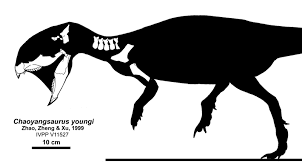
Chaoyangsaurus
Chaoyangsaurus was a genus of marginocephalian dinosaur belonging to the Ceratopsia, meaning "horned faces." This herbivorous dinosaur lived during the Late Jurassic period in what is now northeastern China. Despite a complex naming history, it was officially described in 1999, with its scientific name honoring both its discovery location and a pioneering Chinese paleontologist.

Beipiaosaurus
Beipiaosaurus is a genus of therizinosauroid theropod dinosaur that lived in China during the Early Cretaceous period. Known for its distinctive primitive plumage, Beipiaosaurus was a relatively small dinosaur, measuring about 2.2 meters in length and weighing approximately 27 kilograms. Its classification as a theropod, despite herbivorous-like features, helped solidify the placement of therizinosaurs within the Theropoda.