
Chuanqilong
Chuanqilong is a genus of basal ankylosaurid dinosaur that lived during the Early Cretaceous period in what is now Liaoning Province, China. Known from a nearly complete juvenile skeleton, this medium-sized dinosaur was characterized by a triangular skull, osteoderm-covered body, and a tail lacking a club. It is closely related to Liaoningosaurus, with some research suggesting they may represent the same species at different life stages.
Key Facts
- ›Lived during the Early Cretaceous (Barremian to Aptian stages).
- ›Estimated length of 4.5 meters, though potentially larger as a juvenile.
- ›Possessed a triangular skull and a body covered in osteoderms and ossicles.
- ›Unlike derived ankylosaurids, its tail did not end in a club.
- ›Quadrupedal locomotion with robust limbs.
- ›Fossils were discovered in the Jiufotang Formation, Liaoning Province, China.

- Triangular skull
- Neck protected by cervical half rings
- Body covered in osteoderms and ossicles of various shapes and sizes
- Tail lacked a club
- Robust forelimbs and hindlimbs
Liaoningosaurus
China
About Chuanqilong
Chuanqilong, meaning "legendary dragon," is a genus of basal ankylosaurid dinosaur that roamed the Earth during the Early Cretaceous period. Its fossils were discovered in the Jiufotang Formation of Liaoning Province, China, a region known for its rich fossil record. This medium-sized dinosaur is primarily known from a nearly complete skeleton of a juvenile individual, providing valuable insights into its anatomy and evolutionary relationships.
Discovery and Naming
The single known specimen of Chuanqilong was unearthed by local farmers and subsequently described in 2014 by paleontologists Fenglu Han and colleagues. The generic name honors the legendary status of fossils from western Liaoning, while the specific epithet "chaoyangensis" notes the broader region of its discovery. The holotype specimen, CJPM V001, includes a nearly complete skull and skeleton, though the very end of the tail is missing. Its preservation is two-dimensional, with only the ventral side visible, and much of the skull and vertebral column are compressed or disarticulated.
Physical Characteristics and Diet
Chuanqilong is estimated to have been about 4.5 meters (14.8 feet) in length, although given the immature age of the type specimen, it may have grown larger. Distinctive features include a triangular skull and a neck adorned with cervical half rings, which are bands of osteoderms. Its entire body was covered in a variety of osteoderms and ossicles, providing significant armor. Unlike more derived ankylosaurids, Chuanqilong lacked a tail club. As an ankylosaurid, Chuanqilong was a herbivore, adapted to a plant-based diet. It moved on four robust limbs, classifying it as quadrupedal.
Classification and Paleoenvironment
Chuanqilong is classified as a basal ankylosaurid and exhibits strong similarities with the genus Liaoningosaurus. Some researchers have proposed that Chuanqilong might represent a later ontogenetic stage of Liaoningosaurus, suggesting they could be the same species. The Jiufotang Formation, where Chuanqilong was found, represents freshwater lacustrine environments that experienced seasonal fluctuations. This environment, coupled with infrequent volcanic activity, contributed to the exceptional preservation of fossils, including soft tissues and integument impressions in other species found within the same formation.
Source: Wikipedia ↗
Frequently Asked Questions
What does the name Chuanqilong mean?
The name Chuanqilong is derived from the Chinese words "Chuanqi," meaning "legendary," and "long," meaning "dragon." This name reflects the abundance of fossils found in western Liaoning and its dragon-like appearance.
Where was Chuanqilong discovered?
Fossils of Chuanqilong were discovered in the Jiufotang Formation of Liaoning Province, China. The skeleton was found by local farmers.
What period did Chuanqilong live in?
Chuanqilong lived during the Early Cretaceous period, specifically between the Barremian and Aptian stages. This time frame is estimated to be between 124.0 and 121 million years ago.
What did Chuanqilong eat?
As an ankylosaurid, Chuanqilong was a herbivore, meaning it primarily consumed plants. Its anatomy, typical of armored dinosaurs, is adapted for a plant-based diet.
What were the distinguishing physical characteristics of Chuanqilong?
Chuanqilong had a triangular skull and its neck was protected by cervical half rings made of osteoderms. Its body was covered in various osteoderms and ossicles, and unlike many other ankylosaurids, its tail did not feature a club.
Is Chuanqilong related to other dinosaurs?
Chuanqilong is considered a basal ankylosaurid and shows many similarities with Liaoningosaurus. Some research suggests that Chuanqilong might represent a later developmental stage of Liaoningosaurus.
Related Dinosaur species

Beipiaosaurus
Beipiaosaurus is a genus of therizinosauroid theropod dinosaur that lived in China during the Early Cretaceous period. Known for its distinctive primitive plumage, Beipiaosaurus was a relatively small dinosaur, measuring about 2.2 meters in length and weighing approximately 27 kilograms. Its classification as a theropod, despite herbivorous-like features, helped solidify the placement of therizinosaurs within the Theropoda.

Crichtonsaurus
Crichtonsaurus was a genus of herbivorous ankylosaurid dinosaur that lived in what is now China during the Late Cretaceous period. Named in honor of author Michael Crichton, the genus is now considered dubious, with its type species, Crichtonsaurus bohlini, being a nomen dubium due to a lack of unique diagnostic traits in the holotype and questionable referral of other specimens. A second species, Crichtonsaurus benxiensis, was later renamed Crichtonpelta.
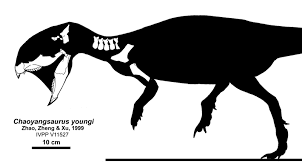
Chaoyangsaurus
Chaoyangsaurus was a genus of marginocephalian dinosaur belonging to the Ceratopsia, meaning "horned faces." This herbivorous dinosaur lived during the Late Jurassic period in what is now northeastern China. Despite a complex naming history, it was officially described in 1999, with its scientific name honoring both its discovery location and a pioneering Chinese paleontologist.