
Citipes
Citipes is an extinct genus of small-bodied caenagnathid theropod dinosaur that lived during the Late Cretaceous period in what is now Alberta, Canada. Its scientific name, meaning "fleet-footed" and "elegant," reflects its slender build and presumed agility. The genus has a complex taxonomic history, having been previously assigned to several other genera before being recognized as distinct in 2020.
Key Facts
- ›Citipes was a small caenagnathid theropod dinosaur.
- ›It lived during the Late Cretaceous period in the Dinosaur Park Formation of Alberta, Canada.
- ›Its scientific name, Citipes elegans, means "fleet-footed and elegant."
- ›The genus was formally established in 2020, consolidating a species with a convoluted taxonomic history.
- ›Adult Citipes are estimated to have been between 1-2 meters (3.3-6.6 ft) long.

- Small-bodied Caenagnathid theropod.
- Estimated adult length of 1–2 meters.
- Estimated height at the hip of 82 cm.
- Estimated mass of 32 kg.
- Possessed coossification of the distal ends of tarsals III and IV.
- Featured a lack of posterior protrusions on the proximal ends of metatarsals II and IV.
- Had a prominent ridge on the posterior surface of metatarsal III.
Elmisaurus, Leptorhynchos, Chirostenotes, Caenagnathus
North America
About Citipes
Citipes is an extinct genus of small-bodied caenagnathid theropod dinosaur that roamed the Earth during the Late Cretaceous period. Fossils of this agile dinosaur have been discovered in the Dinosaur Park Formation of Alberta, Canada. The scientific name, Citipes elegans, is derived from Latin, translating to "fleet-footed and elegant," a descriptor that likely reflects its slender build and presumed swiftness.
Discovery and Taxonomy
The history of Citipes is marked by a complex taxonomic journey. The material initially discovered in 1926 was first described in 1933 by William A. Parks as a new species of Ornithomimus, named Ornithomimus elegans. Over the decades, this specimen, along with others, was reassigned to various genera, including Macrophalangia, Elmisaurus, Chirostenotes, and Leptorhynchos. It was not until 2020 that Gregory Funston's comprehensive review of caenagnathid material from the Dinosaur Park Formation led to the establishment of the new genus, Citipes, to encompass these remains and resolve the long-standing taxonomic uncertainties.
Physical Characteristics and Behavior
Citipes is characterized by its relatively small size compared to its contemporaneous caenagnathid relatives like Caenagnathus and Chirostenotes. Adult individuals are estimated to have ranged from 1 to 2 meters (approximately 3.3 to 6.6 feet) in length, with an estimated mass of around 32 kilograms (71 pounds). Its physical attributes, including specific features of its tarsals and metatarsals, distinguish it from closely related genera. As a theropod, Citipes was likely bipedal, moving with a swift and graceful gait.
Paleoecology
Citipes inhabited the ecosystem of the Dinosaur Park Formation, a rich fossil site that provides insights into the Late Cretaceous environment of North America. While the precise diet of Citipes is not definitively known, caenagnathids generally lacked teeth and are considered to have been omnivores or carnivores, likely consuming a varied diet. The relative scarcity of caenagnathid remains compared to other coelurosaurs may be partly due to their smaller size and lack of teeth, potentially creating a sampling bias in the fossil record.
Source: Wikipedia ↗
Frequently Asked Questions
What does the name Citipes mean?
The generic name Citipes is derived from Latin, meaning "fleet-footed." The specific epithet "elegans" also comes from Latin and translates to "elegant."
Where was Citipes discovered?
Fossils of Citipes were discovered in the Dinosaur Park Formation in Alberta, Canada, specifically in the Sand Creek area of the Red Deer River.
What was the estimated size of Citipes?
Adult Citipes are estimated to have measured between 1 to 2 meters (3.3 to 6.6 ft) in length. Some estimates suggest a length of 2.1 meters (6.9 ft) and a weight of approximately 32 kilograms (71 lb).
What is the taxonomic history of Citipes?
The material now assigned to Citipes has a complex history, having been previously identified as Ornithomimus elegans, Macrophalangia elegans, Elmisaurus elegans, Chirostenotes elegans, and Leptorhynchos elegans before being established as the distinct genus Citipes in 2020.
What is known about the diet of Citipes?
While specific details about Citipes' diet are not extensively documented, caenagnathids generally lacked teeth and are believed to have consumed a varied diet. Their classification as theropods suggests they were likely omnivores or carnivores.
Related Dinosaur species

Archaeornithomimus
Archaeornithomimus was a medium-sized ornithomimosaurian theropod dinosaur that lived in what is now Inner Mongolia, China, during the Late Cretaceous period, approximately 96 million years ago. Named "ancient bird mimic," this dinosaur is thought to have been an omnivore, potentially feeding on plants, fruits, eggs, and small animals, and it likely possessed feathers and a keratinous beak.

Caenagnathasia
Caenagnathasia is a genus of small oviraptorosaurian theropod dinosaurs that lived in present-day Uzbekistan during the Late Cretaceous period. It is notable for being one of the smallest non-avian dinosaurs known, characterized by its beaked skull and bird-like features.
Citipati
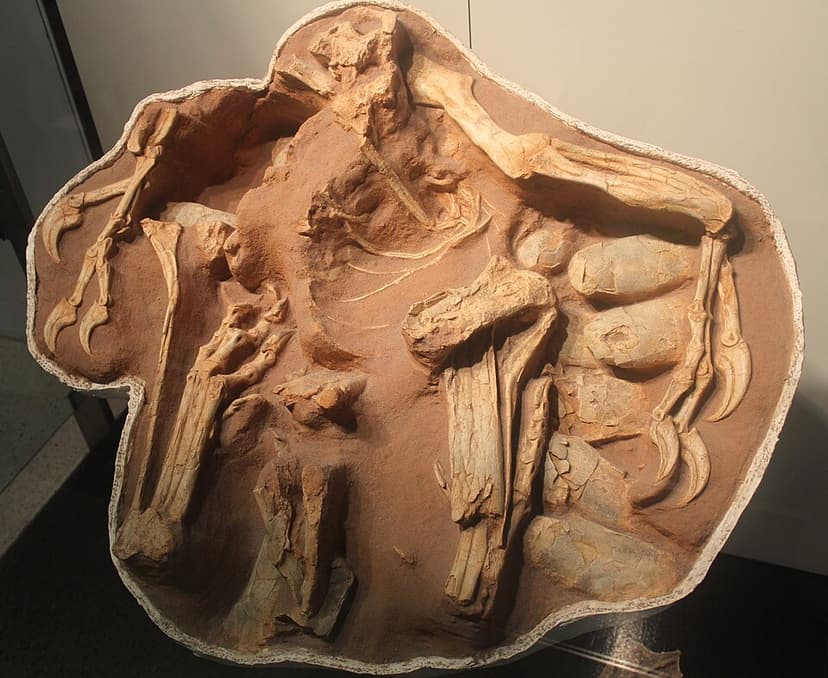
Citipati is a genus of large oviraptorid dinosaur that lived in Asia during the Late Cretaceous period. Known for its distinctive crest and toothless beak, Citipati is famous for specimens found in brooding positions on nests, providing crucial evidence for the link between non-avian dinosaurs and birds. Its diet may have been omnivorous, with evidence suggesting it possibly preyed on smaller animals to feed its young.