
Colepiocephale
Colepiocephale, meaning "knucklehead," was a genus of pachycephalosaurid dinosaur that lived during the Late Cretaceous period in what is now Alberta, Canada. This dome-headed dinosaur is distinguished by specific cranial features, including a steeply down-turned parietal bone and the absence of certain bony shelves.
Key Facts
- ›Colepiocephale lived during the middle Campanian stage of the Late Cretaceous period.
- ›Fossils were discovered in the Foremost Formation of Alberta, Canada.
- ›Its scientific name, Colepiocephale, means "knucklehead" due to its dome's appearance.
- ›It is characterized by a lack of lateral and posteriosquamosal shelves and a steeply down-turned parietal.
- ›The holotype specimen was originally described as Stegoceras lambei before being reclassified.
- ›Colepiocephale is considered one of the oldest pachycephalosaurs found in North America.

- Domed Skull
- Lack of Lateral and Posteriosquamosal Shelf
- Steeply Down-Turned Parietal
- Two Incipient Nodes Tucked Under the Posterior Margin of the Parietosquamosal Border
Stegoceras
North America
About Colepiocephale
Colepiocephale, a genus of pachycephalosaurid dinosaur, is known from fossils discovered in North America, primarily in Alberta, Canada, and Montana, USA. The name "Colepiocephale" originates from Latin and Greek, meaning "knucklehead," a fitting description for this dinosaur characterized by its distinctive domed skull.
History and Naming
The type species, Colepiocephale lambei, was initially described by paleontologists Barnum Brown and Erich Maren Schlaikjer in 1943 as a specimen of Troodon validus. Charles Mortram Sternberg later recognized it as a distinct species in 1945, naming it Stegoceras lambei in honor of the Canadian paleontologist Lawrence M. Lambe. Following further research and taxonomic reviews, Robert M. Sullivan reclassified Stegoceras lambei into its own genus, Colepiocephale, in 2003. He noted its closer relationship to Pachycephalosaurus than to Stegoceras.
Physical Characteristics and Paleobiology
Colepiocephale is identified by several unique cranial features. These include a prominent dome on its skull, the absence of specific bony shelves (lateral and posteriosquamosal shelves), and a parietal bone that angles steeply downwards. Additionally, two small, incipient nodes are present beneath the posterior edge of the parietosquamosal border. While its diet and locomotion are not definitively established from the available fossil record, its classification as a pachycephalosaurid suggests it was likely a herbivore and potentially bipedal.
Geological Context
Fossils of Colepiocephale have been recovered from the Foremost Formation in Alberta, Canada, and the Judith River Formation in Montana, USA. These formations date to the middle Campanian stage of the Late Cretaceous period, roughly 78 to 80 million years ago. The discovery of numerous Colepiocephale specimens in the Foremost Formation suggests it may have been the sole pachycephalosaurid present in that specific time and place, making it one of the oldest pachycephalosaurs found in North America. A redescription and revision in 2009 further supported its distinctiveness and ancient lineage among pachycephalosaurs.
Source: Wikipedia ↗
Frequently Asked Questions
What does the name Colepiocephale mean?
The name Colepiocephale is derived from Latin and Greek. It combines the Latin word 'colepium,' meaning 'knuckle,' with the Greek word 'cephale,' meaning 'head.' This name refers to the distinctive knuckle-like appearance of its domed skull.
Where were Colepiocephale fossils found?
The primary fossils of Colepiocephale were discovered in the Foremost Formation of Alberta, Canada. Later, specimens were also identified in the Judith River Formation of Montana, USA.
What geological period did Colepiocephale live in?
Colepiocephale lived during the Late Cretaceous period, specifically during the middle Campanian stage. This places its existence approximately 78 to 80 million years ago.
What are the distinctive physical characteristics of Colepiocephale?
Colepiocephale is recognized by its domed skull. Key diagnostic features include the absence of a lateral and posteriosquamosal shelf, a parietal bone that slopes steeply downwards, and two small nodes located under the posterior edge of the parietosquamosal border.
Who first described Colepiocephale?
The species now known as Colepiocephale was first described as Stegoceras lambei by Charles Mortram Sternberg in 1945. It was later renamed Colepiocephale by Robert M. Sullivan in 2003.
Was Colepiocephale the only pachycephalosaur in its environment?
Evidence suggests that Colepiocephale may have been the only pachycephalosaur present in its specific time and geographic interval within the Foremost Formation. A significant number of pachycephalosaur specimens from this formation exhibit features diagnostic to Colepiocephale.
Related Dinosaur species

Apatoraptor
Apatoraptor is a genus of caenagnathid dinosaur known from a single species, A. pennatus. Its name, "deceptive thief," reflects how its true identity was hidden for years. Discovered in Alberta, Canada, this dinosaur is notable for evidence of feathers.

Caenagnathus
Caenagnathus was a large oviraptorosaurian dinosaur that lived during the Late Cretaceous period in what is now Alberta, Canada. Known from partial remains, it possessed a toothless beak and likely had a coat of feathers. Its classification has been complex, with debates about its relationship to other caenagnathids like Chirostenotes and Anzu.
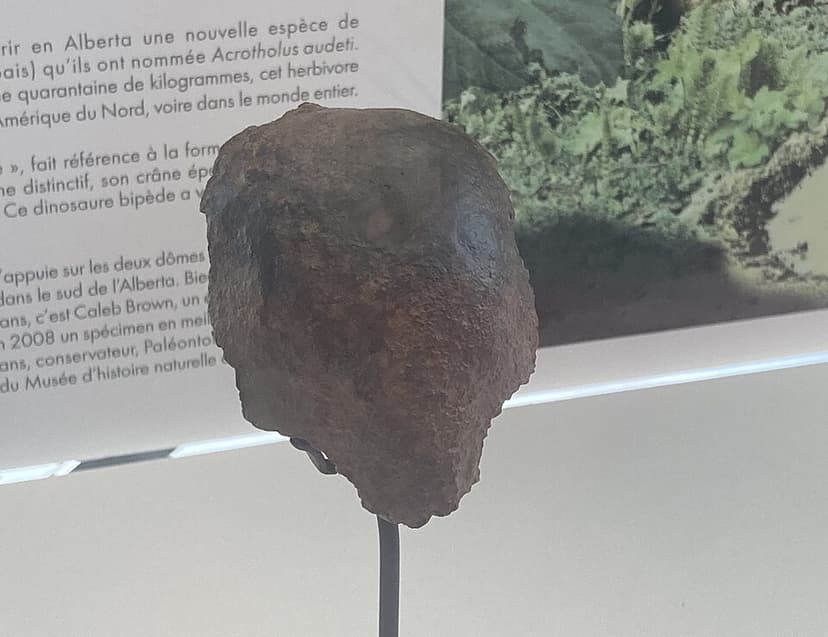
Acrotholus
Acrotholus is an extinct genus of pachycephalosaurian dinosaur that lived during the Santonian stage of the Late Cretaceous period in what is now Canada. It is notable for being one of the earliest known members of the pachycephalosaur family with a well-developed, dome-shaped skull. Acrotholus was a bipedal herbivore whose cranial dome has been theorized to have been used for intraspecies combat or display.