
Coloradisaurus
Herbivore·Late Triassic·La Rioja Province, Argentina·Quadrupedal
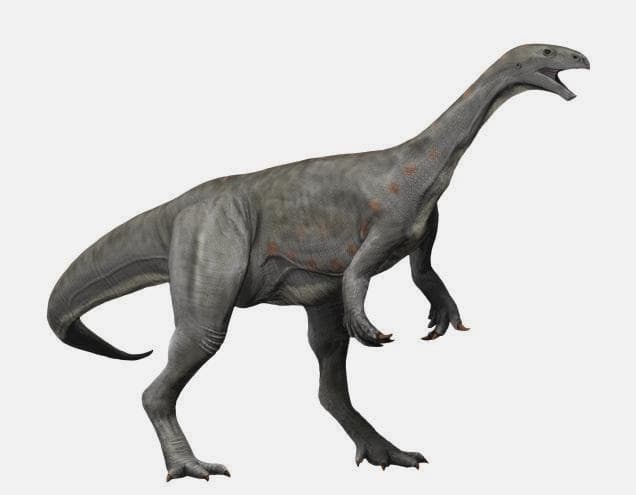
Coloradisaurus is a genus of sauropodomorph dinosaur that lived during the Late Triassic period. Its fossils have been discovered in what is now La Rioja Province, Argentina. The genus is known from a few specimens, including a mostly complete skull and parts of a skeleton.
Key Facts
- ›Lived during the Late Triassic period (Norian stage).
- ›Fossils discovered in La Rioja Province, Argentina.
- ›Named 'Los Colorados lizard' due to its discovery location.
- ›Estimated length of 3 meters and weight of 70 kg.
- ›Classified as a massospondylid sauropodomorph.

- Estimated length of 3 meters.
- Estimated mass of 70 kg.
- Possessed a mostly complete skull with well-preserved right side.
- Skull features include an angle between the pterygoid and quadratojugal rami nearly 90 degrees.
Lufengosaurus, Glacialisaurus
Argentina
About Coloradisaurus
Coloradisaurus is a genus of sauropodomorph dinosaur that roamed the Earth during the Late Triassic period. Its name, meaning 'Los Colorados lizard', is derived from the Los Colorados Formation in Argentina, where its fossilized remains were discovered. This dinosaur represents an early branch of the sauropodomorph lineage, the group that would eventually give rise to the giant long-necked dinosaurs of the Jurassic and Cretaceous periods.
Discovery and Classification
The fossils of Coloradisaurus were unearthed in the La Esquina locality of the Los Colorados Formation in La Rioja Province, Argentina. This geological formation dates to the Norian stage of the Late Triassic, approximately 213 million years ago. The genus was first described by José Bonaparte in 1979 as Coloradia brevis, but this name was already in use for a moth. David Lambert later proposed Coloradisaurus, a name that was formally diagnosed and credited to Peter Galton in 1990. Modern phylogenetic analyses consistently place Coloradisaurus within the Massospondylidae family, indicating a close relationship with genera like Lufengosaurus and Glacialisaurus.
Physical Characteristics and Lifestyle
Based on the known fossil material, Coloradisaurus is estimated to have been a relatively small dinosaur, reaching about 3 meters (10 feet) in length and weighing around 70 kilograms (150 pounds). The holotype specimen includes a mostly complete skull, which exhibits certain features, such as the angle between the pterygoid and quadratojugal rami, that are found in related sauropodomorphs. As a sauropodomorph, Coloradisaurus was likely a herbivore, feeding on plant material. While its exact locomotion is not definitively described, its classification suggests it was likely quadrupedal, walking on all fours.
Source: Wikipedia ↗
Frequently Asked Questions
What does the name Coloradisaurus mean?
The name Coloradisaurus means 'Los Colorados lizard'. This refers to the Los Colorados Formation where its fossils were found.
When did Coloradisaurus live?
Coloradisaurus lived during the Late Triassic period, specifically the Norian stage. This places its existence around 213 million years ago.
Where were Coloradisaurus fossils found?
The fossils of Coloradisaurus were discovered in the Los Colorados Formation of the Ischigualasto-Villa Unión Basin, located in what is now La Rioja Province, Argentina.
What was the estimated size of Coloradisaurus?
The holotype individual of Coloradisaurus is estimated to have been about 3 meters (10 feet) long. Its mass is estimated to have been around 70 kilograms (150 pounds).
What group of dinosaurs does Coloradisaurus belong to?
Coloradisaurus is classified as a massospondylid sauropodomorph. This means it is related to early long-necked, plant-eating dinosaurs.
Related Dinosaur species

Crosbysaurus
Crosbysaurus is a genus of extinct archosauromorph that lived during the Late Triassic period. Known primarily from its teeth, this dinosaur was first identified as an ornithischian but is now considered likely an archosauromorph, possibly within Archosauriformes. Its teeth suggest a herbivorous diet.
Asylosaurus
Asylosaurus is a genus of basal sauropodomorph dinosaur that lived in England during the Late Triassic period. Its name, "unharmed or sanctuary lizard," reflects its survival from potential wartime destruction of other fossils. This dinosaur is known from partial remains discovered in Bristol, England.
Blikanasaurus
Blikanasaurus is a genus of sauropodomorph dinosaur that lived in South Africa during the Late Triassic period. It is known only from partial hindlimb bones, which suggest it was a robust, quadrupedal animal. Due to the fragmentary nature of its fossils, much about its anatomy and classification remains uncertain.