
Crosbysaurus
Herbivore·Late Triassic·Southwestern United States
Crosbysaurus is a genus of extinct archosauromorph that lived during the Late Triassic period. Known primarily from its teeth, this dinosaur was first identified as an ornithischian but is now considered likely an archosauromorph, possibly within Archosauriformes. Its teeth suggest a herbivorous diet.
Key Facts
- ›Crosbysaurus lived during the Late Triassic period.
- ›Fossils have been found in Arizona, New Mexico, North Carolina, Texas, and Utah.
- ›It is known from the Chinle Formation and Dockum Group.
- ›The only known fossil material consists of teeth.
- ›Teeth are small, triangular, and serrated, with compound denticles.
- ›It is presumed to have been a herbivore based on its teeth.

- Small teeth, approximately 3-5 millimeters tall.
- Teeth are triangular in outline.
- Teeth have serrations on both edges.
- Many teeth exhibit 'compound denticles', which are subdivisions of the serrations.
Revueltosaurus, Tecovasaurus, Krzyzanowskisaurus, Lucianosaurus, Protecovasaurus
United States
About Crosbysaurus
Crosbysaurus is an extinct genus of archosauromorph that roamed the Earth during the Late Triassic period. Its fossil record is sparse, consisting solely of individual teeth, which has led to its classification as a dinosaur known only from its dentition. These teeth are small, typically measuring between 3 and 5 millimeters in height, and are characterized by a triangular outline with serrations along both edges. Many of these serrations exhibit further subdivisions, known as compound denticles, with those on the trailing edge being more pronounced than those on the leading edge.
Classification and Diet
When first described in 2004 by Andrew Heckert, Crosbysaurus was identified as an ornithischian dinosaur. However, subsequent research based on the distinctive features of its teeth has led to its reclassification as a likely archosauromorph, potentially belonging to the Archosauriformes clade. The morphology of its teeth, particularly their blunt outline, strongly suggests that Crosbysaurus was a herbivore, subsisting on plant matter. Despite the limited fossil evidence, the genus is considered valid due to its differentiation from other tooth-based genera found in the same geological formations, such as Revueltosaurus and Tecovasaurus.
Geographic and Temporal Distribution
Fossil evidence of Crosbysaurus has been recovered from several states in the southwestern United States, including Arizona, New Mexico, Texas, and Utah, as well as from North Carolina. These finds are predominantly associated with rock units such as the Chinle Formation and the Dockum Group, which are chronologically situated within the Late Triassic epoch. The discovery of eleven specimens, each comprising a single tooth, provides the entirety of our current understanding of this ancient creature.
Source: Wikipedia ↗
Frequently Asked Questions
What period did Crosbysaurus live in?
Crosbysaurus lived during the Late Triassic period. This was a significant time in Earth's history, marking a transition for many life forms.
Where were Crosbysaurus fossils found?
Fossils of Crosbysaurus have been discovered in several locations across the United States, including Arizona, New Mexico, North Carolina, Texas, and Utah. These finds are often associated with the Chinle Formation and Dockum Group rock units.
What did Crosbysaurus eat?
Based on the morphology of its teeth, Crosbysaurus is presumed to have been a herbivore. The teeth are described as triangular and serrated, features common among plant-eating dinosaurs.
What kind of dinosaur was Crosbysaurus?
Crosbysaurus was originally classified as an ornithischian dinosaur. However, further analysis of its teeth suggests it is more likely an archosauromorph, possibly belonging to the Archosauriformes group.
What is known about Crosbysaurus's physical appearance?
Very little is known about Crosbysaurus's overall physical appearance, as the only fossil material discovered consists of individual teeth. These teeth are small, measuring approximately 3-5 millimeters in height, and possess a triangular outline with serrations on both edges.
Related Dinosaur species

Coloradisaurus
Coloradisaurus is a genus of sauropodomorph dinosaur that lived during the Late Triassic period. Its fossils have been discovered in what is now La Rioja Province, Argentina. The genus is known from a few specimens, including a mostly complete skull and parts of a skeleton.
Agnosphitys
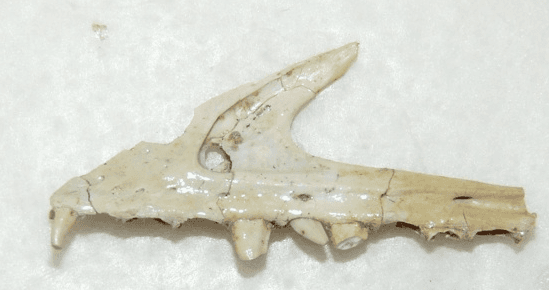
Agnosphitys is a genus of dinosauriform that lived during the Late Triassic period. Only one species, A. cromhallensis, is known, with its fossils discovered in Avon, England. Its precise classification has been debated, with some analyses placing it as an early theropod or a member of Guaibasauridae, while more recent studies suggest it was a silesaurid.
Alwalkeria
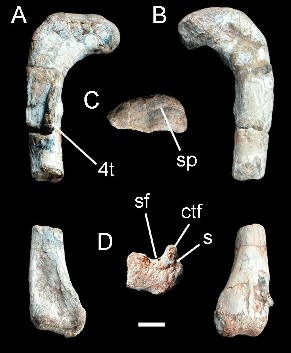
Alwalkeria is a genus of extinct avemetatarsalian from the Late Triassic of India. Originally described as a theropod dinosaur, subsequent research has revealed its fossil material to be chimaeric, belonging to multiple unrelated taxa. Its precise classification remains uncertain, with current interpretations placing it within Avemetatarsalia of indeterminate placement.