
Daurlong
Daurlong is an extinct genus of dromaeosaurid dinosaur that lived during the Early Cretaceous period in what is now China. It is known from a single, nearly complete skeleton, which is significant for preserving an intestinal region, a feature rarely seen in theropods closely related to birds.
Key Facts
- ›Daurlong lived during the Aptian age of the Early Cretaceous period.
- ›It was a MID-sized dromaeosaurid, estimated to be about 1.5 meters long.
- ›The genus name "Daurlong" means "Daur dragon."
- ›The species "wangi" honors Wang Junyou, director of the Inner Mongolia Museum of Natural History.
- ›Fossils preserve plumage along the back of the skull and neck, and the edges of the tail.
- ›Daurlong is the first described dromaeosaurid closely related to birds to show a preserved intestinal region.

- Mid-Sized Dromaeosaurid
- Estimated Length of Approximately 1.5 Meters
- Preserved Plumage Along the Back of the Skull and Neck
- Preserved Plumage Along the Edges of the Tail
- Near-Perfectly Articulated Skull
- Forelimbs Less Than 60% the Length of Hindlimbs
Tianyuraptor, Zhenyuanlong
China
About Daurlong
Daurlong is an extinct genus of dromaeosaurid dinosaur from the Early Cretaceous period, known from what is now China. The genus contains a single species, Daurlong wangi, which is recognized from a remarkably well-preserved and nearly complete skeleton. This fossil is particularly significant as it represents the first described occurrence of a preserved intestinal region in a theropod dinosaur that was closely related to birds.
Discovery and Naming
The holotype specimen of Daurlong wangi was unearthed in sediments belonging to the Longjiang Formation, specifically from the Pigeon Hill locality in Morin Dawa Daur Autonomous Banner, Inner Mongolia, China. This region is dated to the Aptian age of the Early Cretaceous. The specimen includes an almost perfectly articulated skull and a nearly complete skeleton. In 2022, the genus and species were formally described by paleontologists Xuri Wang, Andrea Cau, Bin Guo, Feimin Ma, Gele Qing, and Yichuan Liu. The genus name, "Daurlong," is derived from a combination of a reference to the Daur Nation and the Chinese word "龙" (lóng), meaning "dragon." The specific epithet, "wangi," was chosen to honor Wang Junyou, the director of the Inner Mongolia Museum of Natural History.
Description and Classification
Daurlong is characterized as a mid-sized dromaeosaurid, with an estimated length of approximately 1.5 meters (4.9 feet). The preserved specimen is notably complete, with its forelimbs being less than 60% of the length of its hindlimbs. The fossil exhibits evidence of plumage along the back of the skull and neck, as well as along the edges of the tail. Unlike some other dromaeosaurids, such as Zhenyuanlong, the fossil does not preserve pennaceous remiges (wing feathers) or rectrices (tail feathers). The discovery of a bluish layer within the ribcage, matching the intestinal tract seen in the Scipionyx holotype, provides rare insights into the digestive system of this theropod. Phylogenetic analyses have placed Daurlong within the Dromaeosauridae family, in a clade that also includes Tianyuraptor and Zhenyuanlong.
Source: Wikipedia ↗
Frequently Asked Questions
What does the name Daurlong mean?
The genus name 'Daurlong' is a combination of a reference to the Daur Nation and the Chinese word '龙' (lóng), which means 'dragon.' Therefore, Daurlong translates to 'Daur dragon.'
When did Daurlong live?
Daurlong lived during the Aptian age of the Early Cretaceous period. This places its existence in a specific timeframe within the broader Cretaceous era.
What is significant about the Daurlong fossil discovery?
The nearly complete skeleton of Daurlong is significant because it represents the first described occurrence of a preserved intestinal region in a theropod dinosaur that was closely related to birds. This offers rare insights into the internal anatomy of such dinosaurs.
How large was Daurlong?
Daurlong was a mid-sized dromaeosaurid, with an estimated length of about 1.5 meters (4.9 feet). Its preserved specimen was comparable in size to other dromaeosaurids like Tianyuraptor and Zhenyuanlong.
Where were the fossils of Daurlong found?
The holotype specimen of Daurlong was discovered in sediments of the Longjiang Formation, specifically at the Pigeon Hill locality in Morin Dawa Daur Autonomous Banner, Inner Mongolia, China.
Related Dinosaur species
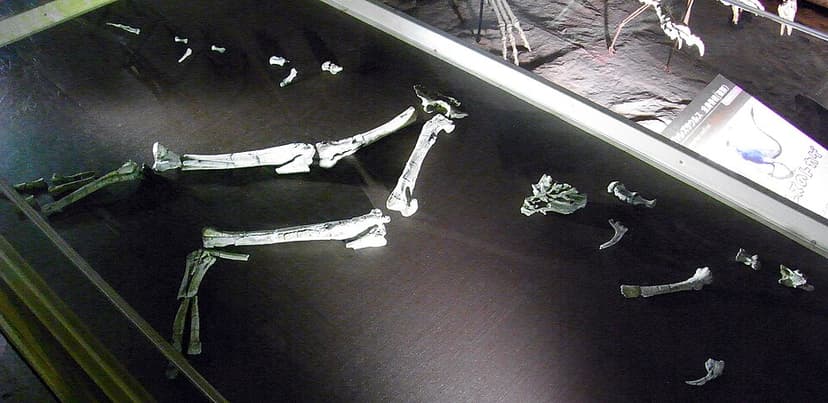
Bannykus
Bannykus is an extinct genus of alvarezsauroid dinosaur that lived during the Early Cretaceous period. Discovered in Inner Mongolia, China, this theropod is notable for its transitional forelimb morphology, which showed significant reduction but was less specialized than later alvarezsauroids. Evidence suggests Bannykus was a carnivore, likely using its forelimbs for digging.
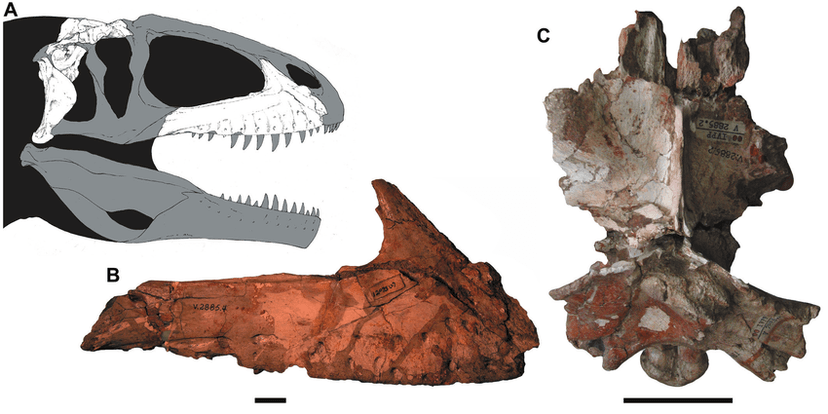
Alashansaurus
Shaočilong (meaning "shark toothed dragon") was an extinct genus of theropod dinosaur that lived during the Early Cretaceous period in what is now China. Initially classified as a carcharodontosaurid, its exact phylogenetic placement has been subject to debate, with some studies suggesting it may be a tyrannosauroid or a member of the polytomic allosauroid group. Shaochilong was a relatively small carnosaur, estimated to be around 5 to 6 meters in length and weighing approximately 500 kilograms.

Chilantaisaurus
Chilantaisaurus was a large, extinct theropod dinosaur that inhabited what is now China during the Late Cretaceous period. Known primarily from an incomplete skeleton, it was characterized by its massive forelimbs, particularly its humerus, and robust hindlimbs. Its exact classification has been a subject of debate among paleontologists, with various studies placing it within or related to groups like Carcharodontosauria, Spinosauridae, or Coelurosauria.