
Diodorus
Omnivore·Late Triassic·Morocco·Quadrupedal, facultative bipedal
Diodorus is a genus of silesaurid dinosauromorph that lived during the Late Triassic in what is now Morocco. Fossils were discovered in the Timezgadiouine Formation, and the genus was named for mythological and historical figures. Diodorus was a quadrupedal animal with a beak-like jaw and leaf-shaped teeth, estimated to be up to 2.3 meters long.
Key Facts
- ›Diodorus lived during the Late Triassic period, approximately 230 million years ago.
- ›Its fossils were found in the Timezgadiouine Formation of Morocco.
- ›Estimated to be up to 2.3 meters (7.5 ft) in length.
- ›Possessed a beak-like front of the lower jaw and leaf-shaped teeth.
- ›Likely a quadrupedal animal, though capable of bipedal locomotion.
- ›Belongs to the Silesauridae family, considered a sister group to dinosaurs.
- Estimated length up to 2.3 meters.
- Beak-like front of the lower jaw.
- Leaf-shaped teeth with serrations.
- Forward-tilted teeth that decrease in size towards the front of the jaw.
- Distinct ridge on the side of the lower jaw.
- Long limbs.
Silesaurus, Sacisaurus, Asilisaurus, Lutungutali, Eucoelophysis, Kwanasaurus
Africa
About Diodorus
Diodorus is a genus of silesaurid dinosauromorph, a group closely related to dinosaurs, that inhabited North Africa during the Late Triassic period. The scientific name, Diodorus scytobrachion, honors both mythological figures and historical scholars, with the specific epithet referring to a 'leathery arm'. Fossils of Diodorus have been recovered from the Timezgadiouine Formation in Morocco.
Physical Characteristics and Behavior
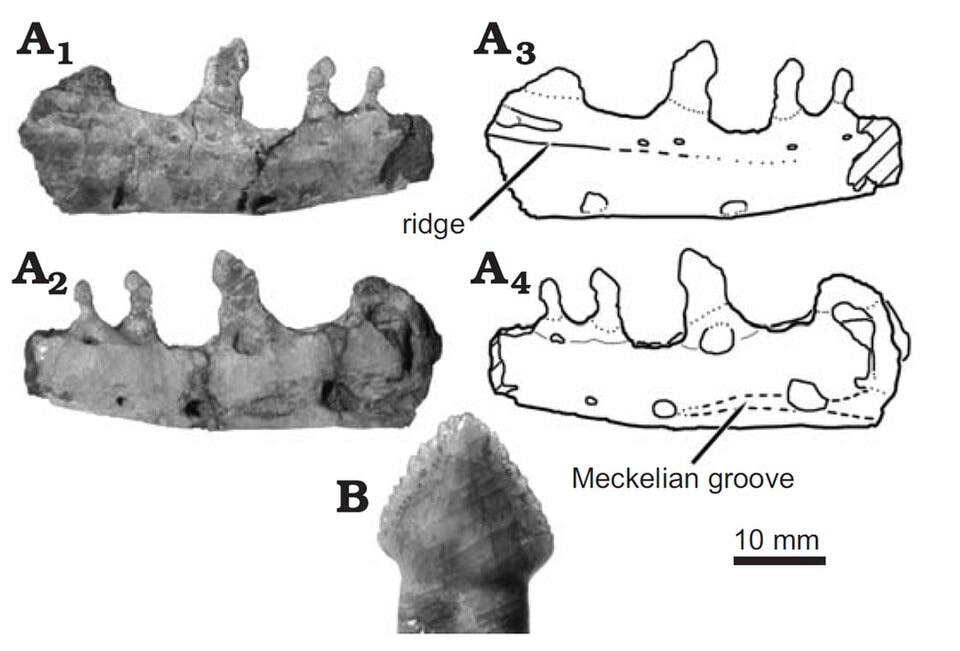
Estimated to reach lengths of up to 2.3 meters (7.5 feet), Diodorus shared several characteristics with other silesaurs, including a beak-like front to its lower jaw and leaf-shaped, serrated teeth. Distinctive features of Diodorus include forward-tilted teeth that decrease in size towards the front of the jaw and a unique ridge along the side of the lower jaw. The Meckelian groove in its jaw also exhibits an unusual expansion in height towards the rear. Its limb anatomy suggests a primarily quadrupedal stance, though it was likely capable of bipedal locomotion. While the teeth suggest a herbivorous or omnivorous diet, evidence from related genera indicates a diet that could include insects.
Classification and Discovery
Diodorus belongs to the family Silesauridae, which is considered a sister group to the dinosaurs within the broader clade Dinosauromorpha. The first fossils of Diodorus were scientifically described in 2012 by Christian F. Kammerer, Sterling J. Nesbitt, and Neil H. Shubin. The discovery in Morocco provided crucial evidence for the presence of silesaurids in Africa during the Late Triassic, suggesting a wider geographic distribution for this group than previously understood. The holotype specimen consists of a partial dentary bone (lower jaw), with assigned specimens including isolated teeth, humeri, a metatarsal, and a femur.
Source: Wikipedia ↗
Frequently Asked Questions
What does the name Diodorus mean?
The genus name Diodorus honors the mythological king Diodorus and the ancient historian Diodorus Siculus. The specific name, scytobrachion, is ancient Greek for 'leathery arm' and also honors the mythographer Dionysius Scytobrachion.
Where were Diodorus fossils found?
Fossils of Diodorus were discovered in the Timezgadiouine Formation of the Argana Basin in northeastern Morocco.
What did Diodorus eat?
While most silesaurids are inferred to have been herbivorous based on their teeth, coprolites assigned to Silesaurus (a related genus) contained beetles, suggesting they may have been omnivorous.
How big was Diodorus?
Diodorus is estimated to have been up to 2.3 meters (7.5 feet) long and is described as a 'small' silesaurid.
How did Diodorus move?
Diodorus had long limbs and a quadrupedal posture, indicating it primarily walked on four legs. However, it was likely also capable of running bipedally.
What is Diodorus related to?
Diodorus is a silesaurid dinosauromorph, belonging to a clade that includes dinosaurs. Silesauridae is generally considered a sister group to the dinosaurs within the wider group Dinosauromorpha.
Related Dinosaur species

Ambopteryx
Ambopteryx was a genus of scansoriopterygid dinosaur that lived in China during the Late Jurassic period. It is notable for being one of the few dinosaurs discovered with both feather coverings and bat-like membranous wings, a feature it shared with its close relative, Yi. Ambopteryx possessed a short head, a hyper-elongate third finger likely used for wing support, and a short tail ending in a pygostyle.

Deinocheirus
Deinocheirus was a colossal ornithomimosaur that roamed during the Late Cretaceous period, approximately 70 million years ago. Initially known only from its massive arms, later discoveries revealed a bulky, sail-backed dinosaur with a duck-like bill. Its unusual combination of features made its classification a long-standing mystery.

Caenagnathasia
Caenagnathasia is a genus of small oviraptorosaurian theropod dinosaurs that lived in present-day Uzbekistan during the Late Cretaceous period. It is notable for being one of the smallest non-avian dinosaurs known, characterized by its beaked skull and bird-like features.