
Dornraptor
Dornraptor is an extinct genus of averostran theropod dinosaur that lived during the Early Jurassic period in what is now England. Known from fragmentary remains, including a knee joint and femur, it was initially misidentified as an early armored dinosaur before being recognized as a distinct theropod species. Its name, "Dorset robber," reflects its discovery location and predatory nature.
Key Facts
- ›Dornraptor lived during the Early Jurassic, specifically the Late Sinemurian stage.
- ›Its fossils were discovered in Charmouth, Dorset, England.
- ›The genus name "Dornraptor" means "Dorset robber or thief."
- ›It is classified as an averostran theropod dinosaur.
- ›Key features include a large scar on the femur, a medial distal crest, and a prominent anterior trochanter.
- ›Dornraptor likely inhabited terrestrial environments within a shallow marine ecosystem.
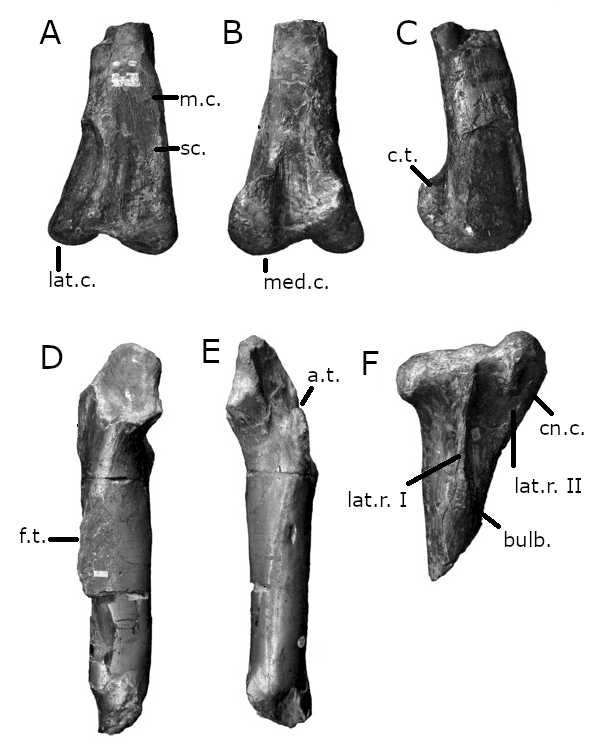
- Large scar along the medial side of the distal end of the femur
- Medial distal crest on the femur
- Prominent anterior trochanter on the femur, separated from the head by a cleft
- Shallow trochanteric shelf on the femur
- Foramen on the anterior surface of the femur
- Deep anterior sulcus between the articular condyles of the femur
- Medial condyle of the femur with similar anteroposterior diameter to the width of the articular surface
- Elongated cnemial crest on the tibia reaching proximally beyond the medial and lateral condyles
- Pronounced fibular crest on the tibia extending up to the proximal end
- Sharp crest on the lateral side of the tibia parallel to the fibular crest
- Distinct bulge distally on the tibia
- Separate crest on the proximal end of the tibia, not connected to the fibular crest
- Noticeable cleft between the posterior condyles of the tibia
- Lateral condyle of the tibia forms an acute angle when viewed from the medial side
Dracoraptor, Sarcosaurus, Elaphrosaurus, Cryolophosaurus, Allosaurus, Piatnitzkysaurus, Eoabelisaurus, Ceratosaurus, Dilophosaurus, Liliensternus, Megalosaurus, Sinraptor, Chuandongocoelurus, Dubreuillosaurus, Eustreptospondylus
England
About Dornraptor
Dornraptor is an extinct genus of averostran theropod dinosaur that roamed the Earth during the Early Jurassic period, specifically the Late Sinemurian stage. Its name, "Dorset robber or thief," reflects both its discovery location in Charmouth, Dorset, England, and its predatory nature. The genus is represented by a single species, Dornraptor normani.
History of Discovery
The fossil material now attributed to Dornraptor was first discovered in Charmouth, Dorset, by James Harrison in 1858. Initially, Sir Richard Owen described these fragmentary leg bones, including a knee joint and a partial femur, as belonging to the early armored dinosaur Scelidosaurus in 1859. Over time, subsequent studies began to question this classification, suggesting theropod affinities instead. The material was informally referred to as "Merosaurus newmani" in an unpublished manuscript. Researchers like Carrano and Sampson, and Naish and Martill, proposed it belonged to basal tetanuran theropods, while Roger Benson suggested possible coelophysoid connections, ultimately concluding it was an indeterminate theropod. In 2024, Matthew G. Baron formally described Dornraptor normani as a new genus and species, designating the right knee joint as the holotype specimen. The partial fibula originally described by Owen has since been lost.
Description and Classification
Dornraptor possesses several distinct anatomical features, particularly in its femur and tibia. These include a significant scar on the medial side of the distal femur, a medial distal crest, and a prominent anterior trochanter separated from the femoral head by a cleft. The tibia exhibits an elongated cnemial crest and a pronounced fibular crest. Early analyses suggested coelophysoid, tetanuran, or ceratosaurian affinities. More recent phylogenetic analyses, utilizing modified datasets, place Dornraptor as an early-branching averostran theropod, closely related to taxa like Elaphrosaurus and Cryolophosaurus, and part of a clade sister to ceratosaurs. Its classification as a tetanuran is supported by features such as a bulbous fibular crest, found in other tetanurans like Megalosaurus and Sinraptor.
Paleoenvironment
The fossils of Dornraptor were recovered from formations that indicate a predominantly shallow marine environment, characterized by marine invertebrates and marine reptiles. However, Dornraptor itself was a terrestrial predator, likely inhabiting islands within this shallow sea. The broader landscape of the Early Jurassic Dorset area was part of the Wessex Basin, an archipelago of islands influenced by regional and global marine transgressions. While the waters teemed with marine life, the terrestrial ecosystems supported flora including conifers and seed ferns, suggesting arid or semi-arid conditions. Dornraptor is thought to have been a terrestrial apex predator in its environment, coexisting with other dinosaurs like Scelidosaurus and smaller theropods, as well as pterosaurs and synapsids.
Source: Wikipedia ↗
Frequently Asked Questions
What does Dornraptor mean?
The name Dornraptor combines 'Dorn,' an abbreviated form of the Anglo-Saxon name for Dorset, England, with the Latin word 'raptor,' meaning 'robber' or 'thief.' Thus, it translates to 'Dorset robber or thief.'
When did Dornraptor live?
Dornraptor lived during the Early Jurassic period, specifically within the Late Sinemurian stage. This places its existence approximately 199 to 190 million years ago.
Where were Dornraptor fossils found?
Fossils attributed to Dornraptor were discovered in Charmouth, Dorset, England. These findings are associated with the Charmouth Mudstone Formation and the underlying Blue Lias Formation.
What kind of dinosaur was Dornraptor?
Dornraptor was a theropod dinosaur, belonging to the averostran group. Theropods are characterized by their hollow bones and three-toed feet, and many were bipedal carnivores.
What are the distinctive physical characteristics of Dornraptor?
Dornraptor is recognized by specific features on its femur and tibia, including a large scar on the medial side of the femur's distal end, a medial distal crest, and a prominent anterior trochanter separated from the head by a cleft. It also had an elongated cnemial crest on the tibia.
What was the environment like where Dornraptor lived?
Dornraptor lived in an environment that was largely shallow marine, with the Charmouth Mudstone and Blue Lias formations containing numerous marine fossils. However, Dornraptor itself was a terrestrial predator, likely inhabiting islands within this shallow sea.
Related Dinosaur species

Afrovenator
Afrovenator, meaning "African hunter," was a large theropod dinosaur that roamed Africa during the Middle to Late Jurassic period. Known from a single, relatively complete skeleton, it is distinguished by several unique anatomical features and is considered the only definitive Gondwanan megalosaur.

Condorraptor
Condorraptor is an extinct genus of theropod dinosaur that lived during the Early Jurassic period in what is now Argentina. It was one of the earliest large South American theropods, characterized by unique anatomical features in its vertebrae and tibia. Its genus name translates to 'robber from Cerro Condor,' reflecting its predatory nature and discovery location.
Compsognathus
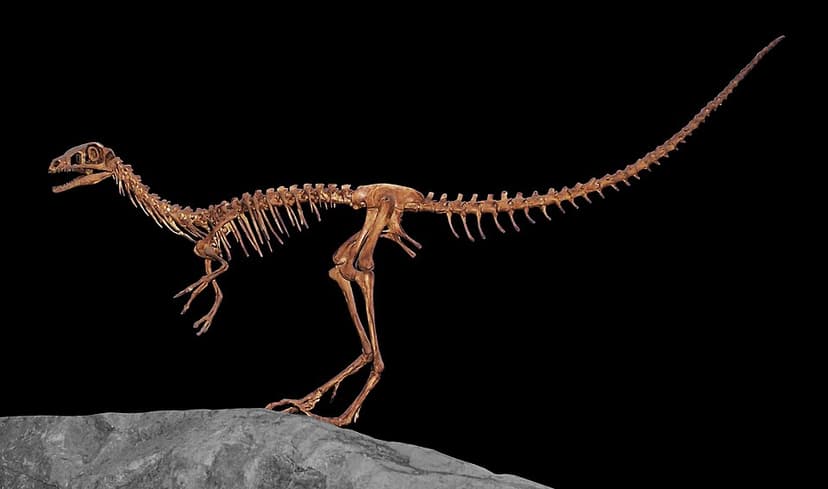
Compsognathus was a small, bipedal, carnivorous theropod dinosaur that lived approximately 150 million years ago during the late Jurassic period. Known for its chicken-like size, it is famous for being one of the first non-avialan dinosaurs discovered with a nearly complete skeleton. Its diet consisted of small vertebrates, evidenced by the remains of lizards found within its fossilized stomach.