
Acris gryllus
The southern cricket frog (Acris gryllus) is a small hylid frog native to the Southeastern United States. It is distinguished from its close relative, the northern cricket frog, by a more pointed snout, longer hind legs, and a sharply defined black stripe on the back of its thigh. This species is typically found in sunny, open areas near water bodies.
Key Facts
- ›Adults measure between 16–32 MM (0.75–1.5 inches) in length.
- ›Characterized by a pointed snout and hind legs that extend beyond the snout when folded forward.
- ›Found in coastal plain bogs, bottomland swamps, ponds, and ditches, preferring sunny open areas.
- ›Feeds on insects, spiders, and other arthropods.
- ›Males produce a loud, rapid 'gick, gick, gick' advertisement call.
- ›Lays up to 150 eggs at a time, potentially producing multiple egg masses per season.
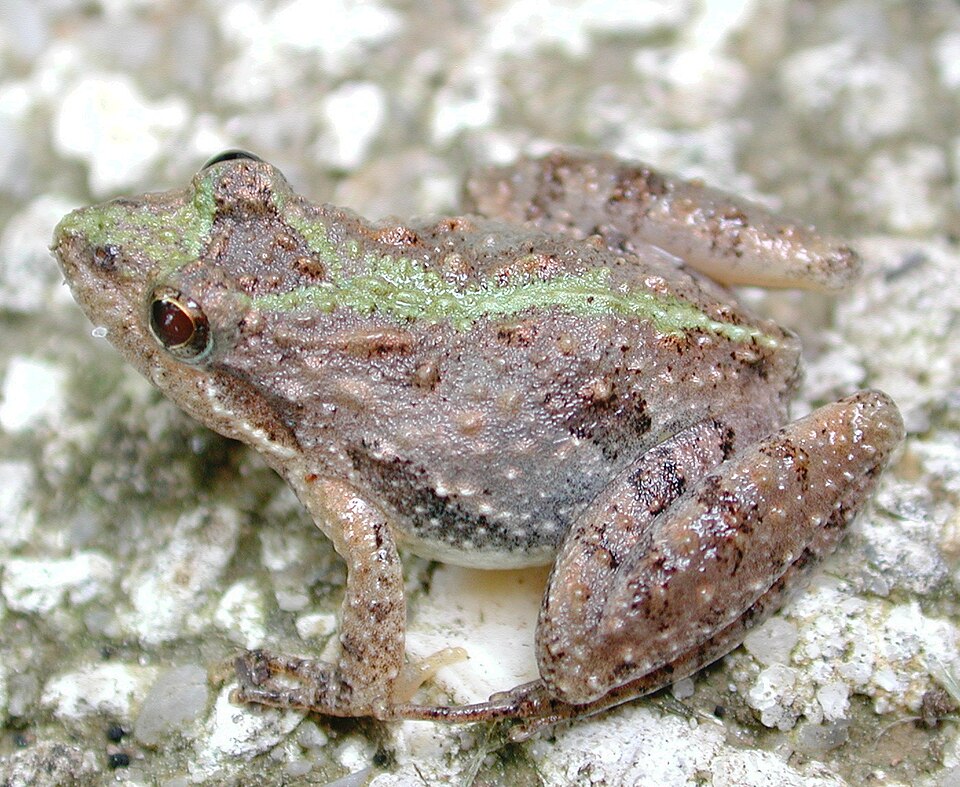
Southeastern Cricket Frog, Florida Cricket Frog, Coastal Plain Cricket Frog
Wetlands, Coastal Plain, Ponds, Swamps, Bogs, Ditches
Virginia, North Carolina, South Carolina, Georgia, Alabama, Mississippi, Florida
- Pointed Snout
- Hind Leg More Than Half Body Length
- Heel of Hind Leg Usually Reaches Beyond Snout When Extended
- Sharply Defined Black Stripe On Back of Thigh
- Sparse Webbing On Rear Feet
About Acris gryllus
Southern Cricket Frog (Acris gryllus)
The southern cricket frog, scientifically known as Acris gryllus, is a small amphibian native to the Southeastern United States. It is a member of the Hylidae family and is closely related to the northern cricket frog, Acris crepitans, with which it was formerly considered the same species. The name 'Acris' is derived from the Greek word for locust, and 'gryllus' is Latin for cricket, reflecting its small size and vocalizations.
Description and Identification
Acris gryllus is notably small, with adult individuals measuring between 16 to 32 mm (0.75 to 1.5 inches) in snout-to-vent length. Several key characteristics differentiate it from Acris crepitans. The southern cricket frog possesses a more pointed snout, whereas A. crepitans has a blunter one. Its hind legs are proportionally longer, exceeding half the body length, and when folded forward, the heel typically reaches beyond the snout, a trait not observed in A. crepitans. Furthermore, Acris gryllus can achieve longer jumps than its northern counterpart. A distinct physical marker is the sharply defined black stripe found on the back of the thigh, contrasting with the ragged stripe seen in A. crepitans. The webbing on the rear feet of the southern cricket frog is sparse, while A. crepitans exhibits more extensive webbing. There is also evidence that the vertebral stripe's color in southern cricket frogs can vary over time and even change within a single frog's lifespan.
Range and Habitat
The southern cricket frog is characteristic of the coastal plain and inhabits a variety of wetland environments. Its preferred habitats include coastal plain bogs, bottomland swamps, ponds, and ditches. It is often found in sunny, open areas and is typically not observed in wooded regions. The subspecies Acris gryllus gryllus is distributed across the Atlantic Coastal Plain, ranging from southeastern Virginia through the Carolinas, Georgia, Alabama, and Mississippi, extending westward to the Mississippi River. This subspecies is mainly found east of the Fall Line but can be found in more upland Piedmont areas along river valleys. The subspecies Acris gryllus dorsalis is widespread throughout the Florida peninsula.
Habits and Diet
Acris gryllus is active throughout the year when warm weather conditions prevail. Its diet primarily consists of insects, spiders, and other small arthropods. They are active hunters, foraging for these small invertebrates within their aquatic and semi-aquatic environments.
Reproduction
Breeding activities for the southern cricket frog occur during the late spring and summer months. The males are known for their distinctive advertisement call, a loud and rapid series of 'gick, gick, gick' sounds, used to attract females. Females lay clutches of up to 150 eggs, and it is possible for a single female to produce more than one mass of eggs within a breeding season.
Source: Wikipedia ↗
Frequently Asked Questions
What are the main differences between the southern cricket frog and the northern cricket frog?
The southern cricket frog (Acris gryllus) has a more pointed snout compared to the northern cricket frog's blunt snout. Additionally, Acris gryllus possesses longer hind legs that usually reach beyond the snout when extended, a sharply defined black stripe on the back of the thigh, and sparser webbing on its rear feet.
Where does the southern cricket frog live?
This frog is native to the Southeastern United States and inhabits coastal plain bogs, bottomland swamps, ponds, and ditches. It generally prefers sunny, open areas and is not typically found in woodlands.
What does the southern cricket frog eat?
The diet of the southern cricket frog consists of insects, spiders, and other arthropods. They are active in warm weather and forage for these small prey items.
How does the southern cricket frog reproduce?
Breeding occurs in late spring and summer. Males emit a distinctive advertisement call described as a loud, rapid 'gick, gick, gick'. Females lay up to 150 eggs per clutch, and can produce more than one egg mass in a single season.
What are the physical characteristics of the southern cricket frog?
Acris gryllus is a small frog, measuring 16–32 mm in length. Key features include a pointed snout, hind legs that are more than half the length of the body and extend beyond the snout, a distinct black stripe on the back of the thigh, and sparse webbing on the hind feet.
Related Frogs

Adelophryne maranguapensis
Adelophryne maranguapensis is a small frog species found exclusively in the Serra de Maranguape in Ceará state, northeastern Brazil. Distinctive for its dark to reddish-brown dorsal coloration with an hourglass-like pattern and a dark lateral band, this species inhabits the Atlantic Forest, often found in leaf litter or within bromeliads.
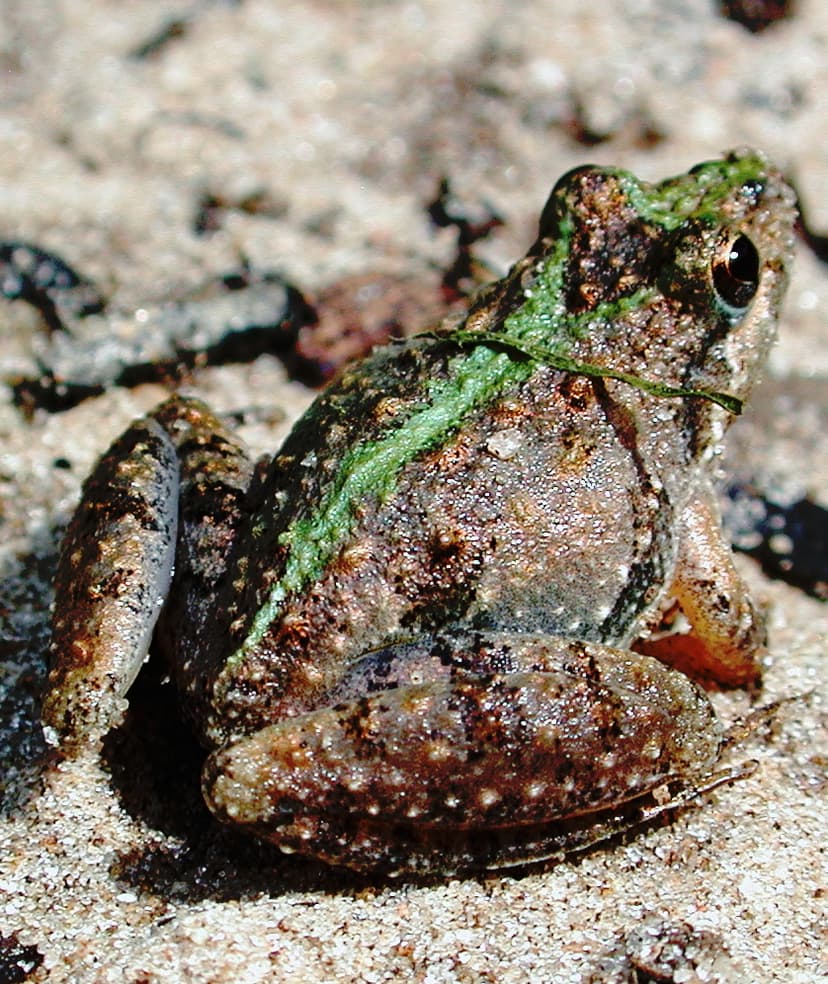
Acris
Cricket frogs, genus Acris, are small North American frogs belonging to the Hylidae family. Found from northern Mexico to southern Ontario, they are known for their cricket-like vocalizations, which play a crucial role in reproductive isolation. These frogs are notably more aquatic than other tree frogs and are strongly associated with permanent water bodies that offer surface vegetation for survival.
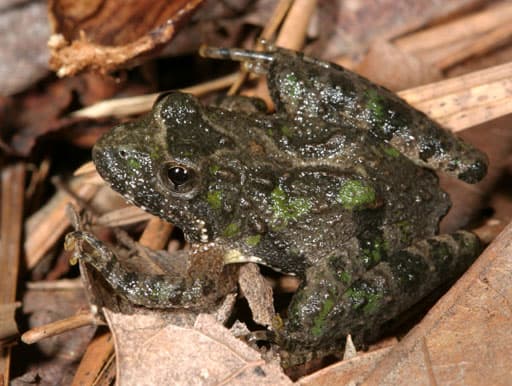
Acris crepitans
The northern cricket frog (Acris crepitans) is a small hylid frog native to the United States and northeastern Mexico. Despite being part of the tree frog family, they are terrestrial and prefer habitats near slow-moving water bodies with nearby shelter. They are distinguished by their small size, varied coloration, and a characteristic triangular mark on their head.