
Adelophryne maranguapensis
Adelophryne maranguapensis is a small frog species found exclusively in the Serra de Maranguape in Ceará state, northeastern Brazil. Distinctive for its dark to reddish-brown dorsal coloration with an hourglass-like pattern and a dark lateral band, this species inhabits the Atlantic Forest, often found in leaf litter or within bromeliads.
Key Facts
- ›Endemic to the Serra de Maranguape in Ceará, Brazil.
- ›Adult males measure 12–13 MM and females 17 MM in snout-to-vent length.
- ›Features dark to reddish-brown dorsal coloration with an hourglass-like pattern and crossbanded limbs.
- ›Inhabits the Atlantic Forest, including primary and secondary forests, and plantations.
- ›A diurnal species found in leaf litter and bromeliads.
- ›Threatened by habitat loss due to logging, agriculture, and bromeliad collection.

Atlantic Forest, Forest, Plantations
Ceará
- Small Size
- Dark To Reddish-Brown Dorsal Coloration With An Hourglass-Like Central Pattern
- Dark Brown Lateral Band
- Crossbanded Limbs
- Smooth Skin
- Fingers and Toes Without Webbing
About Adelophryne maranguapensis
Adelophryne maranguapensis: A Tiny Jewel of the Brazilian Atlantic Forest
Adelophryne maranguapensis is a small frog species belonging to the family Eleutherodactylidae. It is exclusively found in the Serra de Maranguape, a mountain range located west of Fortaleza in the state of Ceará, northeastern Brazil. This species is a characteristic inhabitant of the Atlantic Forest biome, thriving at elevations between 800 and 920 meters.
Appearance and Characteristics
The physical description of Adelophryne maranguapensis highlights its diminutive stature. Adult males typically measure between 12 and 13 millimeters in snout-to-vent length, while adult females are slightly larger, reaching up to 17 millimeters. The frog's head is longer than it is wide, with a snout that appears truncate from above and pointed in profile, slightly protruding beyond the mouth. Its dorsal coloration is a distinctive dark to reddish-brown, often featuring an hourglass-like pattern centrally. A dark brown band runs along its sides, and its limbs are marked with crossbands. The underside is a lighter shade, ranging from light brown to beige. The skin is smooth, and both its fingers and toes lack webbing, though the toes display more distinct discs than the fingers.
Habitat and Lifestyle
Adelophryne maranguapensis inhabits the Atlantic Forest, a habitat that includes both primary and secondary forests. It has also been observed in areas that have been altered by human activity, such as bamboo and banana plantations, but it avoids open environments. This species is diurnal, meaning it is most active during the day. It is commonly found in the leaf litter on the forest floor, but it also seeks refuge and lays its eggs within bromeliads, often positioned above the ground.
Reproduction and Development
The reproductive cycle of Adelophryne maranguapensis is characterized by direct development, where young frogs hatch directly from eggs as miniature versions of adults, bypassing a free-swimming tadpole stage. Egg clutches, which can contain anywhere from three to eight eggs, are typically deposited in the leaf axils of bromeliads, situated at heights of 0.5 to 4.4 meters above the ground. These clutches are carefully placed above the water that accumulates in the bromeliad's leaves. Observations suggest that a single clutch might sometimes contain eggs from multiple females, and the varying developmental stages within one clutch indicate that the eggs may not have been laid at the same time. Male frogs produce a distinct advertisement call during the rainy season, usually in March. This call is composed of 5 to 8 multi-pulse notes and has a dominant frequency around 4800 Hz.
Conservation Concerns
Adelophryne maranguapensis faces significant threats to its survival, primarily stemming from habitat loss and degradation. Logging, agricultural expansion, and the encroachment of human settlements are leading to the destruction and fragmentation of its forest habitat. Furthermore, the collection of bromeliads for commercial purposes also contributes to the loss of essential microhabitats for this species. These pressures place Adelophryne maranguapensis in a vulnerable position within its limited geographic range.
Source: Wikipedia ↗
Frequently Asked Questions
Where is Adelophryne maranguapensis found?
This frog species is endemic to the Serra de Maranguape, located just west of Fortaleza in the Ceará state of northeastern Brazil. It is found within the Atlantic Forest at elevations between 800 and 920 meters.
What does Adelophryne maranguapensis look like?
Adult males are 12–13 mm long, while females reach up to 17 mm. They have a dark to reddish-brown back with a distinctive hourglass-shaped central pattern, a dark brown band along the sides, and crossbanded limbs. The underside is light brown to beige.
What is the habitat of Adelophryne maranguapensis?
Adelophryne maranguapensis lives in the Atlantic Forest, specifically in areas like primary and secondary forests, as well as bamboo and banana plantations. It prefers to stay in the leaf litter on the ground but can also be found in bromeliads situated above the ground.
How does Adelophryne maranguapensis reproduce?
Reproduction involves direct development, where eggs hatch directly into froglets. Egg clutches, containing three to eight eggs, are found in bromeliad leaf axils and are laid above accumulated water. The male's advertisement call consists of 5–8 multi-pulse notes.
What are the threats to Adelophryne maranguapensis?
The primary threats to this species are habitat loss and degradation caused by logging, agricultural expansion, and human settlement. The collection of bromeliads for commercial sale also contributes to the decline of its habitat.
Related Frogs
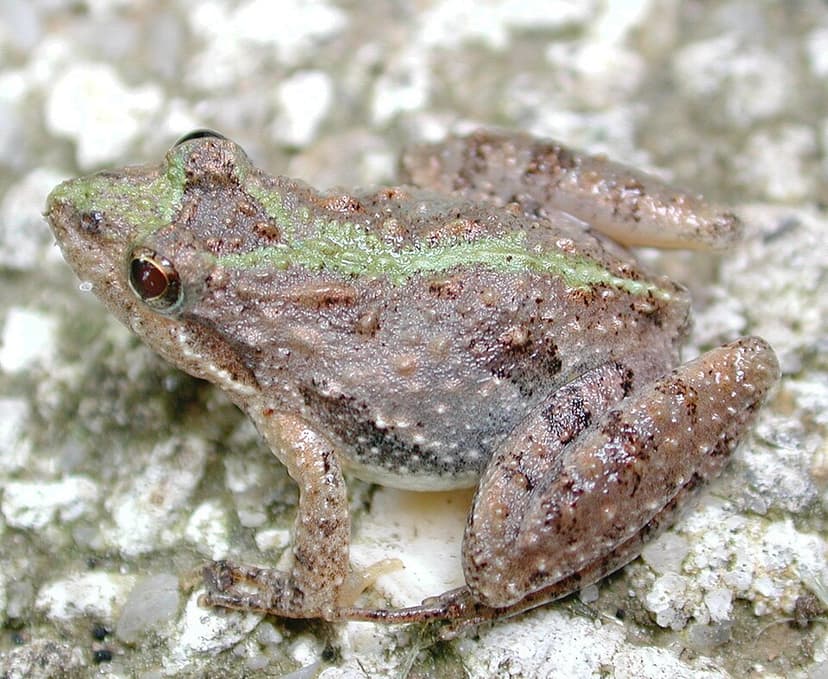
Acris gryllus
The southern cricket frog (Acris gryllus) is a small hylid frog native to the Southeastern United States. It is distinguished from its close relative, the northern cricket frog, by a more pointed snout, longer hind legs, and a sharply defined black stripe on the back of its thigh. This species is typically found in sunny, open areas near water bodies.

Adelophryne baturitensis
Adelophryne baturitensis is a small frog species endemic to the Serra de Baturité region in north-eastern Brazil. It is characterized by its brown dorsal coloration with darker patterns and cross-bands on its limbs, and its small size, with adults measuring between 12 and 16 mm in snout-to-vent length. This species inhabits leaf litter within well-preserved forests and shaded coffee plantations.
Adelophryne gutturosa
The Guiana Shield frog (Adelophryne gutturosa) is a small species of frog found across the Guiana Shield region of South America, including parts of Venezuela, Guyana, French Guiana, and Brazil. It is distinctive for its small size, smooth skin, and specific habitat requirements within rainforest leaf litter.