
Adelophryne baturitensis
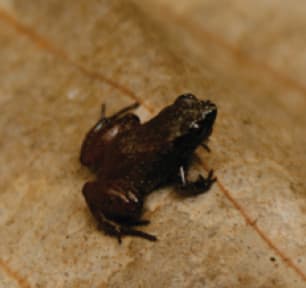
Adelophryne baturitensis is a small frog species endemic to the Serra de Baturité region in north-eastern Brazil. It is characterized by its brown dorsal coloration with darker patterns and cross-bands on its limbs, and its small size, with adults measuring between 12 and 16 mm in snout-to-vent length. This species inhabits leaf litter within well-preserved forests and shaded coffee plantations.
Key Facts
- ›Endemic to the Serra de Baturité in north-eastern Brazil.
- ›Adult size ranges from 12-16 MM in snout-to-vent length.
- ›Dorsal coloration is brown with darker patterns and limb cross-bands.
- ›Found in leaf litter, bromeliads, and stream margins of closed forests.
- ›Also found in shaded coffee plantations.
- ›Threatened by habitat loss due to logging, agriculture, and human settlement.

Closed Forests, Leaf Litter, Coffee Plantations
Ceará, Pernambuco
Small Size, Brown Dorsal Coloration With Darker Patterns, Dark Brown Band From Snout To Groin, Cross-Bands On Limbs, Gold Iris
About Adelophryne baturitensis
Adelophryne baturitensis: A Small Frog of Northeastern Brazil
Adelophryne baturitensis is a species of frog belonging to the family Eleutherodactylidae, found exclusively in northeastern Brazil. This small amphibian is known from its type locality, the Serra de Baturité, also referred to as Maçico de Baturité, within the state of Ceará. Its diminutive size and specific habitat requirements make it a unique component of the region's biodiversity.
Description and Habitat
Adult Adelophryne baturitensis are quite small, with males measuring between 12 and 13 millimeters and females slightly larger, ranging from 12 to 16 millimeters in snout-to-vent length. They possess a head that is longer than it is wide, and their snout is truncate when viewed from above and rounded in profile. Key features include a small but distinct tympanum, the absence of a supra-tympanic fold, and an indistinct canthus rostralis. Both fingers and toes are unwebbed, with only the third and fourth fingers and all toes equipped with small discs. The skin is smooth. The dorsal coloration is predominantly brown, often displaying a darker pattern that begins between the eyes and extends along the snout and sides. A distinct dark brown band runs from the snout to the groin, and the limbs are marked with cross-bands. The frog's iris is a striking gold color.
This species is diurnal, meaning it is active during the day, and is typically found in leaf litter on the forest floor. It thrives in both dry and moist leaf litter environments, and can also be found in bromeliads and along the margins of streams within well-preserved closed forests. Adelophryne baturitensis has also demonstrated an ability to survive in human-modified landscapes, notably in shaded coffee plantations. These habitats are generally found at elevations ranging from 600 to 1,000 meters above sea level. The presence of this frog in a Pernambuco locality further highlights its occurrence within the Atlantic Rainforest biome.
Conservation Concerns
Adelophryne baturitensis faces significant threats, primarily due to habitat loss. Logging, agricultural expansion, and the growth of human settlements are encroaching upon its natural environment. The areas where this frog is found often possess desirable soil and climate conditions, making them attractive for agricultural development, which directly impacts the species' survival. While it can be locally common, the ongoing habitat degradation poses a serious risk to its long-term persistence.
Source: Wikipedia ↗
Frequently Asked Questions
What is the scientific name for this frog species?
The scientific name for this frog species is Adelophryne baturitensis.
Where is Adelophryne baturitensis found?
Adelophryne baturitensis is endemic to north-eastern Brazil, specifically known from the Serra de Baturité (or Maçico de Baturité) in the state of Ceará.
What are the physical characteristics of Adelophryne baturitensis?
Adult males measure 12–13 mm and females 12–16 mm in snout-to-vent length. They have a head longer than wide, with a truncate snout. The dorsal coloration is brown with darker patterns, and the limbs have cross-bands. The iris is gold.
What is the habitat of Adelophryne baturitensis?
This species is a diurnal leaf-litter dweller found in dry or moist leaf litter on the ground, in bromeliads, and along stream margins in well-preserved closed forests. It can also be found in shaded coffee plantations at elevations of 600–1,000 meters.
What are the threats to Adelophryne baturitensis?
Adelophryne baturitensis is threatened by habitat loss caused by logging, agriculture, and human settlement, as its preferred habitats are often favored for agricultural expansion.
Related Frogs

Adelophryne pachydactyla
Adelophryne pachydactyla is a small frog species endemic to the coastal region of Bahia state, Brazil. Its distinctive feature, suggested by its scientific name meaning "thick finger," is its short, swollen fingers. This species inhabits leaf litter near streams and terrestrial bromeliads within forested areas, facing threats from habitat loss due to agricultural practices.
Adelophryne gutturosa
The Guiana Shield frog (Adelophryne gutturosa) is a small species of frog found across the Guiana Shield region of South America, including parts of Venezuela, Guyana, French Guiana, and Brazil. It is distinctive for its small size, smooth skin, and specific habitat requirements within rainforest leaf litter.

Adelophryne maranguapensis
Adelophryne maranguapensis is a small frog species found exclusively in the Serra de Maranguape in Ceará state, northeastern Brazil. Distinctive for its dark to reddish-brown dorsal coloration with an hourglass-like pattern and a dark lateral band, this species inhabits the Atlantic Forest, often found in leaf litter or within bromeliads.