
Adelophryne pachydactyla
Adelophryne pachydactyla is a small frog species endemic to the coastal region of Bahia state, Brazil. Its distinctive feature, suggested by its scientific name meaning "thick finger," is its short, swollen fingers. This species inhabits leaf litter near streams and terrestrial bromeliads within forested areas, facing threats from habitat loss due to agricultural practices.
Key Facts
- ›Endemic to the coastal area of south-central Bahia state, Brazil.
- ›Characterized by short, swollen fingers, a feature reflected in its scientific name.
- ›Found in leaf litter near creeks and within terrestrial bromeliads in forests.
- ›The holotype, an adult male, measured 11 MM in snout-vent length.
- ›Faces probable threats from habitat loss due to agriculture and logging.

Forest, Farmland, Leaf Litter
Bahia
Short, Swollen Fingers, Blackish-Brown Dorsum With Grey Spots, Black Venter, Reddish Iris
About Adelophryne pachydactyla
Adelophryne pachydactyla is a small frog species belonging to the family Eleutherodactylidae, found exclusively in the coastal region of south-central Bahia state, Brazil. Its common name is not widely established, but its scientific name, derived from Greek words meaning "thick finger," directly references a key physical characteristic: its short, swollen digits. This species is known to occur in sympatry with Adelophryne mucronatus, a species that was once identified as Adelophryne pachydactyla but later recognized as distinct.
Description and Characteristics
Adelophryne pachydactyla is a diminutive amphibian, with the single known adult male holotype measuring a mere 11 mm in snout-vent length. It possesses a blackish-brown dorsal coloration marked with grey spots, and its underside is black. The iris of its eyes is a striking reddish hue. Notable features include its short, swollen fingers that lack discs, and toes that have small discs but no webbing. The head is slightly longer than it is wide, with a rounded snout and an indistinct canthus rostralis. The tympanic annulus is incomplete and obscured by skin in its upper sections.
Habitat and Ecology
Little is currently known about the specific ecological role and behaviors of Adelophryne pachydactyla. The holotype was collected at night on a cacao farm, found on the ground within leaf litter near a small creek, under the canopy of cacao trees, bananas, and larger shade trees. Other specimens have been found in terrestrial bromeliads within forested areas, indicating a preference for humid, ground-level or low-vegetation microhabitats. All documented occurrences have been recorded at elevations below 800 meters.
Conservation Concerns
The primary threat facing Adelophryne pachydactyla is habitat loss, a common issue for many endemic species in Brazil. This loss is attributed to various human activities, including agricultural expansion, the establishment of wood plantations, the collection of bromeliads for horticultural purposes, and general logging operations. The species' range includes the Serra do Jequitibá Natural Heritage Reserve, which likely offers some degree of protection.
Source: Wikipedia ↗
Frequently Asked Questions
What does the scientific name Adelophryne pachydactyla mean?
The specific name "pachydactyla" is derived from Greek words: "pachys" meaning thick and "daktylos" meaning finger. This refers to the frog's distinctive thick, short, and swollen fingers.
Where is Adelophryne pachydactyla found?
This frog species is endemic to the coastal area of south-central Bahia state in Brazil. It has been found in forested habitats, including cacao farms and areas with terrestrial bromeliads.
What are the physical characteristics of Adelophryne pachydactyla?
Adelophryne pachydactyla is a small frog, with the holotype male measuring 11 mm in snout-vent length. It has a blackish-brown body with grey spots dorsally and a black underside, and reddish iris. Its fingers are short and swollen, lacking discs, while its toes have small discs and no webbing.
What is the habitat of Adelophryne pachydactyla?
The species has been found in leaf litter near small creeks on the ground under trees, as well as in terrestrial bromeliads within forests. The recorded habitat is below 800 meters in elevation.
What are the threats to Adelophryne pachydactyla?
The primary threat to Adelophryne pachydactyla is habitat loss. This is likely caused by agricultural activities such as farming and wood plantations, as well as logging and the collection of bromeliads.
Related Frogs

Adelophryne baturitensis
Adelophryne baturitensis is a small frog species endemic to the Serra de Baturité region in north-eastern Brazil. It is characterized by its brown dorsal coloration with darker patterns and cross-bands on its limbs, and its small size, with adults measuring between 12 and 16 mm in snout-to-vent length. This species inhabits leaf litter within well-preserved forests and shaded coffee plantations.
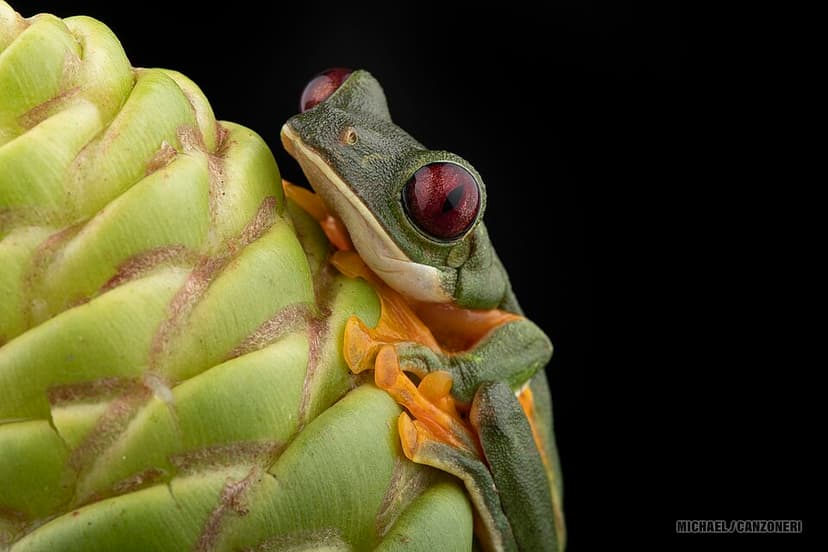
Agalychnis spurrelli
The gliding tree frog (Agalychnis spurrelli) is a species found in the humid forests and marshes of Colombia, Costa Rica, Ecuador, and Panama. It is distinctive for its ability to glide by spreading its limbs and using the extensive webbing as a parachute, and its color changes from pale green to dark green at nightfall.
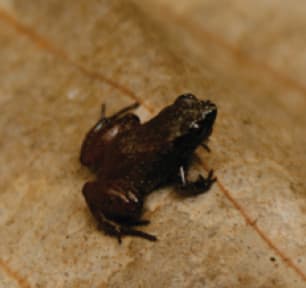
Adelophryne gutturosa
The Guiana Shield frog (Adelophryne gutturosa) is a small species of frog found across the Guiana Shield region of South America, including parts of Venezuela, Guyana, French Guiana, and Brazil. It is distinctive for its small size, smooth skin, and specific habitat requirements within rainforest leaf litter.