
Adelophryne gutturosa
The Guiana Shield frog (Adelophryne gutturosa) is a small species of frog found across the Guiana Shield region of South America, including parts of Venezuela, Guyana, French Guiana, and Brazil. It is distinctive for its small size, smooth skin, and specific habitat requirements within rainforest leaf litter.
Key Facts
- ›Found in the Guiana Shield region of South America.
- ›Adult males range from 12.4–14.7 MM and females from 12.6–16 MM in snout-vent length.
- ›Occurs in rainforest leaf litter near streams at elevations from 40 to 2,200 meters.
- ›Males possess large subgular vocal sacs.
- ›Its secretive nature makes it difficult to locate and assess population numbers.
- ›No significant threats have been identified for the species.
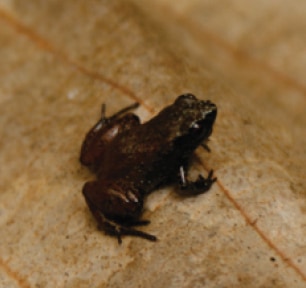
Guiana Shield Frog, Ranita Guturosa
Rainforest, Forest Floor
Amapá, French Guiana, Guyana, Venezuela
- Small Size
- Truncate Snout
- Smooth Skin
- Light Brown Dorsum With Black Flanks
- Males With Large Subgular Vocal Sacs
- Fingers With Asymmetrically Pointed Tips
- Toes With Grooved, Asymmetrically Pointed Discs
About Adelophryne gutturosa
Adelophryne gutturosa: The Guiana Shield Frog
Adelophryne gutturosa, commonly known as the Guiana Shield frog or ranita guturosa, is a small amphibian species belonging to the family Eleutherodactylidae. Its range spans the Guiana Shield, encompassing parts of eastern Venezuela, Guyana, French Guiana, and the Brazilian state of Amapá, with potential extensions into Suriname. The species' type locality is Mount Roraima.
Description and Habitat
Adult males of Adelophryne gutturosa typically measure between 12.4 and 14.7 millimeters in snout-vent length, while females are slightly larger, ranging from 12.6 to 16 millimeters. These frogs possess a truncate snout and a head that is marginally wider than their body. Key diagnostic features include a small but discernible tympanum and indistinct canthus rostralis. Females are further distinguished by a horizontal supra-tympanic fold. Their digit tips are notably asymmetric; fingers have pointed tips without discs, whereas toe tips feature grooved, pointed discs. The skin is smooth, and coloration typically involves a light brown dorsum contrasted by black flanks. Adult males are identifiable by their prominent subgular vocal sacs.
Adelophryne gutturosa is an inhabitant of the rainforest floor, specifically found within leaf litter formations near watercourses. Its habitat preference extends across a broad elevation gradient, from 40 to 2,200 meters above sea level. Males are known to vocalize from concealed positions at the base of vegetation, such as dense clusters of Monotagma spicatum, amidst rootlets and decaying leaves.
Ecology and Conservation
Despite its small size and specific habitat requirements, Adelophryne gutturosa is considered not common, though its secretive habits contribute to its difficulty in detection. As of current understanding, no significant threats have been identified that endanger the species. Its distribution includes several national parks, which may provide a degree of protection for its populations and habitats.
Source: Wikipedia ↗
Frequently Asked Questions
What is the common name for Adelophryne gutturosa?
Adelophryne gutturosa is commonly known as the Guiana Shield frog. Its local Spanish name is ranita guturosa.
Where is the Guiana Shield frog found?
This species is found on the Guiana Shield, stretching from eastern Venezuela through Guyana to French Guiana and adjacent Brazil (Amapá). It may also extend into Suriname.
What are the size ranges for Adelophryne gutturosa?
Adult males typically measure between 12.4 and 14.7 millimeters in snout-vent length, while females are slightly larger, ranging from 12.6 to 16 millimeters.
What is the habitat of the Guiana Shield frog?
Adelophryne gutturosa lives in the leaf litter on the forest floor of rainforests, preferring areas near streams. They have been found at elevations ranging from 40 to 2,200 meters above sea level.
Are there any known threats to the Guiana Shield frog?
Currently, no significant threats to Adelophryne gutturosa have been identified. Its range also encompasses several national parks, which may offer some protection.
Related Frogs
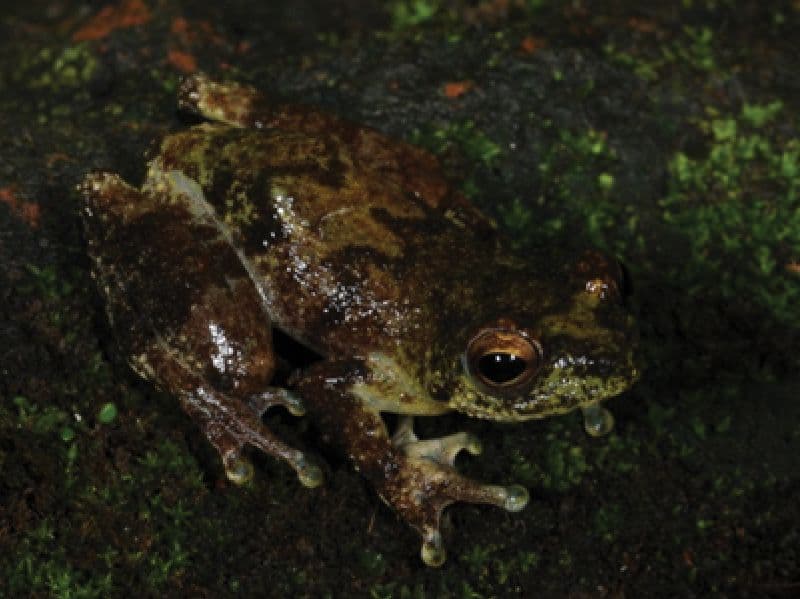
Alexteroon hypsiphonus
Alexteroon hypsiphonus, also known as the cross-banded egg-guarding frog, is a species of tree frog native to the rainforests of southern Cameroon, Gabon, Equatorial Guinea, the western Republic of the Congo, and northwestern Angola. This slender frog is distinguished by its lichen-like, granular skin that changes color from gray to dark brown, numerous black dots, and three distinctive black-bordered, reddish-brown bands. It is an arboreal species that lays its eggs on leaves above small ponds, providing a unique form of parental care as the tadpoles eventually fall into the water below.

African clawed frog
The African clawed frog (Xenopus laevis) is a fully aquatic species native to Sub-Saharan Africa, known for its smooth, mottled skin and powerful legs. These adaptable amphibians are notable for their unique breeding behavior, ability to survive drought by burrowing, and extensive use as a model organism in scientific research, particularly in developmental biology and genetics. They are also recognized as an invasive species in many parts of the world due to their voracious appetite and resilience.

Adelophryne baturitensis
Adelophryne baturitensis is a small frog species endemic to the Serra de Baturité region in north-eastern Brazil. It is characterized by its brown dorsal coloration with darker patterns and cross-bands on its limbs, and its small size, with adults measuring between 12 and 16 mm in snout-to-vent length. This species inhabits leaf litter within well-preserved forests and shaded coffee plantations.