
Alexteroon hypsiphonus
Alexteroon·Not Evaluated
Alexteroon hypsiphonus, also known as the cross-banded egg-guarding frog, is a species of tree frog native to the rainforests of southern Cameroon, Gabon, Equatorial Guinea, the western Republic of the Congo, and northwestern Angola. This slender frog is distinguished by its lichen-like, granular skin that changes color from gray to dark brown, numerous black dots, and three distinctive black-bordered, reddish-brown bands. It is an arboreal species that lays its eggs on leaves above small ponds, providing a unique form of parental care as the tadpoles eventually fall into the water below.
Key Facts
- ›Found in rainforests near rivers in Central and West Africa.
- ›Adults reach up to 28 MM in snout-to-vent length.
- ›Features granular skin with a lichen-like pattern, changing from gray to brown.
- ›Possesses three irregular, black-bordered transverse bands.
- ›Eggs are laid on leaves above small ponds, with tadpoles falling into the water.
- ›Threatened by habitat loss, though it is common in suitable areas.
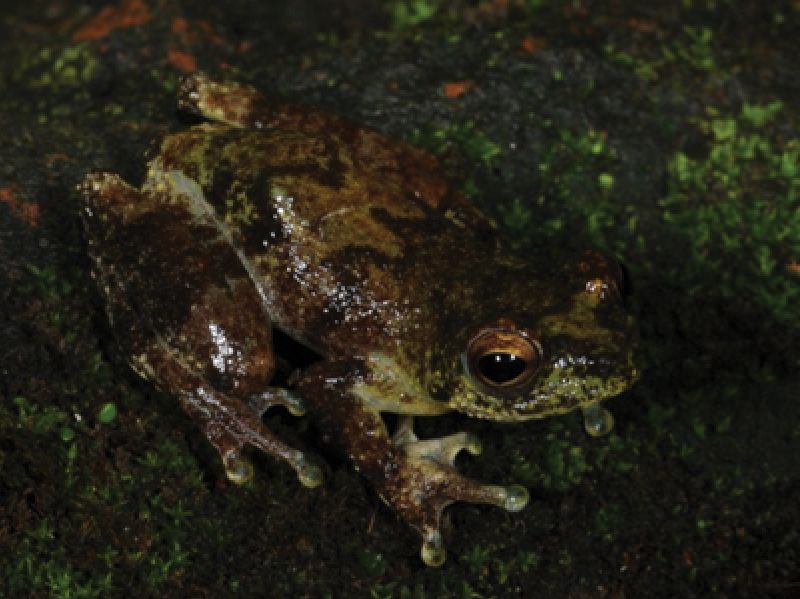
Cross-Banded Egg-Guarding Frog
Rainforest, Riparian
- Granular, Lichen-Like Dorsal Skin That Changes Color
- Three Irregular, Black-Bordered Transverse Bands
- Enlarged Finger and Toe Discs
- Transparent Whitish To Turquoise Belly
About Alexteroon hypsiphonus
Alexteroon hypsiphonus, commonly known as the cross-banded egg-guarding frog, is a species of tree frog native to the tropical rainforests of Central and West Africa. Its range includes southern Cameroon, Gabon, Equatorial Guinea, the western Republic of the Congo, and northwestern Angola. This species is characterized by its distinctive appearance and a specialized breeding strategy.
Description and Habitat
The frog is relatively small, with adults reaching a snout-to-vent length of up to 28 mm. It possesses a slender body, a broad head with a short snout, and large eyes. A notable feature is its granular dorsal skin, which has a lichen-like pattern that shifts from grayish during the day to dark brown at night. This coloration is further enhanced by numerous black dots and three striking, irregular, black-bordered transverse bands that are reddish-brown or match the general dorsal hue. The frog's underside is a transparent whitish to turquoise color. Alexteroon hypsiphonus is arboreal, inhabiting rainforests, typically found near rivers at elevations below 630 meters. Males often call from vegetation situated at least 5 meters above the ground.
Breeding and Conservation
The reproductive behavior of Alexteroon hypsiphonus involves an interesting egg-laying strategy where eggs are deposited on leaves above small ponds. The tadpoles later fall from these leaves into the water, suggesting a form of parental care or environmental adaptation. While the species is considered common within suitable habitats, it faces significant threats from habitat loss. Its presence has been documented in protected areas such as Lopé National Park in Gabon, indicating the importance of these reserves for its survival.
Source: Wikipedia ↗
Frequently Asked Questions
What is the scientific name of the cross-banded egg-guarding frog?
The scientific name for the cross-banded egg-guarding frog is Alexteroon hypsiphonus. It was previously classified under the genus Hyperolius.
Where can Alexteroon hypsiphonus be found?
This frog species is found in southern Cameroon, Gabon, Equatorial Guinea, the western Republic of the Congo, and northwestern Angola. It inhabits rainforests, typically near rivers.
What are the distinguishing physical features of Alexteroon hypsiphonus?
Alexteroon hypsiphonus has a slender body with a broad head and short snout. Its dorsal skin is granular with a lichen-like pattern that appears grayish during the day and dark brown at night. It also has numerous black dots and three irregular, black-bordered transverse bands.
How does Alexteroon hypsiphonus reproduce?
The breeding behavior involves females laying eggs on leaves suspended above small ponds. The tadpoles eventually fall into the water below, suggesting a unique egg-guarding strategy.
What is the conservation status of Alexteroon hypsiphonus?
While Alexteroon hypsiphonus is common in its preferred habitats, it faces threats from habitat loss. Its presence is noted in protected areas like Lopé National Park in Gabon.
Related Frogs
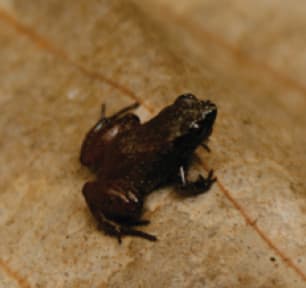
Adelophryne gutturosa
The Guiana Shield frog (Adelophryne gutturosa) is a small species of frog found across the Guiana Shield region of South America, including parts of Venezuela, Guyana, French Guiana, and Brazil. It is distinctive for its small size, smooth skin, and specific habitat requirements within rainforest leaf litter.
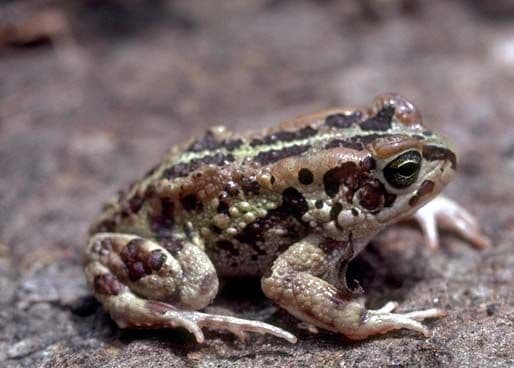
Amietophrynus buchneri
Sclerophrys buchneri, commonly known as Buchner's toad, is a species of toad belonging to the Bufonidae family. Its known distribution is limited to the Cabinda Province of Angola and the western Republic of the Congo, with presumed presence in the Democratic Republic of the Congo. The biology of this species remains largely unstudied, and there is speculation that it might be a synonym for Sclerophrys funereus.

African clawed frog
The African clawed frog (Xenopus laevis) is a fully aquatic species native to Sub-Saharan Africa, known for its smooth, mottled skin and powerful legs. These adaptable amphibians are notable for their unique breeding behavior, ability to survive drought by burrowing, and extensive use as a model organism in scientific research, particularly in developmental biology and genetics. They are also recognized as an invasive species in many parts of the world due to their voracious appetite and resilience.