
Afrixalus weidholzi
Afrixalus weidholzi, also known as Weidholz's banana frog or Weidholz's leaf-folding frog, is a small frog species found across savannas in West and Central Africa. It is distinctive for its breeding behavior, where males call from flooded grass and eggs are laid in folded leaves, and its specific coloration featuring dark vertebral and lateral stripes.
Key Facts
- ›Adults measure between 18–23 MM in snout-to-vent length.
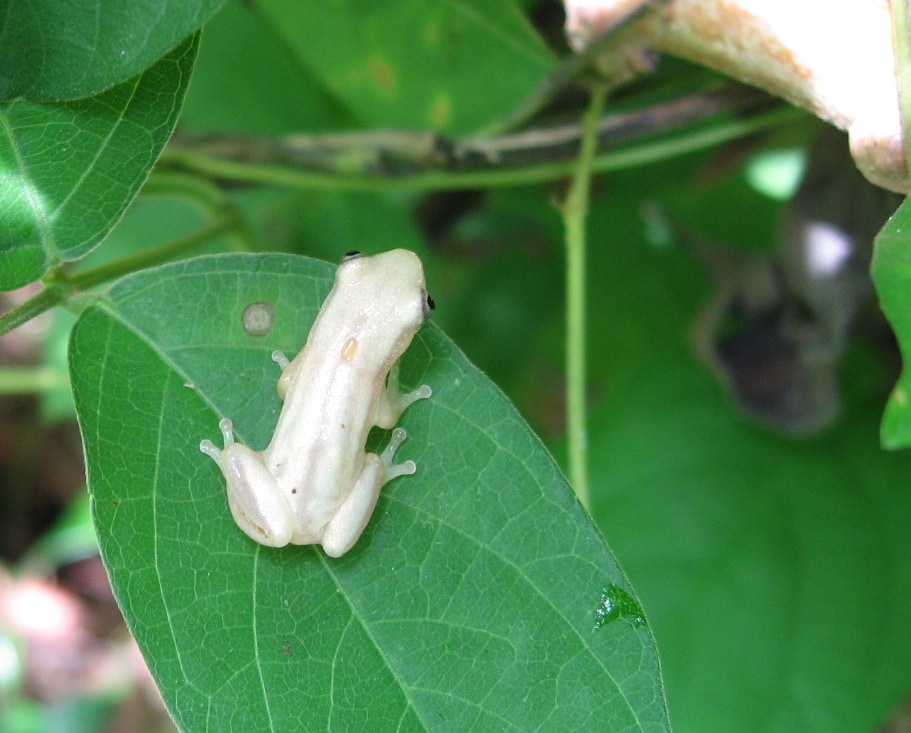
- ›The dorsal side is whitish to yellow with a dark vertebral line and a dark lateral stripe.
- ›Breeding occurs in temporary ponds, with males calling from dense, low grass.
- ›Eggs are deposited in small batches within folded grass leaves, secured by jelly.
- ›Its natural habitats include both moist and dry savannas.
- ›The species is distributed patchily from the Gambia and Senegal to the Democratic Republic of the Congo.
Weidholz's Banana Frog, Weidholz's Leaf-Folding Frog
Savanna, Wetlands
the Gambia, Senegal, Sierra Leone, Mali, Ivory Coast, Ghana, Togo, Benin, Nigeria, Cameroon, Democratic Republic of the Congo, South Sudan
- Small Size
- Whitish To Yellow Dorsum
- Thin, Dark Vertebral Line
- Broad, Dark Lateral Stripe From Snout To Groin
About Afrixalus weidholzi
Afrixalus weidholzi: Weidholz's Banana Frog
Afrixalus weidholzi is a small amphibian species belonging to the family Hyperoliidae, commonly recognized by the names Weidholz's banana frog or Weidholz's leaf-folding frog. This species is notable for its distinctive breeding behavior and specific coloration, which aids in its identification within its natural habitat.
Distribution and Habitat
Weidholz's banana frog is found across a wide but patchy distribution in the savannas of West and Central Africa. Its confirmed range extends from The Gambia and Senegal in the west eastward to the northeastern Democratic Republic of the Congo, bordering South Sudan. It is also expected to occur in several intervening countries, though its presence is often limited by the scarcity of herpetological surveys in these regions.
The natural habitats of Afrixalus weidholzi encompass both dense, moist savannas and more open, dry savanna environments. Crucially, breeding activities occur in temporary ponds, where males are known to call from dense, low grass. While the species can tolerate some degree of habitat alteration and is sometimes locally common, it can be adversely affected by overgrazing, though this remains a localized concern.
Description and Reproduction
Adult Afrixalus weidholzi are small frogs, measuring approximately 18 to 23 millimeters in snout-to-vent length. Their dorsal coloration is typically whitish to yellow, marked by a thin, dark vertebral line that is most prominent posteriorly. A more pronounced, dark lateral stripe runs from the tip of the snout to the groin, further defining its appearance.
Reproduction involves males calling with a quiet, high-pitched buzzing sound from low, dense grass in shallowly flooded areas. The eggs are deposited in small clusters, carefully placed within transversally folded grass leaves that are then glued together with jelly. Newly metamorphosed froglets are quite small, measuring about 10.5 millimeters.
Source: Wikipedia ↗
Frequently Asked Questions
What is the common name for Afrixalus weidholzi?
Afrixalus weidholzi is commonly known as Weidholz's banana frog or Weidholz's leaf-folding frog. These names reflect its appearance and its unique method of egg-laying.
Where is Afrixalus weidholzi found?
This frog species has a patchy distribution across savannas in West and Central Africa. It is confirmed to exist in countries such as The Gambia, Senegal, Nigeria, Cameroon, and the Democratic Republic of the Congo.
How does Afrixalus weidholzi reproduce?
Males call from dense, low grass in shallowly flooded areas. The eggs are laid in small batches within transversely folded grass leaves, which are glued together by jelly.
What does Afrixalus weidholzi look like?
It is a small frog, with adults measuring 18–23 mm in snout-to-vent length. Its back is whitish to yellow and features a dark vertebral line, particularly towards the rear, and a broader dark lateral stripe from snout to groin.
What is the habitat of Afrixalus weidholzi?
Afrixalus weidholzi inhabits both dense moist savannas and open dry savannas. Breeding specifically takes place in temporary ponds.
Related Frogs

Afrixalus osorioi
Afrixalus osorioi is a species of frog belonging to the family Hyperoliidae, native to central Africa. This adaptable species is known for its distinctive light and dark brown dorsal patterning, often featuring a rectangular dark spot. It thrives in degraded forests and uses various water bodies, including artificial ones, for breeding.

Afrixalus vittiger
The banded banana frog, scientifically known as Afrixalus fulvovittatus, is a species of frog native to West Africa. It inhabits moist savannas, swamps, and marshes, and is particularly found in degraded former forest areas. This species is currently threatened by habitat loss.

Afrixalus wittei
Afrixalus wittei, commonly known as De Witte's spiny reed frog, is a species of frog belonging to the Hyperoliidae family. This amphibian is found across several countries in Southern and Central Africa, including Angola, the Democratic Republic of the Congo, Tanzania, and Zambia. Its distinctiveness lies in its adaptation to specific wetland and grassland environments.