
Agalychnis annae
The blue-sided leaf frog (Agalychnis annae), also known as the orange-eyed leaf frog, is a vulnerable species of tree frog native to the tropical rainforests of Costa Rica and Panama. Named in honor of Ann S. Duellman, it is distinguished by its striking coloration and its habitat in the montane rainforests of Central America. Much of its habitat has been fragmented by human development, leading to its vulnerable conservation status.
Key Facts
- ›Native to the tropical rainforests of Costa Rica and Panama.
- ›Found at altitudes between 600 and 1,650 meters.
- ›Its specific name honors Ann S. Duellman.
- ›Habitat fragmentation due to agriculture and urban development is a significant threat.
- ›Classified as a vulnerable species by the IUCN.
- ›May be affected by climate change or the chytrid fungus.

Orange-Eyed Leaf Frog
Tropical Rainforest, Montane Forests
Costa Rica, Panama
Blue-Sided Coloration, Orange Eyes
About Agalychnis annae
Agalychnis annae: The Blue-Sided Leaf Frog
The blue-sided leaf frog, scientifically known as Agalychnis annae, is a species of tree frog native to the lush tropical rainforests of Costa Rica and Panama. It is also commonly referred to as the orange-eyed leaf frog, hinting at its distinctive physical characteristics, though detailed descriptions of its appearance are sparse in historical records. The species' scientific name honors Ann S. Duellman, who collected the holotype specimen and was the wife of the species' describer.
Distribution and Habitat
This frog primarily inhabits the Central Valley of Costa Rica, extending across the slopes of the Cordillera de Talamanca, Cordillera de Tilarán, and Cordillera Central mountain ranges. Its preferred elevations range from approximately 600 to 1,650 meters (2,000 to 5,400 feet) above sea level. While its estimated range covers around 16,000 square kilometers, a significant portion of its forest habitat has been cleared. This fragmentation has led to the formation of isolated subpopulations, separated by agricultural lands like coffee plantations, cultivated areas, and encroaching urban developments. A potential subpopulation has also been identified in the Cerro Colorado range in western Panama, based on a single female sighting in 2012.
Conservation Status and Threats
The blue-sided leaf frog is classified as a vulnerable species by the International Union for Conservation of Nature (IUCN). While it can be found in relative abundance in some parts of the Central Valley, it has become uncommon in other undisturbed forests. This decline is particularly noted in pristine areas where it has disappeared since 1980, although it persists in certain locations within protected areas such as Tapantí National Park and the Monteverde Biological Reserve. The fragmentation of its habitat by human activities poses a severe threat to its long-term survival. Furthermore, local extinctions have been linked to potential impacts of climate change or the chytrid fungus (Batrachochytrium dendrobatidis), which causes chytridiomycosis, a devastating disease affecting amphibian populations across Central America. Although some individuals have tested positive for this fungus, the species continues to exist in affected areas.
Source: Wikipedia ↗
Frequently Asked Questions
What is the blue-sided leaf frog?
The blue-sided leaf frog (Agalychnis annae) is a species of tree frog found in the tropical rainforests of Costa Rica and Panama. It is also referred to as the orange-eyed leaf frog and is characterized by its vibrant coloring.
Where does the blue-sided leaf frog live?
This frog is primarily found in the Central Valley of Costa Rica, along the slopes of the Cordillera de Talamanca, Cordillera de Tilarán, and Cordillera Central mountain ranges. There is also a potential subpopulation in western Panama.
What is the conservation status of Agalychnis annae?
The blue-sided leaf frog is classified as a vulnerable species by the International Union for Conservation of Nature (IUCN). This status reflects threats to its population and habitat.
What are the threats to the blue-sided leaf frog?
Significant threats include habitat loss and fragmentation caused by coffee plantations, cultivated areas, and urban development. Climate change and the chytrid fungus, which causes chytridiomycosis, are also potential contributing factors to population declines.
What is the altitude range of the blue-sided leaf frog?
Agalychnis annae typically inhabits areas at altitudes ranging from approximately 600 to 1,650 meters (2,000 to 5,400 feet) above sea level.
Related Frogs
Acanthixalus spinosus
Acanthixalus spinosus, commonly known as the African wart frog, is a species of frog native to Africa, found from southeastern Nigeria to Gabon and the Democratic Republic of the Congo. It is distinctive for its warty, black or brownish-to-olive dorsum with an hourglass pattern, and the males' unique possession of strong tarsal spines and larger digital discs. This species primarily inhabits lowland rainforests, dwelling in water-filled tree holes and exhibiting predominantly aquatic behavior.
Agalychnis saltator
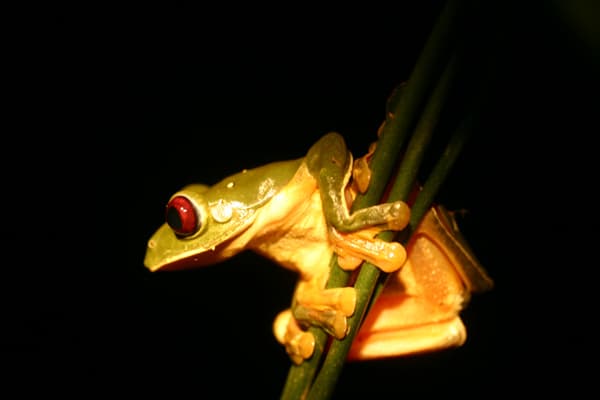
Agalychnis saltator, also known as the parachuting red-eyed leaf frog or misfit leaf frog, is a species of frog found in the humid and wet forests of Central America, from Honduras to Costa Rica. This arboreal and nocturnal species is distinctive for its bright red eyes with vertical pupils and its ability to 'parachute' by spreading webbing between its limbs and toes to glide between trees.

Agalychnis callidryas
The red-eyed tree frog (Agalychnis callidryas) is a vibrantly colored amphibian native to the rainforests of Central America and northwestern South America. Despite its striking appearance with bright red eyes, green body, and blue and yellow side stripes, it is not poisonous. Its colors are thought to serve as camouflage and a startle display to deter predators, allowing it valuable escape time.