
Agalychnis moreletii
Agalychnis·The article text implies a significant population decline but does not explicitly state the IUCN conservation status.
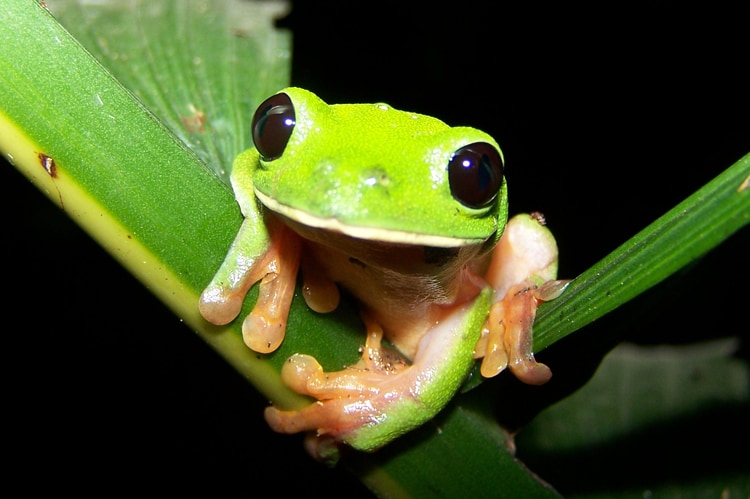
Morelet's tree frog, scientifically known as Agalychnis moreletii, is a species of frog found across several Central American countries, including Belize, El Salvador, Guatemala, Honduras, and Mexico. It is distinguished by its uniformly green body, dark black eyes, and a red or pink underbelly, and shares similarities with the red-eyed tree frog but is typically smaller.
Key Facts
- ›Found in subtropical or tropical moist lowland and montane forests, as well as freshwater marshes.
- ›Characterized by a uniform green body, dark black eyes, and a red or pink underside.
- ›Breeding occurs during the summer with females selecting males based on the quality of their mating calls.
- ›Eggs are laid in clutches of 50-75 on vegetation or rocks above water.
- ›Population decline is significant, estimated at over 80% in 10 years due to habitat destruction and Chytridiomycosis.
- ›Conservation efforts include protected parks and ongoing taxonomic research.
Black-Eyed Leaf Frog, Popeye Hyla
Subtropical/Tropical Moist Lowland Forest, Subtropical/Tropical Moist Montane Forest, Freshwater Marshes
Belize, El Salvador, Guatemala, Honduras, Mexico
- Https://Web.Archive.Org/Web/20080705031457/Http://Fwie.Fw.Vt.Edu/Wcs/020310.Htm
Uniformly Green Body, Dark Black Eyes, Red Or Pink Underbelly, Slightly Smaller Than Red-Eyed Tree Frog
About Agalychnis moreletii
Morelet's Tree Frog (Agalychnis moreletii)
Morelet's tree frog, scientifically identified as Agalychnis moreletii, is a species of frog native to Central America. It is also commonly referred to as the black-eyed leaf frog or popeye hyla. This species is found across Belize, El Salvador, Guatemala, Honduras, and Mexico, inhabiting a range of moist forest and wetland environments.
Description and Habitat
Physically, Morelet's tree frog shares a resemblance with the red-eyed tree frog (A. callidryas), though it is typically smaller. Its most striking features include a uniformly green body, contrasting with dark black eyes and a red or pink underbelly. The frog's natural habitats are subtropical or tropical moist lowland forests, montane forests, and freshwater marshes, where sufficient tree cover is present. They are adaptable and can be found in both undisturbed and human-altered landscapes, requiring access to water for breeding.
Reproduction and Lifecycle
The breeding season for Morelet's tree frog extends through the summer months. A fascinating aspect of their reproduction is the female's selection process for a mate, which is based on the quality of the male's mating call. Males with longer calls and more frequent pulses are more likely to be chosen. Females deposit clutches of 50 to 75 eggs on vegetation or rocks positioned above water. Upon hatching, the tadpoles fall into the water below to complete their development.
Conservation Concerns
Despite being abundant within its range and kept as pets internationally, Morelet's tree frog faces significant threats. Habitat destruction, driven by industry and agriculture, is a primary concern, particularly impacting lowland montane forests. Furthermore, the species is severely affected by Chytridiomycosis, an infectious disease that causes widespread amphibian mortality. These factors are projected to cause an alarming population decline of over 80% within the next decade, with some regions already experiencing local extinctions. Conservation efforts are underway, including the establishment of protected parks and ongoing taxonomic research to better understand and monitor the population's status. However, more data is needed to effectively track population trends and implement comprehensive conservation strategies.
Source: Wikipedia ↗
Frequently Asked Questions
What is Morelet's tree frog known for?
Morelet's tree frog is known for its distinctive appearance, with a uniformly green body, dark black eyes, and a red or pink underbelly. It is also recognized for its breeding behavior where females choose males based on their mating calls.
Where does Morelet's tree frog live?
This species inhabits subtropical or tropical moist lowland forests, montane or cloud forests, and freshwater marshes. Its range extends through Belize, El Salvador, Guatemala, Honduras, and Mexico.
How do Morelet's tree frogs reproduce?
Morelet's tree frogs have an extended breeding season in the summer. Females select mates based on the quality of their calls, and clutches of 50 to 75 eggs are deposited on vegetation or rocks over water.
What are the main threats to Morelet's tree frog?
The primary threats to Morelet's tree frog are habitat destruction, largely due to industry and agriculture, and a devastating disease called Chytridiomycosis, which infects and kills amphibians.
What is the conservation status of Morelet's tree frog?
While historically abundant, Morelet's tree frog is facing a severe population decline, projected to exceed 80% in the next decade. Conservation measures are in place, but more research and implementation are needed to address the threats.
Related Frogs

Agalychnis annae
The blue-sided leaf frog (Agalychnis annae), also known as the orange-eyed leaf frog, is a vulnerable species of tree frog native to the tropical rainforests of Costa Rica and Panama. Named in honor of Ann S. Duellman, it is distinguished by its striking coloration and its habitat in the montane rainforests of Central America. Much of its habitat has been fragmented by human development, leading to its vulnerable conservation status.

Agalychnis callidryas
The red-eyed tree frog (Agalychnis callidryas) is a vibrantly colored amphibian native to the rainforests of Central America and northwestern South America. Despite its striking appearance with bright red eyes, green body, and blue and yellow side stripes, it is not poisonous. Its colors are thought to serve as camouflage and a startle display to deter predators, allowing it valuable escape time.

Agalychnis lemur
The lemur leaf frog, also known as the lemur frog, is a critically endangered amphibian found in the rainforests of Costa Rica, Panama, and northwestern Colombia. It is distinctive for its ability to change color from vibrant green during the day to brown at night, aiding in camouflage, and for its resilience to the chytrid fungus due to unique skin properties.