
Allobates femoralis
Allobates femoralis, also known as the brilliant-thighed poison frog, is a species of terrestrial frog found in the Amazon basin and tropical eastern South America. This species is distinguished by its vibrant orange-yellow thigh patches and its complex reproductive behaviors, including extended male courtship and the male's role in guarding eggs and transporting tadpoles to water bodies.
Key Facts
- ›Found in tropical lowland forests across nine South American countries.
- ›Males are smaller than females, with adults ranging from 28 to 33 MM in snout-to-vent length.
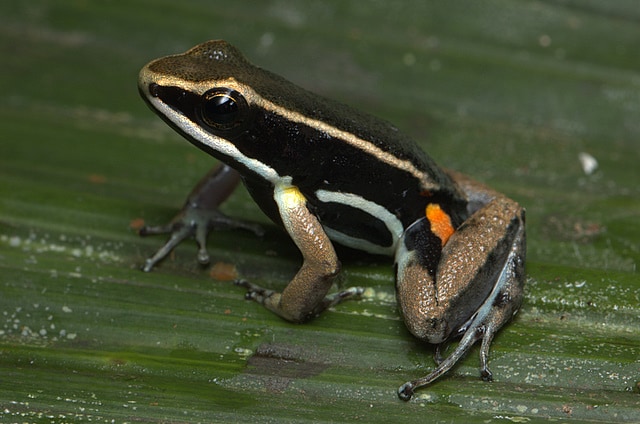
- ›Distinctive features include a pale brown dorso-lateral stripe and bright orange-yellow patches on the thighs.
- ›Males exhibit territorial behavior and engage in prolonged courtship marches with females.
- ›Males are responsible for guarding eggs and carrying hatched tadpoles to suitable water bodies for metamorphosis.
- ›Listed as 'Least Concern' by the IUCN due to its wide distribution and stable population.
Brilliant-Thighed Poison Frog, Brilliant-Thighed Poison-Arrow Frog
Tropical Lowland Forests, Forest Floor
Bolivia, Brazil, Colombia, Ecuador, French Guiana, Guyana, Peru, Suriname
- Orange-Yellow Patch Behind the Forelimbs
- Half-Moon Shaped Orange Patch On the Outer Thigh
- Pale Brown Dorso-Lateral Stripe
- Intermittent White Ventro-Lateral Line
About Allobates femoralis
What is Allobates femoralis?
Allobates femoralis, commonly known as the brilliant-thighed poison frog, is a species of terrestrial frog native to the Amazon basin and tropical eastern South America. It belongs to the family Aromobatidae and is characterized by its distinctive coloration, particularly the bright orange-yellow patches on its thighs, and its intricate reproductive behaviors.
Habitat and Distribution
This species is found in tropical lowland forests, typically inhabiting the forest floor. Its geographical range is extensive, encompassing countries such as Bolivia, Brazil, Colombia, Ecuador, French Guiana, Guyana, Peru, and Suriname. While generally found at lower elevations, it can ascend to altitudes of up to 1,000 meters in certain regions.
Biology and Reproduction
Allobates femoralis is a diurnal species, meaning it is active during the day. Its diet consists of small insects like beetles, crickets, roaches, and ants, with juveniles favoring springtails. The breeding season typically occurs between November and April. Males are territorial and engage in prolonged courtship, which involves a "courtship march" leading the female to a nest site. The male diligently guards the clutch of 8 to 17 eggs. Following hatching, a remarkable display of parental care is observed as the male carries the tadpoles on his back to suitable water bodies for metamorphosis. This species exhibits complex reproductive strategies, including elaborate visual, acoustic, and tactile courtship displays, and males can engage in polygynous behavior, courting multiple females.
Conservation Status
The International Union for Conservation of Nature (IUCN) lists Allobates femoralis as 'Least Concern'. This designation is due to its wide distribution, common occurrence within its range, and a stable population trend, with no significant threats currently identified.
Source: Wikipedia ↗
Frequently Asked Questions
What does Allobates femoralis look like?
Allobates femoralis is a small frog with dark brown to black coloration on its back and limbs. It has a pale brown stripe along its back and an intermittent white line on its sides. A distinctive feature is a bright orange-yellow patch behind its forelegs and a half-moon shaped orange patch on its outer thigh.
Where is Allobates femoralis found?
This species is distributed throughout the Amazon basin and tropical eastern South America. Its range includes countries such as Brazil, Peru, Ecuador, Colombia, Bolivia, Guyana, Suriname, and French Guiana.
What is the habitat of Allobates femoralis?
Allobates femoralis inhabits tropical lowland forests, typically found on the forest floor. While generally found below 300 meters, it can occur at higher altitudes up to 1,000 meters in certain regions of Colombia and Ecuador.
What does Allobates femoralis eat?
As a terrestrial frog, Allobates femoralis feeds on small insects. Its diet consists of prey such as beetles, crickets, roaches, and ants. Juveniles primarily consume springtails.
How does Allobates femoralis reproduce?
Breeding occurs from November to April, with males being territorial and engaging in extended courtship rituals lasting two to three days. After a clutch of 8-17 eggs is laid in a nest of leaves, the male guards them, and upon hatching, he carries the tadpoles on his back to water.
What is the conservation status of Allobates femoralis?
Allobates femoralis is classified as 'Least Concern' by the IUCN. This status is attributed to its wide geographic range, common presence throughout much of its habitat, and a seemingly stable population with no identified major threats.
Related Frogs
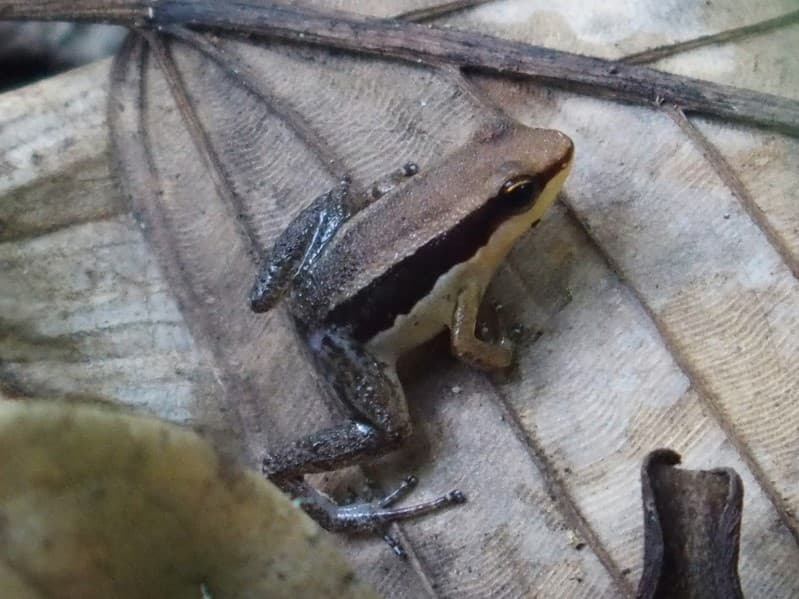
Allobates conspicuus
Allobates conspicuus is a species of frog native to western Brazil and eastern Peru. This diurnal amphibian inhabits bamboo and other forests, including disturbed and regenerating areas, at elevations between 250 and 550 meters. Despite facing threats from agriculture and logging, its conservation status is currently listed as Least Concern.

Allobates fuscellus
Allobates fuscellus is a frog species native to the Amazon Basin in western Brazil, with potential presence in Peru. It is distinguished by its terrestrial egg-laying and the unique behavior of adult frogs carrying hatched tadpoles to streams for further development. The species is currently classified as least concern for extinction.
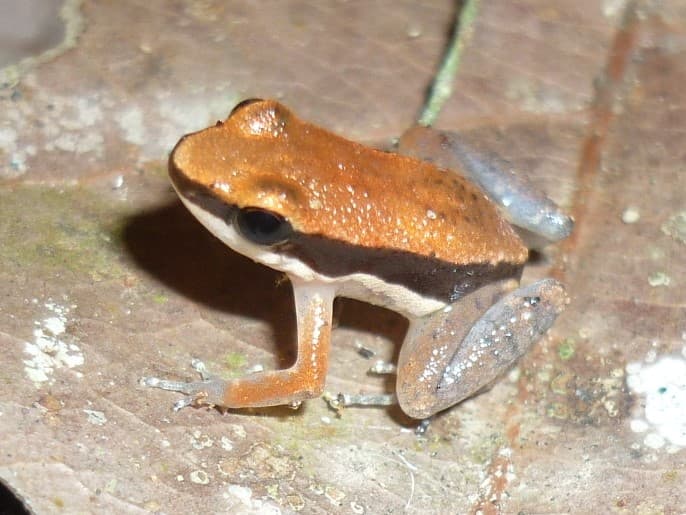
Allobates sumtuosus
Allobates sumtuosus is a small, terrestrial frog species found in the Amazon basin and surrounding Guiana Shield regions of South America. It is characterized by its solid tan-brown to copper dorsal coloration, dark brown flanks, and a distinctive white, iridescent ventrolateral stripe. This species is diurnal and exhibits a unique parental care strategy where males, and occasionally females, transport tadpoles to suitable aquatic environments.