
Allobates marchesianus
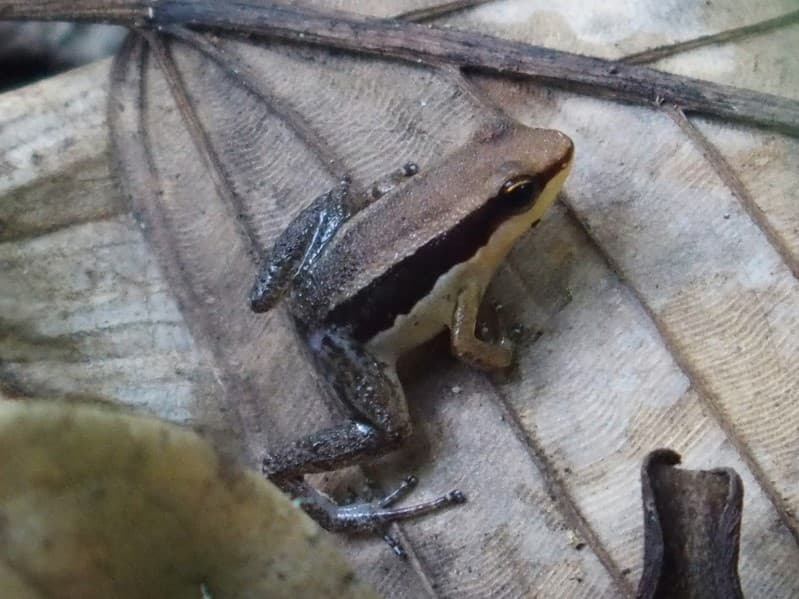
Allobates marchesianus, also known as the dull rocket frog, is a species found in the Amazon Basin across several South American countries. This small frog is characterized by its reddish-brown dorsum and distinct dark brown lateral band, with notable differences in coloration between males and females. It inhabits tropical rainforests, living on the forest floor and breeding in small pools.
Key Facts
- ›Found in the Amazon Basin of Brazil, Colombia, Ecuador, Peru, and Venezuela.
- ›Adults measure between 15.0–17.0 MM in snout-vent length.
- ›Distinctive features include a reddish-brown dorsum and a chocolate-brown band from snout to groin.
- ›Males have gray bellies and throats, while females have yellow throats, chests, and bellies.
- ›Inhabits secondary and old-growth tropical rainforests on the forest floor.
- ›Reproduction involves terrestrial nests guarded by a parent, with tadpoles transported to water bodies.

Dull Rocket Frog
Rainforest
- Reddish-Brown Dorsum With Small Brown Granules
- Chocolate-Brown Band From Snout Through Eye To Groin
- Yellow Throat, Chest, and Belly In Females
- Gray Throat, Chest, and Belly In Males
- Terminal Discs On Fingers and Toes
About Allobates marchesianus
Allobates marchesianus: The Dull Rocket Frog
Allobates marchesianus, commonly known as the dull rocket frog, is a small species of frog belonging to the family Aromobatidae. This amphibian is distributed throughout the vast Amazon Basin, with a presence documented in Brazil, Colombia, Ecuador, Peru, and Venezuela. It is important to note that the populations found in Venezuela may represent a distinct, undescribed species, suggesting potential complexity within the Allobates marchesianus complex.
Description and Habitat
The dull rocket frog is characterized by its diminutive size, with adults typically ranging from 15.0 to 17.0 millimeters in snout-vent length. Males measure between 15.0–16.6 mm, while females are slightly larger at 15.1–17.0 mm. The frog's appearance includes a reddish-brown dorsal surface adorned with small brown granules. A striking feature is a distinct chocolate-brown band that traverses from the snout, through the eye and upper tympanum, above the arm insertion, and continues to the groin. Sexual dimorphism is evident in their coloration: females display a yellow throat, chest, and belly, with varying intensity and pale yellow blotches on their flanks. Males, in contrast, have light gray bellies and gray to dark gray throats and chests, complemented by white blotches on their flanks. Both their fingers and toes are equipped with terminal discs, and their toes exhibit very weak lateral keels and some basal webbing.
Allobates marchesianus thrives in tropical rainforest environments, inhabiting both secondary and old-growth forests. It is a terrestrial species, primarily found on the forest floor, and can be observed at elevations up to 800 meters (2,600 feet) above sea level. Reproduction takes place in small pools within these humid forest settings.
Reproduction and Conservation
The breeding behavior of the dull rocket frog involves the laying of eggs in terrestrial nests, which are then diligently guarded by either the male or the female parent. Following hatching, the parent transports the tadpoles to a safe aquatic location, such as a pond or a small stream, to complete their development. While the species is considered common, its habitat faces significant threats from human activities, including clear-cutting, logging, forest conversion, and fires. Fortunately, the range of Allobates marchesianus includes several protected areas, which may offer some refuge for the species.
Source: Wikipedia ↗
Frequently Asked Questions
What are the common names for Allobates marchesianus?
Allobates marchesianus is commonly known as the dull rocket frog. This name likely refers to its appearance and perhaps its agility.
Where is Allobates marchesianus found?
This species is distributed across the Amazon Basin, with confirmed occurrences in Brazil, Colombia, Ecuador, Peru, and Venezuela. However, populations in Venezuela may represent an undescribed species.
What is the size of Allobates marchesianus?
Adult males typically measure between 15.0 to 16.6 mm, and adult females range from 15.1 to 17.0 mm in snout-vent length. These are very small frogs.
What does Allobates marchesianus look like?
Adults have a reddish-brown dorsum with small brown granules. A striking chocolate-brown band runs from the snout through the eye to the groin. Females have yellow undersides, while males have gray undersides.
What is the habitat of the dull rocket frog?
The dull rocket frog lives on the forest floor in secondary and old-growth tropical rainforests. It can be found at elevations up to 800 meters.
How does Allobates marchesianus reproduce?
Reproduction involves eggs laid in terrestrial nests that are guarded by either the male or the female. The parent then transports the tadpoles to a nearby pond or small stream for further development.
Related Frogs

Allobates brunneus
Allobates brunneus, commonly known as the Chupada rocket frog, is a small frog species found in the southern Amazon drainage of Brazil and northern Bolivia. It is distinguished by its varied dorsal coloration, distinct leg striping, and sexually dimorphic throat and belly colors. This species is classified as endangered primarily due to habitat loss.
Allobates conspicuus
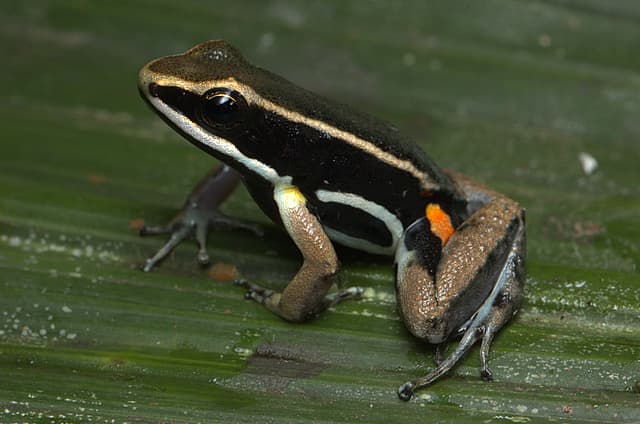
Allobates conspicuus is a species of frog native to western Brazil and eastern Peru. This diurnal amphibian inhabits bamboo and other forests, including disturbed and regenerating areas, at elevations between 250 and 550 meters. Despite facing threats from agriculture and logging, its conservation status is currently listed as Least Concern.
Allobates femoralis
Allobates femoralis, also known as the brilliant-thighed poison frog, is a species of terrestrial frog found in the Amazon basin and tropical eastern South America. This species is distinguished by its vibrant orange-yellow thigh patches and its complex reproductive behaviors, including extended male courtship and the male's role in guarding eggs and transporting tadpoles to water bodies.