
Ameerega braccata
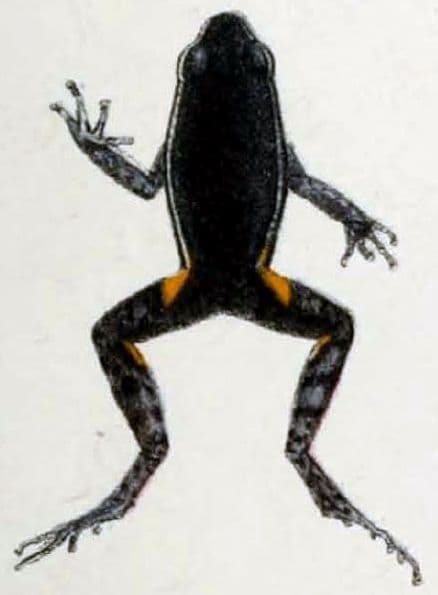
Ameerega braccata, formerly known as Epipedobates braccatus, is a species of small frog endemic to the Central-West Region of Brazil. Distinctive for its dark brown dorsum with pale brown marbling and yellowish spots, it also features prominent yellowish-white dorsolateral stripes. This species has a specialized diet of ants, termites, and mites.
Key Facts
- ›Small frog species measuring 14–17 MM in snout-to-vent length.
- ›Features a dark brown dorsum with pale brown marbling and yellowish spots.
- ›Has two yellowish-white to yellow dorsolateral stripes running from snout to groin.
- ›Inhabits gallery forests and leaf litter in the Cerrado biome.
- ›Diet consists primarily of ants, termites, and mites.
- ›Eggs are laid on land, with larvae transported to streams for development.

Gallery Forests, Cerrado, Leaf Litter
Mato Grosso, Mato Grosso Do Sul, GoiáS
- Small Size
- Dark Brown Dorsum With Pale Brown Marbling and Yellowish Spots
- Black Flanks
- Two Yellowish-White To Yellow Dorsolateral Stripes
- Slightly Granular Skin
About Ameerega braccata
Ameerega braccata, formerly classified as Epipedobates braccatus, is a species of frog belonging to the family Dendrobatidae. This small amphibian is native to the Central-West Region of Brazil, with confirmed presence in the states of southern Mato Grosso, Mato Grosso do Sul, and southwestern Goiás. It is believed that the species' natural range extends into neighboring areas of Bolivia and Paraguay.
Description and Characteristics
Ameerega braccata are relatively small frogs, typically measuring between 14 and 17 millimeters in snout-to-vent length. Their skin has a slightly granular texture, and their fingers are equipped with small discs. The dorsal coloration is predominantly dark brown, often adorned with pale brown marbling and, in many individuals, distinct yellowish spots. The flanks are a solid black, contrasting with two prominent yellowish-white to yellow dorsolateral stripes that run from the tip of the snout all the way to the groin. The ventral side, or belly, is brownish-white and sparsely speckled with small black spots, while the chest and throat are brown.
Habitat and Ecology
These frogs inhabit gallery forests within the Cerrado biome, commonly found amidst the leaf litter. They have also been recorded in more open environments and have been observed at elevations ranging from 180 to 260 meters above sea level. The reproductive cycle involves eggs being laid on land. Notably, the larvae are subsequently transported to streams for their aquatic developmental stage, a task that has been observed to be carried out by the male frog.
Diet and Vocalizations
The diet of Ameerega braccata is specialized, consisting primarily of ants, termites, and mites. Studies have indicated that the abundance of consumed prey can vary between the male and female individuals of the species. Ameerega braccata is known to produce a variety of vocalizations. The male's advertisement call is a brief, unpulsed note lasting about 0.1 seconds, with a frequency range of 3.5 to 4.2 kHz. Their territorial call is composed of 5 to 6 repeated notes that are structurally similar to the advertisement call. Additionally, a courtship call is emitted during close-range interactions between males and females. These courtship calls consist of short notes, approximately 0.04 seconds in duration, and can reach frequencies between 2.2 and 5.3 kHz.
Conservation Concerns
Ameerega braccata does not adapt well to anthropogenic disturbances. Consequently, the species faces threats primarily from habitat loss, driven by agricultural practices such as crop cultivation and livestock farming, as well as by wildfires. The species is known to occur within protected areas, including the Pantanal Matogrossense and Chapada dos Guimarães National Parks.
Source: Wikipedia ↗
Frequently Asked Questions
What is Ameerega braccata?
Ameerega braccata is a species of frog belonging to the family Dendrobatidae. It is native to the Central-West Region of Brazil and is characterized by its small size and distinctive coloration.
What does Ameerega braccata look like?
These small frogs typically measure between 14–17 mm in snout-to-vent length. They have a dark brown back with pale brown marbling and often yellowish spots, black flanks, and two yellowish-white to yellow stripes along their sides.
Where does Ameerega braccata live?
Ameerega braccata is found in the Central-West Region of Brazil, specifically in southern Mato Grosso, Mato Grosso do Sul, and southwestern Goiás states. Its range may extend into parts of Bolivia and Paraguay.
What does Ameerega braccata eat?
The diet of Ameerega braccata is specialized, consisting mainly of ants, termites, and mites. The abundance of these prey items can differ between males and females of the species.
How does Ameerega braccata reproduce?
Reproduction involves eggs being laid on land. In at least one observed instance, the male transported the tadpoles to streams for further development.
What are the threats to Ameerega braccata?
Ameerega braccata is threatened by habitat loss due to agriculture, including crops and livestock, as well as by fires. The species does not adapt well to disturbances caused by human activities.
Related Frogs

Ameerega flavopicta
Lutz's poison frog (Ameerega flavopicta) is a species of frog native to Bolivia and Brazil. This species inhabits a variety of moist environments, including lowland and montane forests, savannas, and shrublands, and reproduces in rocky pools and streams.
Ameerega hahneli
Ameerega hahneli is a diurnal frog species found in the Amazonian lowlands of South America. Its distinctive appearance includes a brown back and limbs often marked with black spots, a black flank bordered by a white dorsolateral line, and a blue venter with black reticulations. This species is named after Paul Hahnel, who collected the initial specimens.

Ameerega macero
The Manú poison frog (Ameerega macero) is a frog species native to the tropical moist and montane forests of southern Peru and Brazil, particularly in the drainages of several major rivers. It is distinctive for its reproductive behavior, where adults transport hatched tadpoles to slow-moving streams.